You want your bird to step up without biting, come when called, or tolerate a harness — and every attempt turns into a standoff. So you ask where to start.
Across roughly 80 pre-recorded shows produced from our Kansas City studio since 2015, we have put that question to professional trainers, bird keepers, and rescue people. The answer is remarkably consistent: not step-up, not recall, not the harness. A target stick. Guests like Yvonne Patterson Burbach of Wings of Love work birds that perform in front of crowds, and they still build from targeting.
Here is what we have heard on-air about what targeting is, why it comes first, how the early sessions run, where people stall, and what the behavior buys you later. This is a walkthrough of trainer conversations, not veterinary advice.
What a Target Stick Actually Is (And What It Is Not)
A Behavior, Not a Tool
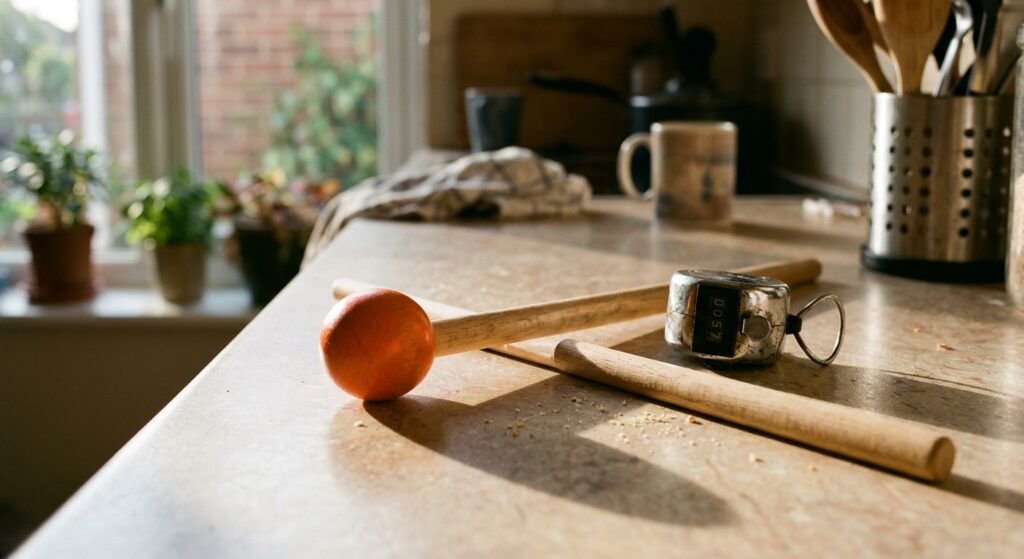
Targeting is a trained behavior: the bird touches a designated object with its beak when cued, and something good follows. The stick is only the object. The behavior lives in the bird, not in the equipment.
That distinction matters because it changes what you are paying attention to. You are not watching the stick travel; you are watching for the moment the beak makes contact, marking that moment, and delivering the reinforcer. A bird that has learned targeting will move toward the presented object on its own initiative — across a perch, up a ladder, onto a scale, into a carrier — because touching it has a history of paying off.
How Targeting Differs From Luring or Chasing
The most common confusion our training guests run into is between targeting and simply moving a bird around with an object. They are not the same thing, and they produce very different birds.
| Targeting | Luring with food | Chasing with a stick | |
|---|---|---|---|
| What the bird does | Chooses to touch a presented object | Follows a visible treat | Moves away from pressure |
| Bird's motivation | Reinforcement history | The food in view | Avoidance or fear |
| What happens when you fade the prop | Behavior holds on cue | Behavior often collapses | Nothing was trained |
| Effect on trust | Builds it | Neutral | Erodes it |
Pushing a stick at a bird to make it step back or move along a perch is not training — it is pressure, and the bird learns that the stick predicts something unpleasant. Birds trained that way frequently develop a lasting aversion to sticks, hands, or both, which is a problem the rescue and sanctuary guests on our shows have to undo more often than they would like.
What You Actually Need
The equipment is deliberately unremarkable. Guests on Bird Talk Radio consistently point to household objects over purpose-built gear, because the bird does not care what the target is made of.
- Chopsticks — the most frequently mentioned option; light, cheap, available in any kitchen, and easy to replace.
- Wooden dowels — a short length from a hardware store works well, especially for larger parrots that need something more substantial.
- A closed fist — no object at all. Useful for birds already comfortable with hands, and it travels with you everywhere.
- The capped end of a pen or a bamboo skewer with the point removed — same principle, whatever is on hand.
For birds that are nervous about novel objects, length is your variable. A longer target lets you work outside the bird's comfort threshold and shorten the distance as confidence builds. A fist target does the opposite — it requires the hand relationship to already be solid.
Choose a target your bird is neutral about, because starting with an object the bird already fears means you are training two things at once and will likely succeed at neither.
Why Trainers Refuse to Start With Step-Up or Recall
Step-Up Asks for Trust the Bird Has Not Offered Yet
A step-up request puts a hand inside the bird's personal space and asks it to climb aboard. For a confident, hand-raised parrot that has done it ten thousand times, it is nothing. For a nervous rehome, a cage-bound rescue, or a bird meeting a stranger for the first time, it is a large request made at close range by someone who has not earned anything yet.
The trainers who have come on our shows tend to describe the problem the same way: the bird has no reason to say yes, and when it says no, the handler is already too close to back out gracefully. The usual next step is a little pressure against the belly, a little lift, a little insistence. That is the moment the relationship gets defined, and not in the handler's favor.
Recall carries a different version of the same flaw. It asks a bird to cross open space toward a person it does not trust, which is a bigger commitment than most birds will make on a first meeting.
Targeting Removes Every Variable That Makes First Contact Risky
Presenting a stick and marking a touch asks for almost nothing. No hands near the body, no pressure, no lift, no consequence for refusing. The bird can ignore the stick entirely and nothing bad happens — which is precisely what makes the second attempt more likely to succeed.
Here is how the three common "first skills" compare on the dimensions that matter with an unfamiliar bird:
| First skill | Hands near bird | Physical pressure | Trust required up front | Cost of a "no" |
|---|---|---|---|---|
| Step-up | Yes, directly | Often, as a belly cue | High | Bird retreats, bites, or is forced |
| Recall | No, but distance closes fast | None | High | Bird refuses and the cue weakens |
| Targeting | No, stick creates distance | None | Almost none | Nothing — stick is withdrawn and re-offered |
What the Bird Learns in That First Exchange
The real value of starting here is not the behavior itself. It is the set of conclusions the bird draws from a transaction it was allowed to decline:
- This person's approach predicts food, not handling.
- Movement toward the object is safe and produces something good.
- The marker sound means a reward is coming.
- Declining does not provoke anything unpleasant.
Those four lessons are the foundation that step-up and recall are eventually built on. Trainers who skip them are not working faster — they are borrowing trust they have not been given, and the bird collects on that debt later, usually with a bite or a bird that will not come out of the cage.
Starting with step-up on a bird that does not know you is not a shortcut to a relationship; it is the fastest way to teach that bird your hands are something to avoid.
The First Five Sessions: What Our Guests Describe Step by Step
Sessions One and Two: Marking the First Accidental Touch
The progression our trainer guests describe on-air almost always starts the same way: the stick comes out, it stays still, and the bird gets to decide what happens next. Nobody pushes it toward the beak. The stick is simply held a few inches out, off to the side rather than straight on, and the trainer waits.
Most birds investigate. A curious parrot leans, looks, and eventually bumps the tip with its beak — not because it understands anything yet, but because that is what beaks do. That accidental touch is the whole lesson. The moment it happens, the trainer marks it (a clicker or a consistent word) and delivers the reward immediately. Guests are emphatic that the timing of the mark matters more than the size of the treat.
In the second session, the same thing happens again, and usually faster. The bird is no longer investigating; it is testing a theory.
Session Three: Adding Distance
Once the touch is reliable, the stick starts moving. Not far — an inch, then two, then a few inches to the left or right so the bird has to shift its weight or take a step to reach it. This is where target training stops being a trick and starts being a tool, because the bird is now following the stick rather than waiting for it.
| Session | Stick position | What gets marked | Typical session length |
|---|---|---|---|
| 1 | Still, a few inches from the beak | Any beak contact, even accidental | Very short — a handful of reps |
| 2 | Same, slightly closer | Deliberate touches only | Short, ends early |
| 3 | Moved an inch or two to each side | A touch after a lean or step | Short |
| 4 | A full step or two away | A touch after movement toward it | Short |
| 5 | Same, with the cue word added | Touch following the cue | Short |
Sessions Four and Five: Naming It and Quitting Early
The cue word goes on last, which surprises a lot of listeners. Guests consistently explain the reason: you name a behavior the bird is already offering, not one you are hoping for. Once the bird moves toward the stick without hesitation, the trainer says the word — "target," "touch," whatever stays consistent — just before the bird commits to the movement.
Across all five sessions, the advice that comes up most often has nothing to do with technique:
- Stop while the bird is still leaning in, not when it looks away
- A few good repetitions beat a long session every time
- End on a touch the bird clearly got right
- Come back later the same day rather than extending
The single most common mistake our guests warn about is running the session until the bird quits on you — end it yourself, early, while the bird still wants one more turn.
Reinforcement, Timing, and the Bridge: The Mechanics People Get Wrong
Finding a Reinforcer the Bird Actually Values
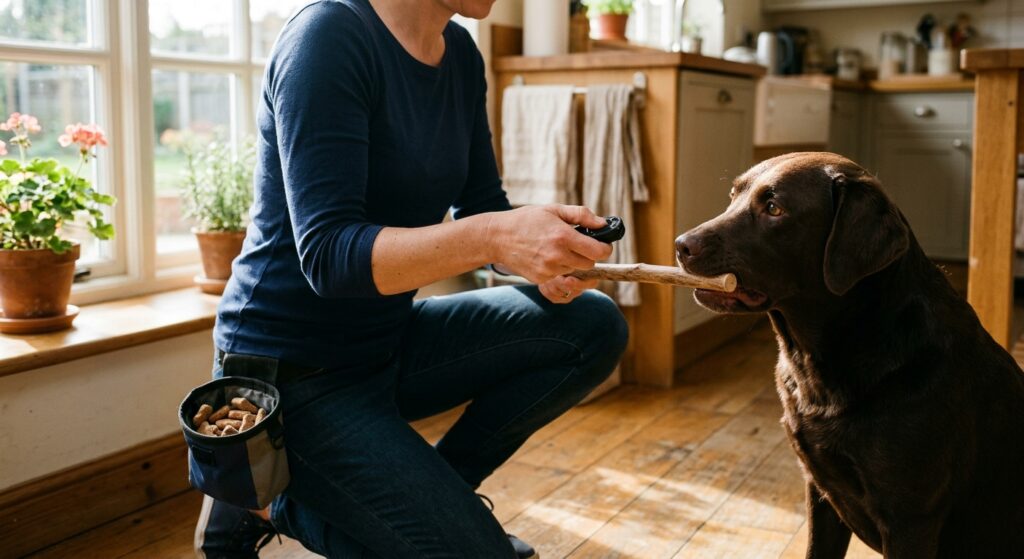
The word "treat" causes more failed training sessions than almost anything else we hear discussed on air. A reinforcer is defined by the bird, not by the person holding it. If the behavior is not increasing, whatever you handed over was not reinforcing — regardless of what the bag it came in claims.
Our trainer guests describe working through a short list and watching the response rather than assuming:
- A small piece of a favorite nut, broken down so one nut yields several deliveries
- A single seed the bird normally has to dig for in a foraging toy
- A bite of fresh fruit or vegetable the bird reliably takes first out of the bowl
- Head scratches or verbal praise, for the subset of birds that genuinely solicit them
The size matters as much as the item. Guests consistently describe reinforcers small enough that a bird can finish one in a second or two and still be interested in the twentieth repetition.
The Bridge: Marking the Exact Moment
The gap between the beak touching the target and the food arriving is where most training falls apart. By the time a treat crosses that distance, the bird may have already turned its head, stepped sideways, or looked at the door. Whatever it was doing when the food landed is what gets reinforced.
A bridge solves this. It is a sound delivered within about a second of the correct behavior that tells the bird the reinforcer has been earned. Clicker or verbal marker, the mechanics are identical — what differs is practicality.
| Clicker | Verbal marker ("good") | |
|---|---|---|
| Sound consistency | Identical every time | Varies with tone and mood |
| Hands required | One, plus target and treat | None |
| Noise-sensitive birds | Can startle at first | Usually accepted immediately |
| Available when you forget it | No | Always |
| Risk of overuse in daily talk | Low | High — the word loses meaning |
Several guests use both: a clicker during formal sessions, a trained verbal marker for the rest of the day.
Food Management Is Not Food Deprivation
This distinction comes up on nearly every training episode, and it deserves the airtime. Food management means scheduling meals so that training happens when the bird is motivated — typically before a meal rather than after a full bowl has been sitting out all morning. The bird eats its full daily ration. The timing simply changes.
Deprivation means withholding food to force compliance. It produces a bird that works out of anxiety, erodes the trust that positive reinforcement is built to create, and carries real health risk in a species that can drop weight fast. As our coverage with Ginger's Parrot Rescue laid out, the entire point of reinforcement-based work is that the bird chooses to participate.
If your bird is not interested in the target, change the reinforcer or the time of day — never reduce the food.
Where Targeting Stalls: Fear of the Stick, Lunging, and Cage-Bound Birds
When the Stick Itself Is the Problem
The most common call we get on this topic starts the same way: "He won't come near it." A bird that backs away, leans off the perch, or flies to the far corner is not being stubborn — it is telling you the stick is too big, too close, or moving too fast. Guests on our shows almost always point back to the same fix: reduce the pressure until the bird's body language settles, then add it back in increments the bird sets, not the trainer.
Three failure points come up over and over, and they call for different responses:
| What the bird does | What it usually means | The adjustment guests suggest |
|---|---|---|
| Flees, leans away, flattens feathers | Target is too close or presented too suddenly | Hold it still at a distance where the bird stays relaxed; reinforce any glance toward it |
| Bites or lunges at the stick | Frustration, or the stick has been used to push the bird before | Stop reinforcing contact with the beak-first grab; shrink and still the target, reward a calm look |
| Freezes, stares, will not eat | Over threshold entirely | End the session, change nothing but distance next time |
Birds That Bite the Stick Instead of Touching It
Lunging is not a training failure so much as a history lesson. Many parrots have had a dowel, a perch, or a hand used to move them where they did not want to go. A bird that attacks the target has learned that sticks make things happen to them. The approach our guests describe is to make the stick boring and predictable: hold it motionless, never advance it toward the bird, and never use it to crowd or herd. Reinforce quiet attention first, then a soft touch. If the beak-grab persists, make the target smaller — the end of a chopstick instead of a full perch — so there is less to seize.
Rescue and Rehomed Birds That Will Not Leave the Cage
This is where callers get most discouraged, and where the advice is most consistent: do not try to get the bird out. Start outside the cage bars entirely.
- Present the target several inches from the bars, far enough that the bird stays settled.
- Reinforce any orientation toward it — a head turn, a step closer, a look.
- Move the target to the bars only when the bird is approaching readily.
- Let the bird touch through the bars for several sessions before the door ever opens.
- Shrink the target as the bird gains confidence, so it can work in tight spaces near perches and food bowls.
A rehomed parrot that has been in the home two weeks has no reason to trust a stranger holding an object. The cage bars are not an obstacle here — they are the safety barrier that makes the first approach possible.
If a bird is lunging at the target, stop presenting it closer and shrink it instead, because advancing a stick toward a defensive parrot teaches exactly the lesson you are trying to undo.
Cashing In the Behavior: Crates, Scales, Harnesses, and Free Flight
Turning One Behavior Into Many
Targeting is not an end in itself. It is a portable cue — a way to tell a bird where to put its body without hands, towels, or chasing. Once a parrot will follow a stick, closed fist, or ball-tipped dowel across a few inches of perch, you own the mechanism for nearly every husbandry behavior our guests describe on the show.
The pattern is always the same: move the target to the place you want the bird, reinforce the approach, then fade the stick until the destination itself becomes the cue. What changes is the destination.
| Behavior | How targeting gets you there | Common sticking point |
|---|---|---|
| Stepping onto a scale | Target onto the platform, then hold position for a count before the bridge | Bird touches and leaves before the readout settles |
| Loading into a carrier | Target to the door, then just inside, then to a perch at the back | Owner shuts the door the first time the bird enters |
| Accepting a harness | Target the head through the loop rather than pushing the loop over the head | Rushing past neck sensitivity |
| Station training for grooming | Target to a fixed perch, build duration, then add nail or feather handling | No clear release cue, so the bird decides when it's over |
| Recall and A-to-B flight | Target between two perches at increasing distance | Distance added faster than reinforcement rate supports |
The Husbandry Wins Most Owners Want First
Our listeners usually come to targeting because something practical has broken down. The bird bites during nail trims. The carrier only appears on vet day, so it predicts a bad afternoon. Nobody knows the bird's weight, which means nobody can spot illness early.
Targeting fixes the access problem in each case:
- Weight tracking. A bird that targets to a scale perch gives you a daily number — the single most useful health data point a keeper can collect.
- Travel. A carrier the bird has targeted into fifty times for food is furniture, not a trap.
- Harness work. Head-through-the-loop is a voluntary behavior when it's built from targeting, and a wrestling match when it isn't.
- Stationing. A bird parked on a marked perch is a bird not shredding your paperwork while you clean the cage.
Why Free-Flight Programs Start Here
The free-flight work behind shows like Yvonne Patterson Burbach's Wings of Love is built on this foundation, not on a separate set of tricks. A bird that reliably goes to a presented target indoors is a bird that can be sent to a station, recalled to a glove, and redirected mid-routine. Flighted work outdoors demands that the bird's default answer to a cue is "yes, immediately" — and that default is rehearsed thousands of times on a target stick in a living room long before anyone opens a door.
Do not add distance, duration, and distraction at the same time — change one variable per session, or you will lose the behavior you spent weeks building.