Most pet bird owners bathe a bird when it seems like a good idea — a warm afternoon, a dusty-looking parrot. The handlers and breeders we interview don't work that way. For people managing performing birds or a full flock, bathing is scheduled alongside food and sleep.
Bird Talk Radio has streamed from our Kansas City studio since 2015, roughly 80 pre-recorded live shows hosted, engineered, and produced in-house. Our guests have included professional bird keepers, wildlife biologists, rescue operators, and Yvonne Patterson Burbach, owner and trainer behind the Wings of Love bird shows.
Here we've gathered what they've said about bathing and misting — where they agree, where they split. We won't prescribe one method. They don't use one.
Why Handlers Call Bathing Maintenance, Not a Treat
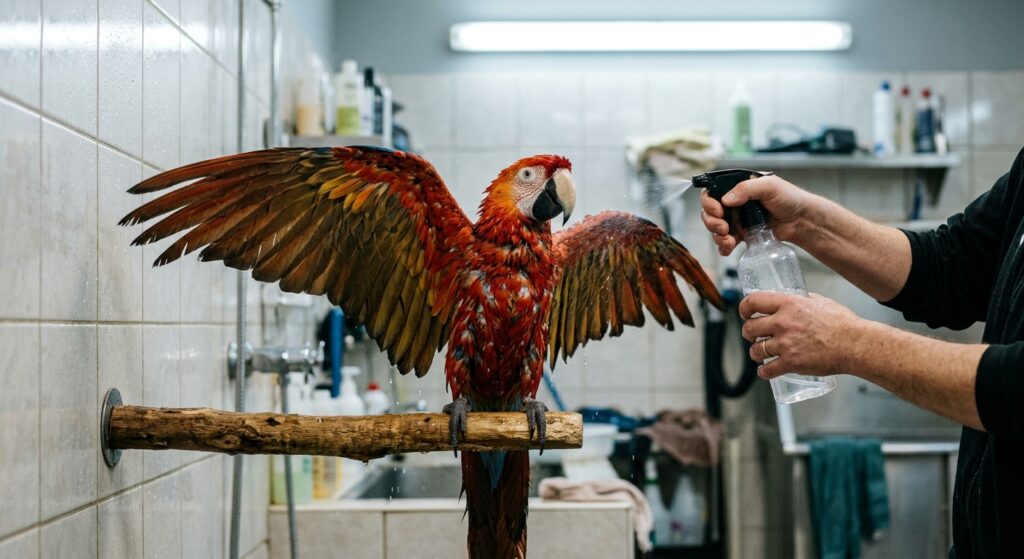
Across years of recording these conversations, one point comes up more often than almost any other husbandry topic, and it usually arrives as a correction. A caller or host describes bathing as something you offer a bird on a good day, and the guest — a breeder, a rescue intake coordinator, a trainer who works free-flighted birds in front of audiences — pushes back. Their framing is simpler: a bird whose plumage is doing its job is a bird that has been getting wet on a regular basis. Rain is not an enrichment item in the wild. It is weather, and it arrives whether the bird is in the mood or not.
Where Bathing Belongs on the Schedule
That reframe has a practical consequence. If bathing is enrichment, it gets done when there is time left over. If it is maintenance, it sits on the same line as diet, light cycle, and sleep hours — the things you plan around rather than fit in. Guests who manage multiple birds tend to talk about it in exactly those terms: a standing part of the week, tied to a day or a time, not to the keeper's mood or the bird's apparent enthusiasm.
| How it gets framed | Enrichment | Maintenance |
|---|---|---|
| When it happens | When there is spare time | On a set schedule |
| Who decides | The bird's mood that day | The care plan |
| If skipped for weeks | Nothing seems wrong | Feather condition drifts |
| How it's tracked | Not tracked | Logged with diet and sleep |
What Guests Say Wet Feathers Do
The reasoning our guests give usually breaks into three effects:
- Preening gets triggered and gets finished. Water prompts a full preening session rather than the scattered, partial grooming a dry bird does out of habit. Guests describe birds working through the flight and tail feathers deliberately after a soaking, zipping barbs back together.
- Feather condition holds longer. Keepers who bathe on a schedule report plumage that looks and sits better over time — less of the dull, rough, unkempt look that shows up on birds that go long stretches dry.
- Household dust drops. This is the one that gets the most listener reaction. Powder-producing species shed less into the room when they are bathed regularly, which matters to the people in the house as much as to the bird.
Why the Dust Point Lands Hardest
Owners often arrive at bathing through the dust problem rather than through feather care, and guests are happy to take that entry point. It gets the routine started. But the argument they keep making on the air is that dust is a symptom, not the issue — the same neglected maintenance that coats your furniture is also showing up in the bird's plumage.
If you are only bathing your bird when it seems to want it, you are treating a maintenance task as an optional one, and the feather condition will tell on you long before the bird complains.
Misting Bottles, Showers, Sinks, and Wet Greens: The Methods Guests Describe
There is no single correct way to get a bird wet. Across the shows we have recorded since 2015, guests have described several delivery methods, and the pattern that emerges is less about which one is "best" and more about matching the method to the individual bird's temperament, size, and tolerance for being handled.
Spray, Shower, and Faucet
The fine-mist spray bottle is the method most often mentioned, and the detail guests repeat is direction: the spray goes up and over the bird so it falls like rain, rather than being aimed at the face. Birds that flinch from a direct stream will often lift their wings and lean into a mist that drifts down onto them from above.
Shower perches come up for birds that are already comfortable on the hand and comfortable with their owner. The appeal guests describe is consistency — the bird gets bathed whenever the person showers, which solves the scheduling problem more than anything else. The caution raised is water temperature and pressure, since a shower set for human comfort is hotter and harder than most birds will accept.
Running faucets occupy a middle ground. Smaller birds in particular will step under a gentle trickle at a kitchen or bathroom sink, and the bird controls how much of itself gets wet, which is often the whole point.
Standing Water and Wet Greens
For birds that would rather bathe on their own terms, guests point to containers: a shallow pan, a heavy ceramic crock, or a dish set on the cage floor. Weight matters, because a light dish gets tipped. Depth matters more — the water should be shallow enough that the bird is standing, not swimming.
Soaking wet leafy greens are the method most often suggested for birds that refuse everything else. The bird gets a foraging opportunity and a bath at the same time, and nothing is being done to it.
| Method | Tends to suit | Main caution guests raise |
|---|---|---|
| Fine mist bottle | Most birds; nervous birds especially | Spray above, never at the face |
| Shower perch | Hand-tame birds bonded to the owner | Water too hot or pressure too strong |
| Running faucet | Smaller birds; birds that like control | Supervision and drain safety |
| Shallow pan or heavy crock | Independent and self-directed bathers | Tipping; water too deep |
| Wet greens | Reluctant or previously unhandled birds | Replace before they wilt or spoil |
Reading the Bird, Not the Clock
Guests consistently describe the same tells when a bird is receptive:
- Wings held out from the body or raised slightly
- Head dipped forward and down
- Tail fanned
- Rolling or rubbing against the wet surface
- Vocalizing in a relaxed, chattering way rather than alarm calls
A bird that turns away, climbs to the far side of the cage, or holds its feathers tight is telling you to try a different method next time.
Pick the method the bird accepts rather than the one that is most convenient for you, because a bird that learns to dread bathing will fight it for years.
Starting a Bird That Hates Water: The Trainer's Approach
Let the Bird Make the First Move
The advice we hear most often from the trainers and rescue volunteers who come on the show is also the least satisfying to an owner who wants a clean bird today: you do not bathe a frightened parrot, you let a frightened parrot decide to get wet. Adult birds that panic at a mister have usually learned that water arrives with a grab, a towel, or a corner they cannot leave. Rebuilding that association starts by removing the ambush entirely.
The pattern guests describe tends to follow the same shape as the positive reinforcement work we've covered on training and biting:
- Put the water source in the room, not on the bird. A spray bottle sitting on a table, a shallow dish on the counter, a running faucet several feet away — with no attempt to use any of it.
- Pair the sight of it with something the bird already likes, whether that's a favorite food, a scratch, or simply your calm presence.
- Introduce the sound next. Mist the air across the room, run the sink, let the shower run while the bird perches outside the bathroom.
- Let the first contact be accidental and brief. A fine mist drifting past, one damp leaf of greens, a toe in a dish.
- Stop while the bird is still relaxed, not after it flees.
Reading the Bird Instead of the Clock
Guests who handle rescue birds daily talk about watching the body, not the schedule. The signals they describe fall into two camps, and the difference decides whether you continue or end the session.
| What you see | What it usually means | What handlers do next |
|---|---|---|
| Feathers raised, wings lifted slightly, leaning toward the mist | Interest or invitation | Continue at the same intensity |
| Preening, tail fanning, head dipping | Bird is engaged in the bath | Keep going, don't escalate |
| Flattened feathers, pinned eyes, shifting away | Tolerance ending | Stop immediately, reward calm |
| Flying off, screaming, climbing down the cage | Fear response | End the session, restart smaller tomorrow |
The common thread: ending a session one step early costs you nothing, and ending it one step late costs you weeks.
Why Forcing a Soak Undoes the Work
Every trainer we've interviewed on this point makes the same argument. A bird that is cornered, toweled, and sprayed does end up wet — but it also learns that water predicts loss of control. The next approach with a bottle gets a faster flight response, and the bird now generalizes the fear to the room, the towel, and sometimes to your hands.
Rescue guests see this frequently in birds surrendered with a history of forced grooming: the bathing problem isn't water, it's handling. Those birds often respond better to indirect methods like wet greens or a shower perch set at a distance they chose, because nobody is holding them.
Stop the session while the bird is still comfortable, because one forced soak can cost you more progress than a month of patient, short sessions will buy back.
How Often, What Time of Day, and How Birds Dry Off
Frequency and Timing
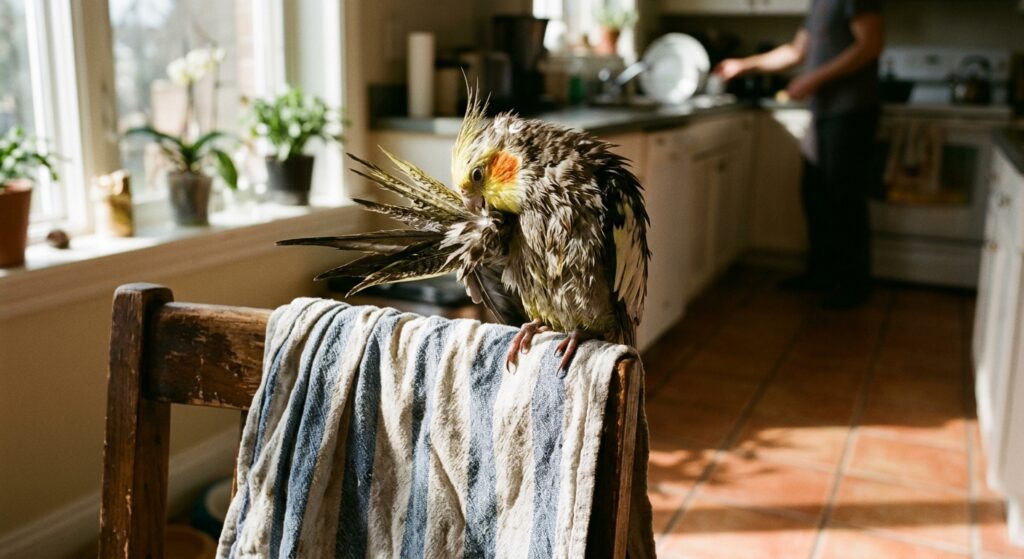
The most consistent piece of advice we hear from bird keepers on the show is that bathing works best as a routine rather than an occasional event. Guests who keep parrots in dry indoor air tend to offer water more often than those in humid climates, and several have described simply making the opportunity available daily and letting the bird decide. A bird that is actively preening, flaking new feather sheaths, or molting usually takes more interest in water than one that is not.
Timing matters more than frequency to most of our guests. The guidance we hear repeated is to bathe in the morning or early afternoon so the bird has hours of warm, active daylight to finish drying and preening. A soaked bird settling onto a perch at lights out has no way to fluff, shake, and work the water out before the room cools and the cage is covered.
Room Conditions and Drying
Guests describe the ideal drying environment in simple terms: a comfortably warm room at ordinary household temperature, with no draft moving across the cage. An open window, an air conditioning vent, a ceiling fan, or a doorway with traffic moving through it can chill a wet bird quickly, even in a room that feels fine to the person standing in it.
On drying itself, the preference we hear is near-unanimous — let the bird do it.
| Method | What guests describe | What to watch for |
|---|---|---|
| Air drying on a perch | The default; the bird shakes, fluffs, and preens the water out | Needs a draft-free room and enough daylight left in the day |
| Light towel blotting | Used for a soaked bird or one that got wetter than intended | Blot, don't rub; rubbing works against feather structure |
| Sunlight through an open window | Warmth plus preening light, where safely available | Never behind glass in direct sun with no shade and no escape |
| Forced heat appliances | Warned against, not recommended | Covered below |
Heat Sources Our Guests Warn Against
The strongest warnings on this topic have nothing to do with bathing technique and everything to do with what people reach for afterward:
- Hair dryers — many carry nonstick-coated heating elements that can off-gas when hot.
- Space heaters and heated towel bars with similar coatings.
- Heat lamps aimed at the cage, which create burn risk and uneven heating.
- Moving the cage near a kitchen to warm up, where cookware, self-cleaning oven cycles, and aerosols are in play.
This overlaps directly with what we cover in our article on nonstick coatings and household air risks — the same coatings that make cookware dangerous to birds turn up in small appliances people assume are harmless.
Never use a hair dryer to dry a bird; bathe early enough in the day that a warm, draft-free room and the bird's own preening are all the drying it needs.
Plain Water and Nothing Else: What Guests Keep Out of the Spray Bottle
The Default Is Water, and the Burden of Proof Is on Everything Else
Across the shows we have recorded since 2015, the question of what goes in the spray bottle has produced less disagreement than almost any other husbandry topic. Professional bird keepers, rescue operators, and trainers who appear on Bird Talk Radio — Yvonne Patterson Burbach of Wings of Love among them — describe the same default: plain, clean water, at room temperature or slightly warm, and nothing added to it.
The reasoning guests give is consistent. A healthy feather is maintained by the bird itself. Preening redistributes oils and realigns barbs, and the job of a bath is to loosen dust and dander so the bird can do that work. Anything that coats the feather interferes with the mechanism rather than assisting it. Guests also point out that birds preen with their beaks, which means whatever is sprayed on the plumage is eventually swallowed.
Why Guests Are Skeptical of Sprays Marketed for Shine
The products that come up most often on air are soaps, "conditioning" sprays, feather-shine formulas, and additives sold alongside them. The objections our guests raise fall into a few recurring categories:
- Residue that dulls or weighs down feathers instead of brightening them, especially with repeated use
- Ingestion during preening, with no way for an owner to know the dose
- Masking a problem rather than fixing it — guests repeatedly connect dull, frayed, or chewed plumage to diet, humidity, or behavior, not to a missing product
- Unknown reaction on a respiratory system that birds depend on more heavily than we do
Guests who work in rescue make the same point from the other direction: the birds arriving in poor feather were rarely under-sprayed. They were under-fed, under-bathed, or under-stimulated.
Temperature, Bottle Hygiene, and Two Separate Bowls
The practical details guests return to are mundane and easy to get wrong.
| Detail | What guests describe | Why it matters |
|---|---|---|
| Water temperature | Room temperature to lukewarm | Cold water drives avoidance; hot water is never appropriate on skin or feathers |
| Spray bottle contents | Water only, refilled fresh | Residue from a bottle previously used for cleaners or plant sprays is a real risk |
| Bottle cleaning | Washed and dried on a schedule, not topped up indefinitely | Standing water in a warm bottle grows bacteria that then get misted onto the bird |
| Bath water vs. drinking water | Kept in separate vessels | Birds defecate in bath water and soak food in it; that is not what you want them drinking from all day |
The separation of bath and drinking water is the point guests make most emphatically. A shallow dish offered for bathing should be put down for the session and taken away afterward, with the drinking source left clean and untouched.
If you take one thing from our guests on this topic, it is that a dedicated bottle holding nothing but clean water — never a repurposed household sprayer — is the safest tool in the cage room.
Species Differences and the Feather Problems Bathing Won't Fix
One Routine Does Not Fit Every Bird
The guests we put on air rarely give a single answer about how often to wet a bird down, because the birds in front of them are not built the same way. Cockatoos, cockatiels, and African greys carry powder down — the fine white dust that coats the feathers and ends up on your black shirt, the window glass, and the air filter. Handlers who keep those species treat bathing partly as dust management for the bird and partly for the room. Macaws, amazons, conures, and eclectus come from humid forest, and the guests who keep them talk about warm, soaking rain-style sessions rather than a light surface mist, because the goal is getting water down to the skin.
Then there is the house itself. A dry winter home with forced-air heat, a wood stove, or a bird cage sitting in a dusty corner changes the picture for any species. Several guests have pointed out that the bird's feather condition is often telling you something about the room, not about the bird.
| Setup | What handlers emphasize | What they watch for |
|---|---|---|
| Powder-down species (cockatoos, greys, cockatiels) | Regular light wetting to settle dust and keep the surface of the feather clean | Heavy dust buildup, dull or grimy-looking plumage |
| Rainforest species (macaws, amazons, conures, eclectus) | Longer, warmer soakings that reach the skin, not a surface spray | Feathers that never seem to get properly wet |
| Dry or dusty households, any species | Fixing the environment alongside the bathing routine | Flaky skin, static-looking feathers, constant preening |
The Line Our Guests Draw
Every guest who talks about bathing eventually says some version of the same thing: a spray bottle is maintenance, not medicine. Bathing more often will not resolve a problem that started somewhere else. The signs they consistently route to a veterinarian rather than a misting schedule include:
- Plucking, chewing, or barbering — feathers removed or destroyed by the bird itself
- Broken, bent, or bleeding feathers, including damaged blood feathers
- A molt that stalls, drags on, or comes in patchy and uneven
- Skin that looks red, thickened, crusted, scaly, or otherwise wrong
- Sudden changes in feather color, texture, or shape with no obvious cause
Why Guessing Costs You Time
The reason our guests are firm about this is that feather destruction and skin disease have a long list of possible causes — diet, disease, pain, hormones, environment, behavior — and misting addresses exactly one small corner of that list. Time spent increasing the bath schedule is time the underlying cause keeps working. A broken blood feather in particular is an immediate problem, which is why we covered supplies and response in our article on putting together a bird first aid kit.
If your bird is plucking, bleeding from a feather, or showing abnormal skin, stop troubleshooting the bathing routine and get an avian veterinarian involved.