You notice a bare patch on your bird's chest, or stubble down the thighs where there used to be feathers. The first conclusion most owners reach is boredom, and the first purchase is a box of toys. Meanwhile, nothing that actually caused the plucking has been examined.
Across roughly 80 pre-recorded shows produced from our Kansas City studio since 2015, our avian veterinary, aviculture, and rescue guests have described plucking the same way: a symptom with a long differential list, not a diagnosis. They work through causes in a deliberate order.
That order is what this article lays out. It is not veterinary advice and does not replace an exam by an avian vet — it is a map of the questions our guests ask, so you arrive at that exam prepared.
Plucking Is a Symptom, Not a Diagnosis
What Owners Are Actually Looking At
"Plucking" gets used as a catch-all for several different behaviors, and they do not all mean the same thing. Before a cause can be discussed on air, we have to know which one is in front of us.
- Barbering — the bird trims or notches the vane of a feather but leaves the shaft and follicle intact. The plumage looks ragged or scissor-cut rather than bare.
- Chewing — feathers are shredded or crushed, often along the shaft, frequently on wing and tail feathers the bird can reach easily.
- Over-preening — normal grooming carried past the point of usefulness, producing dull, frayed, thinned feathering without obvious bald areas.
- True plucking — feathers are pulled out at the follicle, leaving bare skin and, over time, follicle damage that can stop regrowth entirely.
- Self-mutilation — the bird moves past feathers and injures skin or muscle. This is a medical emergency, not a behavior problem to be managed at home.
How This Differs From Normal Molt and Normal Preening
A molting bird loses feathers symmetrically and in sequence, shows pin feathers coming in, and keeps a complete feather coat throughout. A preening bird works through feathers methodically and leaves them aligned and intact. Neither produces bare skin.
| What you see | Normal molt | Normal preening | Plucking behavior |
|---|---|---|---|
| Pattern | Symmetrical, sequential | Whole-body, routine | Often asymmetrical, reachable areas only |
| Pin feathers | Present | Incidental | Often chewed off as they emerge |
| Bare skin | No | No | Yes, in true plucking |
| Feathers on cage floor | Whole, with clean shafts | Few | Broken, shredded, or with follicle tissue |
| Head and nape | Involved | Involved | Usually spared unless another bird is involved |
Why Guests Ask About Pattern First
Our guests — professional bird keepers, wildlife biologists, and rescue and sanctuary staff — almost always ask the same questions before they will name a cause: which feathers, which body areas, and is the head involved.
The head matters most. A bird cannot reach its own head. Head and nape feather loss points toward a cagemate, disease, or a skin problem rather than self-directed behavior. Chest, flank, thigh, and under-wing loss means the bird is reaching those areas itself. Where the damage stops tells you who is doing it.
Describe the pattern before you accept any explanation — a cause offered without knowing which feathers are affected is a guess, not an assessment.
Step One: The Medical Workup Our Avian Vet Guests Start With
Why the Exam Comes Before the Behavior Conversation
Every time this subject has come up on our shows, the guests take the same position: a bird that is destroying its own feathers gets a full veterinary workup before anyone talks about cages, toys, or attention. The reason is simple. Feather damage is one of the few visible signals a parrot has, and a long list of physical problems can produce it — skin and feather disease, external parasites, internal illness, chronic pain from an old injury or arthritis, and liver or hormonal involvement. A bird in discomfort may chew over the sore spot the same way it would chew over an itchy one, and from the outside the two look identical.
Guests also point out the opposite risk. If you spend six months enriching the cage of a bird that has an underlying medical issue, you have not just failed to solve the problem — you have given it six months to get worse.
The Diagnostics That Get Mentioned
| Diagnostic | What it's looking for |
|---|---|
| Hands-on physical exam | Skin condition, body weight, old injuries, sore or swollen areas |
| Bloodwork | Organ function including liver, signs of systemic illness |
| Imaging | Internal disease, masses, skeletal or joint problems causing pain |
| Feather and skin sampling | Feather and skin disease, parasites, infection |
No single test carries the whole case. Guests describe it as a process of elimination, where the behavior question only becomes the leading theory after the physical ones have been worked through.
What the Pattern on the Bird Tells the Vet
One detail that comes up often enough to be worth repeating: where the damage is located is itself diagnostic information.
- Head fully feathered, body bare or chewed — the bird can reach everything that is damaged, which points toward self-inflicted plucking.
- Head feathers missing or damaged too — a bird cannot reach its own head, so this suggests something other than self-plucking, such as disease, or a cage mate doing the damage.
- Damage concentrated in one spot — raises the question of a localized problem underneath, rather than a whole-bird behavioral pattern.
That head-versus-body distinction is usually the first thing an experienced avian vet notices, and it shapes which tests get run next.
Bring your bird in for the workup before you redesign its environment, because an untreated medical cause will keep driving the behavior no matter how good the enrichment gets.
Step Two: Diet, Because a Feather Is Built From What the Bird Eats
Start With Seven Days of Writing It Down
The first thing our rescue and aviculture guests ask for is not a diet change — it's a record. Owners describe the diet they intend to feed. The bird eats something else. A sunflower seed picked out of a mix, a corner of the pellet bowl ignored for three days, and the half of the vegetable plate that goes in the trash untouched all disappear from memory by the weekend.
The log our guests describe is simple and kept for a full week:
- What goes into the bowl each morning, by item, not by brand name alone
- What is physically left at the end of the day, including the hulls
- Table food, treats, and anything handed over during training
- Who else in the household feeds the bird, and what they give
- Water: when it was changed, and what it looked like when it was dumped
A week of that usually settles arguments that a month of conversation will not.
Seed-Heavy Bowls and the Move to Formulated Food
Most of the plucking cases our guests bring to the show arrive on a seed-heavy diet, often one the bird has eaten since it was weaned. The conversion target they describe is a formulated pellet as the base, with fresh vegetables and some fruit alongside it — not a swap made overnight, but a gradual change with the old food reduced as the new food is accepted, and weight monitored the whole way. A bird that stops eating during a conversion is an emergency, and our guests are blunt about that.
| What guests look at | Why it comes up with pluckers |
|---|---|
| Seed-only or seed-dominant diet | Narrow nutrient profile; birds self-select the fattiest seeds |
| Vitamin A | Affects skin and feather-follicle condition; dark leafy greens and orange vegetables come up constantly |
| Protein quality | Feathers are largely protein; molting and regrowth raise demand |
| Water | Bowls fouled by food, droppings, or dunked pellets; guests favor fresh water more than once a day |
| Treats and table food | Often the real calorie source, and the part owners forget to mention |
Give the Change Time to Show Up
A feather already damaged will not repair itself. Improvement shows in the next feathers grown, which means diet work is judged over months of molt, not over a week of hopeful watching.
Fix the diet before you change the cage, the toys, or the schedule — a nutritional problem will keep producing new damaged feathers no matter how enriched the environment becomes.
Step Three: Humidity, Bathing, and Skin That Itches
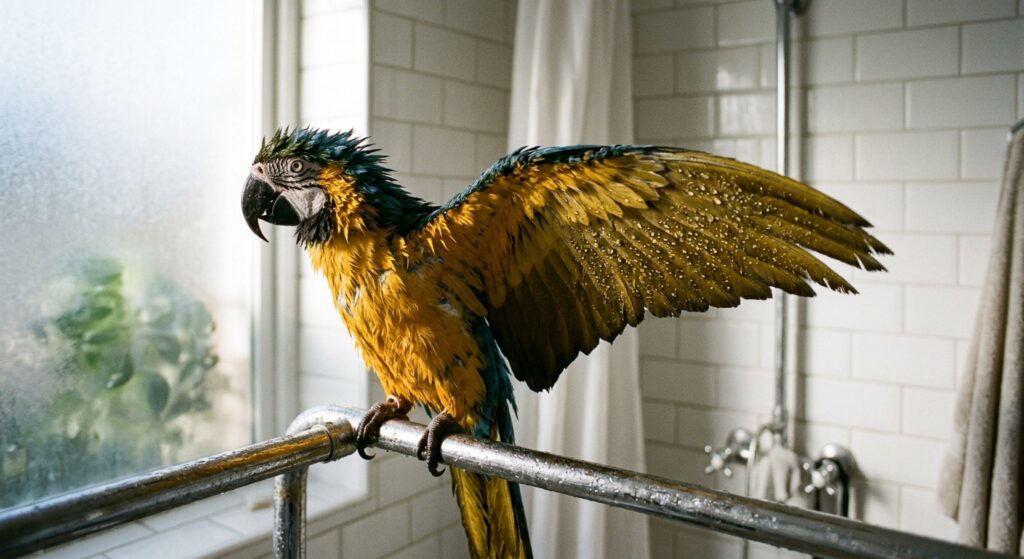
Why Winter Air Comes Up So Often
Most of the parrots our listeners keep trace back to humid tropical and subtropical regions. A Kansas City winter is the opposite of that. Forced-air furnaces run for months, the house dries out, and the bird's skin dries with it. Guests on our shows return to this point again and again: itchy skin provokes chewing, and chewing that starts as scratching an itch can harden into a habit long after the dry season ends.
So when a caller describes plucking that started in November and eased in spring, the first questions back are usually about the house, not the bird. Is the cage sitting in the path of a heat register? Is there a humidifier running anywhere near it? Has the bathing routine changed because the house got cold?
What Guests Say About Bathing and Misting
The common thread is frequency over ceremony. Most guests favor regular, low-drama water access rather than an occasional full soaking the bird dreads.
| Method | Suits | Water | Watch for |
|---|---|---|---|
| Fine-mist spray bottle | Birds wary of handling | Lukewarm to tepid | Mist above the bird, not into the face |
| Shower perch | Confident, shower-trained birds | Comfortable to your inner wrist | Pressure and direct spray on the head |
| Shallow dish or crock | Self-directed bathers | Fresh, room temperature | Change water once soiled |
| Wet leafy greens | Reluctant bathers | N/A | Offer fresh, discard after a few hours |
On drying, the advice is consistent:
- Let the bird air-dry in a warm, draft-free room whenever possible.
- Bathe earlier in the day so the bird is dry well before lights-out.
- Keep hair dryers away — most are nonstick-coated internally, and the heat is hard to judge.
- Skip soaps, sprays, and conditioning products unless an avian vet has prescribed them.
The Air the Bird Breathes
Dry skin is one irritant; airborne chemicals are another, and guests raise them in nearly every husbandry discussion. Overheated nonstick and PTFE-coated cookware, self-cleaning oven cycles, aerosol sprays, scented candles, plug-in air fresheners, and tobacco or fireplace smoke all end up in the same conversation. Birds have extraordinarily efficient respiratory systems, which is exactly why fumes that a person barely notices can harm them.
Before you assume your bird is bored, spend one winter tracking humidity, bathing frequency, and what gets sprayed or burned in the house — those three variables resolve more plucking complaints than any new toy.
Step Four: Sleep, Light Cycles, and Hormonal Triggers
Counting the Dark Hours, Not the Bedtime
The question our guests ask first is not "when do you cover the cage?" but "how many hours is the bird actually undisturbed in the dark?" Those are different numbers. A bird covered at nine o'clock in the corner of a living room is still hearing a television, still seeing light leak under the cover, still being woken when someone walks through. Broken sleep is not sleep, and a chronically under-rested parrot is a bird with less tolerance for everything else on this list.
Cage location drives most of it. A bird in the main traffic area of a busy household goes to bed when the household does. Guests who run rescues and boarding operations tend to describe the same fix: a separate, quiet sleeping space, dark and uninterrupted, independent of what the people are doing. Seasonal daylight matters too — a bird near a window in a sunroom or on a porch is reading the lengthening spring photoperiod whether anyone intends that or not.
Long Light Cycles and the Hormonal Chain
A long day tells a bird it is breeding season. Keep that signal running year-round and you get chronic hormonal behavior rather than a short seasonal episode, and in some birds that lands as feather destruction over the shoulders, chest, and thighs.
| Trigger | What it signals to the bird | What guests suggest changing |
|---|---|---|
| 14+ hour light cycle | Breeding season | Shorten to a consistent, genuinely dark night |
| Huts, tents, boxes, cabinet and couch access | Available nest cavity | Remove the cavity, block the furniture gap |
| Warm, soft, high-fat foods fed often | Abundance, mate feeding | Keep them occasional, not routine |
| Petting down the back, under wings, near the vent | Mate contact | Restrict touch to head and neck |
Reading the Pattern Before You Change Everything
Watch for the cluster, not one sign alone:
- Regurgitating for a person, mirror, or toy
- Tail lifting, wing drooping, or crouching when touched
- Territorial lunging at the cage door that was not there in winter
- Shredding paper and working into dark corners
- Plucking that starts and stops with the seasons
Hormonal plucking usually travels with two or three of these. If none are present, the light cycle is probably not your answer and the earlier steps deserve another pass.
A bird that gets twelve hours of darkness but is woken four times in the night has not slept, and that distinction is where most well-intentioned sleep fixes fail.
Step Five: Only Now Do We Talk About Enrichment, Foraging, and Training
Enrichment is the first thing most people reach for and the last thing our guests reach for. That order matters. If a bird is plucking because of an air sac infection, a seed-only diet, bone-dry air, or twelve months of fourteen-hour daylight, a new foraging toy will not fix it — and the owner will conclude that enrichment "doesn't work" when it was simply applied to the wrong problem. Once the first four steps are genuinely ruled out or corrected, enrichment becomes one of the most useful tools you have.
Make It Specific, Not Just "More Toys"
A cage full of plastic trinkets the bird ignores is not enrichment. The guests who work with plucking birds describe something more deliberate:
- Destructible material. Soft pine, untreated wicker, palm leaf, cardboard, paper — things the bird is supposed to shred and destroy. A toy that survives a year was never being used.
- Food that takes work. Whole vegetables, foraging boxes, food wrapped or hidden, pellets split across several locations instead of one full bowl.
- Flight and real exercise. Wing use burns the physical energy that otherwise goes into the feathers. Our free-flight training episodes cover what that preparation actually involves, and it is not casual.
- A predictable routine. Same uncovering time, same feeding window, same out-of-cage block. Birds settle into pattern; unpredictability is its own stressor.
- Positive reinforcement training. Short daily sessions giving the bird something to do and something to earn.
Training Does Double Duty
The rescue work discussed in our Ginger's Parrot Rescue episode and the training approach Yvonne Patterson Burbach uses with the Wings of Love birds share a common thread: the bird is given a job, a clear cue, and a reward it cares about. A five-minute station or target session gives a bird mental work, builds handling tolerance, and gives an anxious bird a predictable interaction it can control.
Enrichment Addresses Anxiety, Not Only Boredom
| What's driving it | What tends to help most |
|---|---|
| Nothing to do all day | Destructible toys, foraging, longer out-of-cage time |
| Household change or new stressor | Routine, cage placement with a solid wall behind it, training sessions |
| Over-attachment to one person | Independent foraging, multiple handlers, short separations |
| Excess physical energy | Flight, climbing, wing exercise |
Treat the cause you actually have, not the one that is easiest to buy a product for.
Adding enrichment before you have cleared medical causes, diet, humidity, and sleep does not just fail — it costs you weeks while the plucking behavior becomes more established.
Keeping Records, Setting Expectations, and When to Call for Help
Build a Record Before You Build a Theory
Memory is a poor diagnostic tool. By the time you reach an avian vet, "he's been picking for a while" is far less useful than a dated file you can hand over. Start one today, even if the plucking looks minor.
- Dated photos, same angle, same light. Weekly is enough. Shoot the chest, under the wings, the legs, and the back of the neck. Patterns of regrowth or new damage show up in photos long before they register in daily observation.
- A diet log. What you offer, what actually gets eaten, and what gets thrown on the cage floor. Include supplements, treats, and anything shared from your plate.
- A sleep log. Lights out, lights on, and any nights the room was noisy or bright.
- Household change notes. New furniture, a move, a new pet or person, construction next door, a change in your own work schedule, new candles or cleaning products.
- Molt timing. Note when feathers drop normally so you can tell a molt from a problem.
What Damaged Follicles Mean for Expectations
Feathers grow from follicles, and a follicle that has been repeatedly damaged may stop producing a normal feather or stop producing one at all. That is worth hearing early, because owners who expect a full cosmetic recovery often abandon a plan that is actually working. The realistic goal is a comfortable bird whose skin is healthy and whose damage is not progressing. Bare patches may simply be part of how that bird looks now.
Fixes That Are Not First-Line Fixes
| Approach | Why it is not where you start |
|---|---|
| Collars and cones | Stop access, not the cause; stressful, and the behavior often resumes when removed |
| Anti-pluck sprays | Address the surface, not the medical or husbandry trigger underneath |
| Online remedies and forum protocols | Not matched to your bird's bloodwork, diet, or environment |
Any of these may have a role, but that is a decision for a vet who has examined your bird — not a substitute for the workup.
Where to Keep Learning
Our archive streams 24/7 at birdtalkradio.com, with episodes featuring avian vets, wildlife biologists, professional bird keepers, and rescue organizations covering diet, training, and health. Our guidance on assembling a bird first aid kit and on adopting from a rescue pairs well with this material.
The single most common mistake we hear described is covering the behavior with a collar or spray while the underlying medical or husbandry cause goes uninvestigated.