You watched a macaw peel off over an open field, circle wide, and come back to a glove, and now you want to know how that is done. The honest answer is that the flight is the last thing that happens, not the first. What you saw is the visible end of years of relationship, conditioning, and risk management.
Since 2015, we have produced roughly 80 pre-recorded live shows from Mike Kiger's Kansas City studio, with Yvonne Patterson Burbach — owner and trainer behind the Wings of Love bird shows — as a recurring guest.
This article explains the groundwork professional trainers describe on our shows. It is not a step-by-step home protocol, because free flight is not a beginner project.
Free Flight, Flighted, Harnessed: Three Different Things
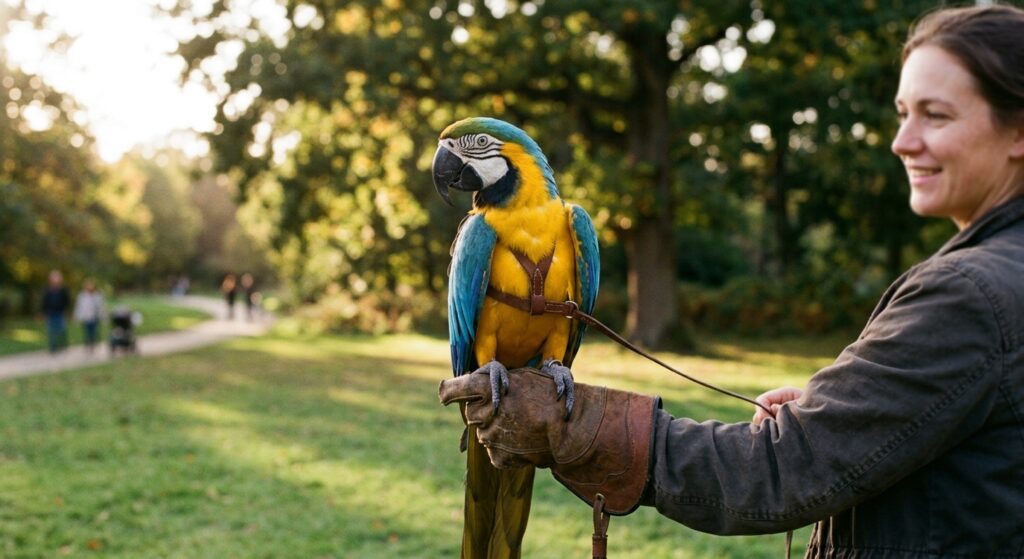
When callers ask us about "flying their bird," they usually mean four very different activities. Sorting them out first saves a lot of frustration — and, in some cases, a lost bird.
What free flight actually means
Free flight is outdoor flight, untethered, in open airspace, where the bird leaves the handler and returns on cue. There is no line, no harness, no ceiling, and no fence. The bird chooses to come back because recall has been trained to a very high standard and because the relationship and reinforcement history support that choice. This is the category the performing birds in shows like Wings of Love fall into, and it is the category with the least margin for error. Wind, hawks, unfamiliar terrain, a startle, or a bird that is simply not hungry enough to care can all end a session badly.
Everything else on the list below is a different discipline with different risks and different equipment.
The four categories, side by side
| Activity | Where | Restraint | Main risk |
|---|---|---|---|
| Free flight | Outdoors, open airspace | None | Loss of the bird; predation |
| Flighted indoors | Inside the home | Walls and ceiling | Windows, mirrors, ceiling fans, cookware fumes, open doors |
| Aviary / flight cage | Enclosed outdoor or indoor run | Full enclosure | Predator harassment through mesh; weather exposure |
| Harness / aviator-style | Outdoors | Harness and tether | Equipment failure; panic flight into the end of the line |
Which one is your actual goal?
Most of the questions we get on the show are not really free-flight questions. They are fitness questions, enrichment questions, or "I want to take my bird outside safely" questions. Ask yourself what you are trying to accomplish:
- Fitness and muscle tone — a flight cage, an aviary, or indoor recall between two people gets you most of the way there without outdoor risk.
- Mental stimulation and novelty — a harness, a secure travel carrier, or a covered patio aviary all provide outdoor sights and sounds.
- A trained behavior you can perform or demonstrate — indoor recall, station training, and targeting build the same foundation the show birds use, indoors.
- Genuine untethered outdoor flight — this is the only goal that requires free-flight training, and it is the only one where a mistake can be permanent.
A harness is not a training tool for free flight. A bird that flies confidently around your living room is not a bird prepared to fly outdoors. Being flighted is a prerequisite for free flight, not a step in the progression, and the two should never be treated as the same conversation.
If your goal can be met by an aviary, a flight cage, or indoor recall work, choose that route — free flight is the only option on this list where a single bad session can cost you your bird.
What a Wings of Love Bird Represents by the Time You See It Fly
Yvonne Patterson Burbach has been one of the most frequent guests on our show since we started broadcasting in 2015, and the reason we keep coming back to her is not the flying. It is everything that happens in the hours nobody buys a ticket for. As owner and trainer of the Wings of Love bird shows, she is not a hobbyist who takes a macaw outside on nice afternoons. She runs a business whose income, reputation, and travel schedule all rest on birds that come back, on cue, in front of strangers.
The performance is the smallest part of the job
A free-flight demonstration lasts minutes. The practice that makes it possible is daily and does not pause for weather, holidays, or slow bookings. What an audience sees and what the trainer actually manages are two different scopes of work:
| Dimension | What the audience sees | What the trainer manages |
|---|---|---|
| Flight | A few confident passes | Years of cumulative recall history with that individual bird |
| Condition | A bird that looks healthy | Weight, feather condition, and fitness tracked continuously |
| Handling | A calm bird on the glove | Handling every day, including days with no show |
| Venue | One stage | Each new site assessed before the bird ever leaves the carrier |
| Risk | Nothing goes wrong | A plan for what happens when it does |
The support structure behind one working bird
Owner-trainers at this level are running several operations at once, and none of them are optional:
- Daily handling and session work, so the relationship never goes stale between bookings.
- Physical conditioning, because a bird that only flies at shows is not fit enough to handle wind, distance, or a startle response.
- Veterinary support from a professional who knows the birds and can be reached when something changes.
- Travel logistics — carriers, vehicle temperature, unfamiliar venues, crowds, unfamiliar sound systems.
- Site evaluation at every new location, since the hazards differ every time.
- Record-keeping on weight, diet, and behavior, which is the only way to notice a small problem before it becomes a lost bird.
Why the trainer's livelihood raises the standard, not the risk
It is easy to assume that a professional pushes harder because there is money on the line. In our experience interviewing working trainers, the pressure runs the opposite direction. A bird that does not return is not a story to tell later — it is the end of an act, a booking calendar, and a relationship built over years. That consequence produces conservative decisions: shows that get scrubbed, birds that stay in the carrier, venues that get declined. The people with the most to lose are the ones most willing to say no.
If you are drawn to free flight because of what you saw at a bird show, understand that you watched the output of a full-time professional practice, not a technique you can copy on a weekend.
Recall Is the Whole Job: Building the Cue Before Building Distance
The Cue Comes First, the Distance Comes Later
Recall is not a trick a free-flight bird performs at the end of a routine. It is the foundation everything else sits on, and it gets built in the least dramatic setting possible: a hallway, a training room, a familiar space where the bird has nowhere interesting to go and nothing pulling its attention away. The trainer establishes that a specific sound — a whistle, a word, a hand position — reliably predicts a specific outcome, then repeats it until the response is automatic rather than considered.
Only after that does distance enter the picture, and it enters in small increments. A bird that flies across a room adds a longer room, then a covered arena or gymnasium, then a large enclosed space with height available. Each step changes one variable at a time. Adding distance, altitude, wind, and novel scenery all at once is how trainers lose birds.
Why "Nine Out of Ten" Is a Failing Grade
Indoors, a missed recall costs a repetition. Outdoors, a missed recall can cost the bird. That asymmetry is the entire reason experienced free-flight trainers treat a 90 percent indoor response as nowhere near ready.
| Setting | What a missed cue costs | What the bird can do instead of returning |
|---|---|---|
| Indoor room | One repetition | Land on furniture, wait, try again |
| Enclosed arena or barn | A few minutes of recovery | Perch high, circle, come down on its own |
| Open air | Potentially the bird | Catch a thermal, follow a flock, disappear over a treeline |
Before open-air work, trainers generally want to see:
- An immediate response — no hesitation, no scanning the room first
- Consistency across different people, times of day, and hunger levels
- Recall through mild distraction: noise, movement, another bird present
- Recall from height, not just from a perch at chest level
- A bird that returns even when it was doing something more interesting
Fledging History and Flight Fitness Shape What a Bird Can Read
A bird that fledged properly — meaning it learned to fly, brake, turn, and land as a juvenile before its confidence outran its skill — reads air differently than one that was clipped or kept from full fledging. Fledging is when a young bird calibrates altitude, learns that landings require planning, and discovers that wind pushes back.
Flight fitness matters just as much. A bird with the stamina for sustained flight has options when it overshoots or gets pushed downwind. A bird without that conditioning has one attempt, and if the approach is wrong it is out of gas at the worst moment. This is why free-flight preparation starts long before any recall session — it starts with how the bird was raised.
Do not treat outdoor free flight as the next distance increment in a training plan; it is a different activity with a different failure cost, and a recall that has never been tested against distraction and altitude has not actually been tested.
Motivation Without Coercion: The Positive Reinforcement Backbone
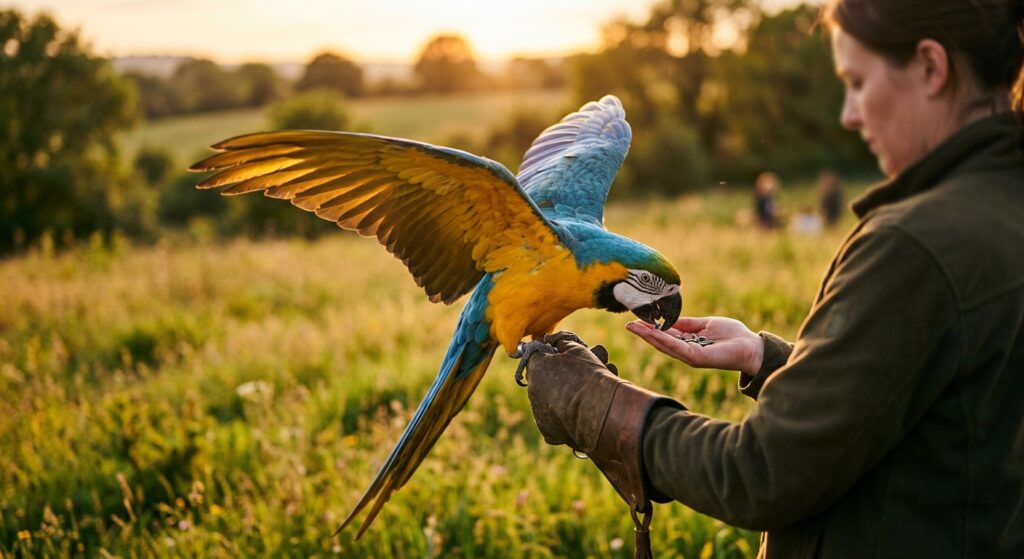
We came back to positive reinforcement repeatedly in our conversation on the Ginger's Parrot Rescue show because it is not a philosophical preference in free-flight work — it is the only mechanism that holds up outdoors. A bird in open air has every option available to it. The only thing keeping it oriented toward the handler is that returning has consistently been the most rewarding choice it can make.
Reinforcement Value Is the Currency
Not every reward carries the same weight, and free flight spends the highest-value currency the bird has. A treat that works fine for stepping up in the living room is often too weak to compete with a thermal, a passing flock, or an interesting rooftop. Trainers stratify what they use:
| Reinforcer tier | Typical use | Why it matters outdoors |
|---|---|---|
| Everyday food | Baseline indoor behaviors, husbandry | Freely available, low competitive pull |
| Preferred treats | Recall practice indoors and in flight suits | Enough value for controlled settings |
| Highest-value item | Outdoor recalls, long distance, distraction work | Must outcompete the entire environment |
The highest-value item is reserved. If a bird gets its favorite nut all afternoon for free, that nut cannot buy a recall at forty yards.
Food Management Is a Veterinary Conversation, Not a Guess
This is where free-flight preparation earns its reputation for demanding rigor. Motivation is managed by controlling when and for what food is delivered — never by depriving a bird into compliance. That distinction is the entire ethical line, and it requires:
- A working relationship with an avian veterinarian who knows the individual bird
- Regular weight records on an accurate gram scale, taken at the same point in the daily routine
- Body-condition assessment, not weight alone — keel palpation, muscling, feather quality
- A defined healthy range agreed with the vet, with training paused if the bird drifts below it
- Attention to droppings, energy, and molt status, all of which change caloric need
A bird that is flying poorly because it is underfed is not a trained bird. It is a bird at risk, and it will make bad decisions in the air.
Short Sessions, and No Place for Punishment
Sessions end while the bird is still eager, not after it has quit. Short, frequent, successful repetitions build a recall that stays reliable; long grinding sessions teach a bird that the handler is the thing that ends the fun. If a bird hesitates, the answer is to lower the criteria — shorter distance, fewer distractions — not to raise the pressure.
Punishment and forced flight have no role here at all. You cannot startle, chase, or throw a parrot into good judgment. Coercion damages the trust that recall depends on, and a bird that associates the handler with something unpleasant has one very effective escape available to it: altitude.
If your bird's motivation depends on being hungry rather than on being genuinely rewarded, stop training and call your avian veterinarian before you ever consider taking it outside.
The Risk Ledger Nobody Puts in the Highlight Reel
Free flight looks effortless on video because the failures never make the edit. Trainers who have flown birds outdoors for years talk about risk constantly — it is a standing topic whenever we have professional bird keepers and show trainers on the air, and nobody who does this seriously describes it as safe. They describe it as managed.
The hazards that get planned around
Most of what goes wrong outdoors is environmental, not behavioral. A bird with a rock-solid recall in a familiar field can still be put in a situation where recall is the last thing on its mind.
| Hazard | How it actually shows up | What planning looks like |
|---|---|---|
| Raptors and other predators | Hawks, falcons, owls, crows mobbing; loose dogs or cats on landing | Scanning the sky before release, avoiding dawn/dusk and known raptor corridors, ending sessions when a predator is spotted |
| Wind and thermals | A light bird pushed downwind, unable to make headway back | Checking wind speed and direction, flying into the wind on outbound legs, canceling on gusty days |
| Sudden spooking | Gunshots, backfires, drones, umbrellas, applause, camera flashes | Extensive desensitization before outdoor work, controlled crowd exposure, known-quiet locations |
| Unfamiliar sightlines | Bird flies over a treeline and loses the visual reference for home | Site surveys, keeping early flights inside a bowl of known landmarks |
| Reflective glass and structures | Windows, greenhouses, glass entryways, power lines | Avoiding built-up sites entirely for young flyers |
| Traffic | Landing in or crossing a roadway | Distance from roads as a hard site requirement |
| Permanent loss | Bird lands high, night falls, weather turns | The recovery plan below, in place before the first outdoor flight |
Preparation that exists before the leash comes off
Identification and recovery are not reactions to a lost bird. They are conditions of flying one at all.
- Microchip and leg band, with the numbers recorded somewhere other than the bird's own paperwork.
- Current photographs showing distinguishing feather patterns, foot markings, and any band from multiple angles.
- A telemetry or GPS transmitter fitted and worn comfortably long before it is needed, not clipped on the morning of a flight.
- A weight and diet log, because a bird that has been out overnight needs informed care, not guesswork.
- A contact list: local avian vet, parrot rescues and sanctuaries, animal control, and the lost-bird networks that circulate sightings regionally.
- A second person at every outdoor session whose only job is to watch where the bird goes.
The honest arithmetic
Every free-flight trainer we have hosted accepts a nonzero chance of losing the bird. The training reduces that number. It never reaches zero. Owners who cannot make peace with that outcome — and who would not have the recovery infrastructure ready the same evening — should be flying indoors or harnessed instead, and there is nothing lesser about that choice.
The moment a bird leaves your hand outdoors, you are relying on preparation you finished weeks ago, so if the microchip, the transmitter, the photos, and the phone numbers are not already in place, the flight should not happen.
If You Are Not Going to Free Fly: Better Uses of the Same Effort
Most of the training that makes a free-flight bird possible has nothing to do with open sky. Recall, weight awareness, stationing, crate loading, and calm handling are the foundation — and every one of them pays off in a living room, a sanctuary flight, or a vet exam room. If you decide the outdoor risk ledger is not for you, you are not giving up the training. You are keeping the useful ninety percent and skipping the part that gets birds lost.
Skills That Transfer Directly
These are the same behaviors show birds learn first, applied to a setting you control:
- Indoor recall. A reliable A-to-B flight between two people, or from a cage top to a hand, builds the same cue-and-reinforcement history. It also gives a flighted bird a job during out-of-cage time instead of chewing baseboards.
- Station training. Teaching a bird to go to a perch, scale, or towel and stay there is the single most useful behavior for grooming, weighing, and multi-bird households.
- Crate and carrier training. A bird that walks into a carrier on cue turns vet visits, evacuations, and travel from a wrestling match into a two-second behavior.
- Harness conditioning. Slow, reinforced desensitization to the harness gives outdoor time without the recall risk. It takes weeks, not minutes, and it should never be forced over the head of an unprepared bird.
- Enriched aviary flight. Length matters more than height. Varied perch diameters, foraging stations, and flight lanes give a bird real exercise inside a barrier.
Matching the Goal to Your Setup
| Goal | Space needed | Rough time to build | Main risk |
|---|---|---|---|
| Indoor recall | One room, two handlers | Weeks | Windows, ceiling fans, other pets |
| Station training | Cage top or tabletop | Days to weeks | None significant |
| Crate training | Existing carrier | Weeks | Rushing and poisoning the cue |
| Harness conditioning | Any indoor space, then outdoors | Weeks to months | Forcing it; heat, dogs, hawks outdoors |
| Aviary flight | Dedicated outdoor or indoor flight | Build time, then ongoing | Predators, escape through double doors |
Sanctuary volunteers in particular get more mileage out of stationing and crate work than anything else. A flight full of rehomed birds that will move to a station on cue is a flight that can be cleaned, medicated, and rearranged without netting anybody.
Bring Us Your Questions
We have been hosting, engineering, and producing Bird Talk Radio from our Kansas City studio since 2015 — around 80 shows with professional bird keepers, wildlife biologists, rescue organizations, and trainers including Yvonne Patterson Burbach of Wings of Love. If you are working through a recall plateau, a harness refusal, or an aviary design question, send it to us and we will put it to a guest who has handled it. The archive streams 24/7/365 at birdtalkradio.com.
The foundation skills are not a consolation prize for people who decided against free flight — they are the behaviors that protect your bird's health and safety every single week, whether or not it ever flies outdoors.