The bird that stepped up all winter now lunges at your hand. He screams as the light goes down, shreds the cage papers into a tidy pile in one corner, and regurgitates on the person he likes best. Nothing in your training changed. The season did.
Across roughly 80 shows recorded in our Kansas City studio since 2015, breeders, trainers and wildlife biologists keep naming the same handful of environmental triggers — day length, the kind and amount of food in the bowl, cavity-like spaces, and where hands land on the body — rather than the bird's temperament.
This article walks through those triggers and what our guests actually change at home when the season starts. It is general guidance from those conversations, not veterinary advice. Chronic egg laying, or a bird that stops eating, belongs with an avian vet.
What Breeders Mean When They Say a Bird Is "In Condition"
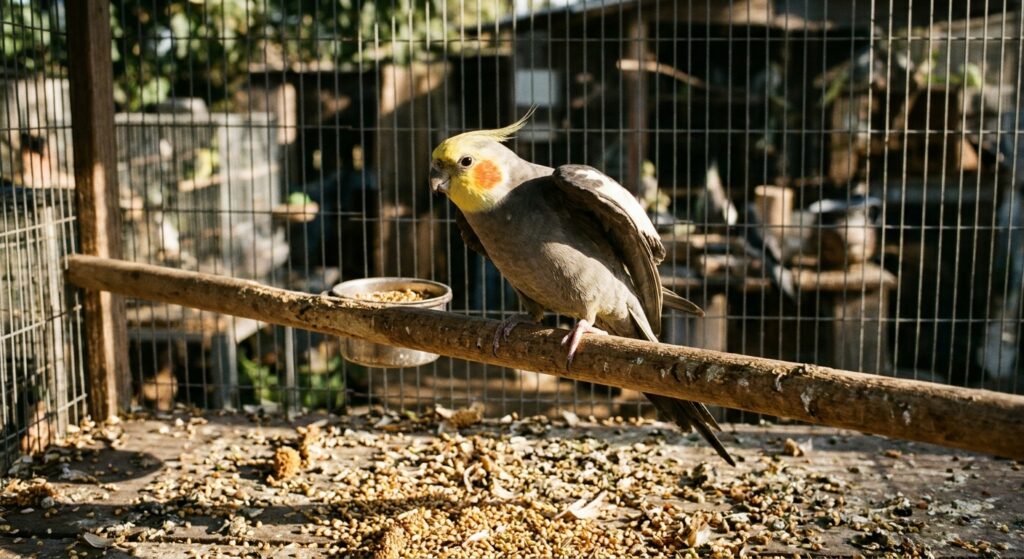
The phrase comes from the breeding loft, not the living room
When a breeder tells us a pair is "in condition," they mean the birds are physiologically ready to reproduce. Weight is up slightly, the vent may look fuller, feather quality is tight and glossy, and behavior has shifted toward nesting. It is a husbandry assessment, not a complaint.
That framing matters for pet owners, because the same bird in your kitchen is responding to the same cues a breeding pair responds to in a flight: longer daylight, warmer temperatures, abundant food, and access to dark enclosed spaces. The bird has not developed a personality problem over the winter. Its endocrine system read the environment and answered. Breeders who have joined us on Bird Talk Radio tend to describe hormonal season as cyclical and predictable — something you manage through light, diet, and housing rather than something you correct through discipline.
The signs listeners describe most often
Owners rarely call it hormonal behavior at first. They call it "he turned on me" or "she's obsessed with my husband." The reported signs cluster into a recognizable pattern:
- Sudden pinpointing and lunging — the iris flashes rapidly, often with a beak-open strike at a hand that was welcome the week before.
- Regurgitating for a chosen person — head bobbing and food brought up for one human, one toy, or one mirror.
- Tail lifting or wing drooping — a crouched posture, tail raised, wings held slightly away from the body or quivering.
- Shredding and burrowing — paper, cage liners, towels, and cardboard destroyed with purpose, followed by the bird wedging itself under or behind something dark.
- Territorial defense of a cage corner — one specific spot becomes off-limits, defended harder than the rest of the enclosure.
- A shift in vocal patterns at dawn and dusk — longer, louder contact calling at the edges of the day, often at times the bird was previously quiet.
Normal cycle versus a reason to call the vet
Hormonal signs and illness signs can overlap, and the distinction is worth drawing clearly.
| Observation | Consistent with hormonal season | Warrants veterinary attention |
|---|---|---|
| Tail lifting | Brief, posture-driven, bird is bright and active | Persistent straining, tail pumping, puffed and quiet |
| Regurgitation | Directed at a person or object, controlled, head bobbing | Involuntary, food stuck to head feathers, weight loss |
| Shredding and burrowing | Paper, toys, bedding; bird is otherwise normal | Accompanied by feather destruction over the chest or thighs |
| Vocal change | Dawn and dusk calling, seasonal | Voice change, open-mouth breathing, tail bobbing at rest |
| Territorial defense | Localized to one cage area, resolves off-cage | New aggression with lethargy or appetite loss |
If a hen is straining, sitting fluffed on the cage floor, or losing weight, stop treating it as hormonal behavior and get her to an avian veterinarian the same day — egg binding is a medical emergency.
Day Length Is the First Switch: Photoperiod and the 12-Hour Rule
When we bring a bird keeper onto the show to talk about spring behavior changes, almost nobody starts with hormones or diet. They start with light. Day length is the signal a parrot's body reads before anything else, and in most homes it is also the one thing the owner has accidentally been controlling all year without realizing it.
Why Light Comes Up First
Wild-type breeding cycles are tied to the lengthening days of spring. As the photoperiod stretches, the bird's system responds the way it was built to respond — more vocalizing, more territorial defense of a cage or a favorite corner, more interest in cavities, more regurgitating at a chosen person. The bird is not misbehaving. It is reading a calendar.
The problem in a living room is that the calendar never ends. A parrot in a room with lamps, overhead lights, a television, a computer monitor, or a kitchen visible through a doorway is experiencing a day that runs from sunrise to whenever the last human goes to bed. Fourteen, fifteen, sixteen hours of perceived daylight is permanent spring, and a bird held in permanent spring tends to stay in condition far longer than it should.
The number our guests keep returning to is twelve. Roughly twelve hours of genuine darkness, uninterrupted, every night — not twelve hours of a dim room with a screen flickering on the other side of it.
What Counts as Dark
- A cage cover over a cage in a lit living room is still a lit living room with a sheet on it.
- Screen glow from across the room reaches the bird even when the overhead light is off.
- A hallway light switched on at 11 p.m. is a sunrise as far as the bird is concerned.
- Partial covers that leave the front or one side open defeat the purpose entirely.
- Going to bed at a different time every night produces a different day length every night.
Three Approaches Our Guests Describe
| Approach | Darkness achieved | Effort for the owner | Fits best when |
|---|---|---|---|
| Move the main cage to a low-traffic room | Good, if the room is genuinely unused at night | One-time change | The home has a spare quiet room |
| Cover the cage in place | Partial — sound and light still leak in | Nightly, easy | Evenings in that room are already quiet and dark |
| Relocate to a dedicated sleep cage | Best — a small cage in a dark, quiet room | Nightly handling both directions | The household stays up late or the living room is busy |
The sleep cage is the option that comes up most often for birds in active households. It is a small, plain cage — perches, water, nothing to shred — in a closet, spare bedroom, or any room the family does not enter after dark. The bird goes in at a set hour and comes out at a set hour.
For the full routine, including how to build the habit without it becoming a nightly fight, see our article on parrot sleep.
Shortening a bird's day only works if you do it consistently — an erratic bedtime teaches the bird nothing and leaves the hormonal signal firmly switched on.
Soft, Warm and Endless: How the Food Bowl Sends a Breeding Signal
Day length starts the conversation, but food finishes it. A bird reading a long day and then finding a bowl that never empties has received two signals pointing the same direction: the season is good, resources are abundant, raise chicks now.
What the Bowl Is Actually Telling Your Bird
Breeders who have come on our shows talk about conditioning birds deliberately, and the tools are familiar to anyone who loves spoiling a pet. Warm mash. Cooked grains and legumes. Sprouted seed. Soft, sweet fruit. Oily seed like sunflower, safflower and hemp. Corn. Egg food. These are the same items a well-meaning companion owner offers every morning because the bird gets excited about them.
The problem is not the ingredient list. It is the combination — warm, soft, high-calorie, and always available. In the wild, that combination only occurs during a narrow window. Offered year-round from a full dish, it tells a hormonal bird the window never closes.
Cooler, Firmer, Measured
The adjustments breeders make when they want to take a bird out of condition are mostly about temperature, texture and volume, not about removing nutrition.
| Breeding-signal offering | Lower-signal swap |
|---|---|
| Warm mash or cooked grain served hot | Same food served cool or at room temperature |
| Soft cooked sweet potato, squash, corn | Raw, firm vegetables requiring work to break down |
| Soft sweet fruit daily | Small fruit portion, offered occasionally |
| Oily seed mix free-fed | Measured seed portion, oily seed as a training reward only |
| Bowl topped up whenever it looks low | One measured portion served at set times |
A practical starting sequence:
- Weigh or measure what your bird actually eats in a day instead of guessing from the bowl.
- Serve that amount as a defined portion rather than a standing buffet.
- Shift the soft, warm items to cooler and firmer versions of the same vegetables.
- Pull oily seed out of the base diet and reserve it for training and enrichment.
- Watch weight weekly — the goal is a change in signal, not a change in body condition.
Move the Calories Into Work
The step that does the most, and the one that ties back to what we covered in our piece on foraging toys, is deciding where the food lives. Calories sitting in an open dish are free. The same calories wrapped in paper, buried in shreddable material, stuffed into a foraging box or spread across several hidden stations become a job.
That matters for two reasons. The bird spends hours doing what a wild parrot spends hours doing, which occupies the energy that otherwise goes into regurgitating, tearing and defending a cage corner. And an unpredictable, scattered food supply does not read as a reliable breeding-season resource.
Do not cut calories to control hormones — keep the nutrition identical and change only the temperature, texture, portioning and location of the food, and weigh your bird weekly to confirm you have changed the signal and not the bird's condition.
Huts, Boxes and the Space Behind the Couch: Removing Nest Cues
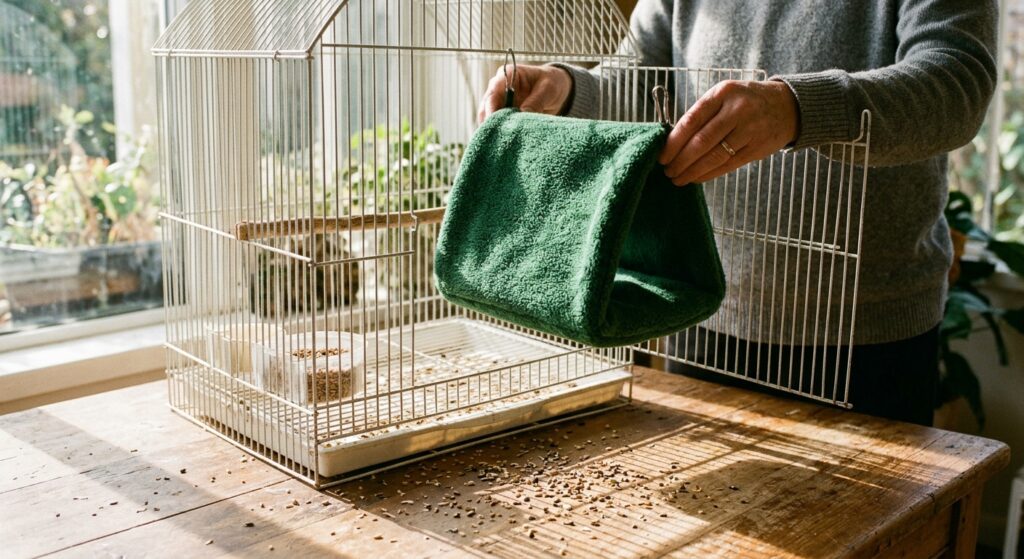
A parrot does not need a nest box to decide it has found a nest. It needs a space that is dark, enclosed on most sides, and defensible. Guests on our shows return to this point constantly: the food bowl and the light cycle set the bird up, but the cavity is what closes the deal. Once a bird claims a cavity, the territorial lunging, the cage-mouth guarding, and in hens the egg-laying tend to follow.
What Counts as a Cavity to a Bird
Owners usually think of the obvious ones and miss the rest. The list of cavity-like spaces that come up again and again in our interviews includes:
- Snuggle huts, tents, and hanging fabric sleeping pouches
- Cage bottoms layered with shredded paper the bird can burrow into
- Open cupboards, pantry shelves, and partly open drawers
- Laundry baskets and piles of clean clothes on a bed or chair
- The dark space behind and under the couch, bed, dresser, or entertainment center
- Cardboard boxes left on the floor, and the inside of paper grocery bags
- Behind books on a low shelf, or inside a shoe
| Space | Why it reads as a nest | What to do |
|---|---|---|
| Snuggle hut or tent | Dark, enclosed, body contact on all sides | Remove entirely during hormonal season |
| Paper-filled cage bottom | Loose substrate to burrow and dig in | Switch to a flat liner under a grate |
| Open cupboard or drawer | Deep, dark, defensible, hard to reach | Keep closed; use childproof latches |
| Under furniture | Low ceiling, one entrance, dim | Block with a board or stored bins |
| Laundry pile | Soft, warm, shapeable | Put laundry away before out-of-cage time |
Auditing the Room at Bird Height
The method our guests describe is simple and physical: get down on the floor and look at the room from where the bird actually travels. A parrot on the ground sees horizontal gaps that you never notice standing up. Crouch at each wall, look along the baseboards, and mark every opening a bird could walk into. Then do the same at perch and shoulder height for shelves and cabinet tops. Fix what you find before the bird finds it, because a bird that has already claimed a spot will fight to get back to it.
Redirecting the Shredding Drive
Taking away cavities does not remove the urge to chew and tear, and you should not want it to. Keep the shredding, lose the enclosure. Offer destructible toys that are open on all sides — hanging palm leaf, yucca, soft wood blocks, vine balls, paper strips tied to a cage bar where the bird works them from outside rather than from within. Foraging toys the bird must dismantle to reach food channel the same energy without handing it a nest.
If your bird has a snuggle hut, the single most effective change you can make this season is to throw it away rather than move it, because a relocated hut is still a nest.
Head and Neck Only: Why Trainers Change Where Hands Land
The Touch a Bird Reads as a Mate
Guests on our shows come back to the same point year after year: a parrot does not interpret petting the way a dog does. A hand that runs down the back, slips under the wings, works around the vent or presses along the base of the tail is delivering the same contact a mate would during courtship. The bird is not confused about what it feels — it responds exactly as designed, with displays, regurgitation, chronic egg-laying in hens, and frustration-driven aggression when the follow-through never comes.
That is why trainers keep the rule simple enough to repeat to every family member in the house: head and neck only. Those are the spots a bonded pair preens on each other outside of mating, and the spots a parrot cannot reach alone.
| Contact | How the bird tends to read it | Better substitute |
|---|---|---|
| Stroking down the back | Mating approach | Scratches at the back of the head and nape |
| Hands under the wings | Mating approach | Pin-feather preening around the cheeks and jawline |
| Vent area or tail base | Direct sexual contact | Stop entirely during hormonal season |
| Full-body cuddling under a shirt or blanket | Nest cavity plus mate contact | Perch time on a stand beside you |
| Head, cheeks, around the ears | Social preening | Keep — this is the safe zone |
Replace the Handling, Don't Just Remove It
Cutting out body petting leaves a gap in the bird's day, and an idle hormonal parrot finds its own outlet. The trainers we have hosted — including Yvonne Patterson Burbach, who has built entire free-flight bird shows on this foundation — push owners toward structured work instead of passive cuddling:
- Short training sessions, a few minutes at a time, several times a day, using targeting or simple behaviors the bird already knows.
- Station work — teaching the bird to go to a specific perch and stay there for reinforcement. It builds a default behavior you can ask for when the bird is wound up.
- Foraging setups that make the bird work for portions of the day's food rather than emptying a full bowl.
- Recall and step-up practice in a quiet room, which keeps the relationship going without hands on the body.
- Shoulder and chest time off the menu for the season, replaced with a portable perch or training stand near you.
When Hands Get Bitten Anyway
Hormonal birds bite. A parrot in condition can be affectionate one second and land a serious bite the next, often over a perceived rival or a territory it has claimed. The response matters more than the bite — dramatic reactions reinforce the behavior, and punishment damages the trust you need for the training work above. We cover the mechanics of reading the warning signals, avoiding the setup, and rebuilding handling afterward in our article on parrot biting.
If one person in the household keeps petting the bird's back because "he likes it," the entire seasonal management plan fails — every pair of hands has to follow the same rule.
What We Change in Our Own Birds' Routines Through the Season
We Write the Season Down Instead of Running It From Memory
Every spring adjustment we make gets written on paper and taped inside the cabinet by the cage, because the one thing that fails in a hormonal season is memory. A plan you can hand to a house-sitter is a plan that survives a work trip.
Here is the shape of what we run when a bird starts shifting in spring:
- A light schedule with times on it. Cover and uncover at the same clock times every day, not at "whenever we get home," and hold the dark period long enough that day length stops lengthening from the bird's point of view.
- A diet shift away from the warm, soft, endless bowl. Measured portions, served and removed, with the richest items reserved for training rather than left sitting in the cage.
- A cavity sweep of the whole room, not just the cage. Huts and boxes out, then the gap behind the couch, under the dresser, inside the open cabinet, the laundry basket, the space behind the bookshelf.
- Revised handling rules for everyone in the house. Head and neck only, and the same rule for visitors, who are the usual leak in the system.
- More flight and more foraging. Food that has to be worked out of something, and recall flights or wing-flapping work scheduled daily rather than when there's time.
The Gram Scale Is the Early Warning
The tool our guests come back to most often is the cheapest one in the room. A kitchen gram scale with a perch, used at the same point every day — ideally first thing in the morning, before the first meal — gives you a number that moves before behavior does.
| What the number does | What it often means | What we do |
|---|---|---|
| Climbs steadily over several days in a hen | Egg production underway | Confirm calcium access, review light and cavity sweep, watch closely |
| Spikes then drops sharply | An egg has likely been laid | Locate it, leave it in place, monitor the hen |
| Drops a few percent and keeps going | Bird is off food | Investigate same day, do not wait out the week |
| Holds flat through the season | Routine is working | Keep logging |
Log it. A single weight tells you almost nothing; fourteen days of weights tells you the story.
When It Stops Being a Routine Change
Some signs are not hormonal management problems. Call an avian veterinarian, not a behaviorist, for a hen straining or sitting puffed on the cage floor, a swollen or tense abdomen, a wide-legged stance, weakness or an inability to perch, labored breathing, an egg not passed within normal time, continued weight loss, blood, or a bird that stops eating entirely.
A gram scale used every morning will tell you a hen is egg-bound or a bird is off food days before you could see it with your eyes, and those days are the ones that decide the outcome.