Your bird screams at dusk, lunges when you reach into the cage, or has turned territorial seemingly overnight. You've adjusted the diet. You've tried ignoring it. Nobody mentioned sleep.
Across roughly 80 shows recorded in our Kansas City studio since 2015, we've watched the same thing happen. An owner describes screaming, nipping, or sudden hormonal behavior, and before the guest — a trainer, a breeder, a rescue operator — says anything else, they ask how many hours that bird sleeps and where.
This piece covers what we've heard on air: hours, light cycles, what "quiet and dark" means in a real house, how to transition a bird, and when sleep isn't the answer. It builds on our screaming and biting coverage rather than repeating it. We're reporting guest commentary, not giving veterinary advice.
The Number Our Guests Keep Repeating: 10 to 12 Hours of Dark
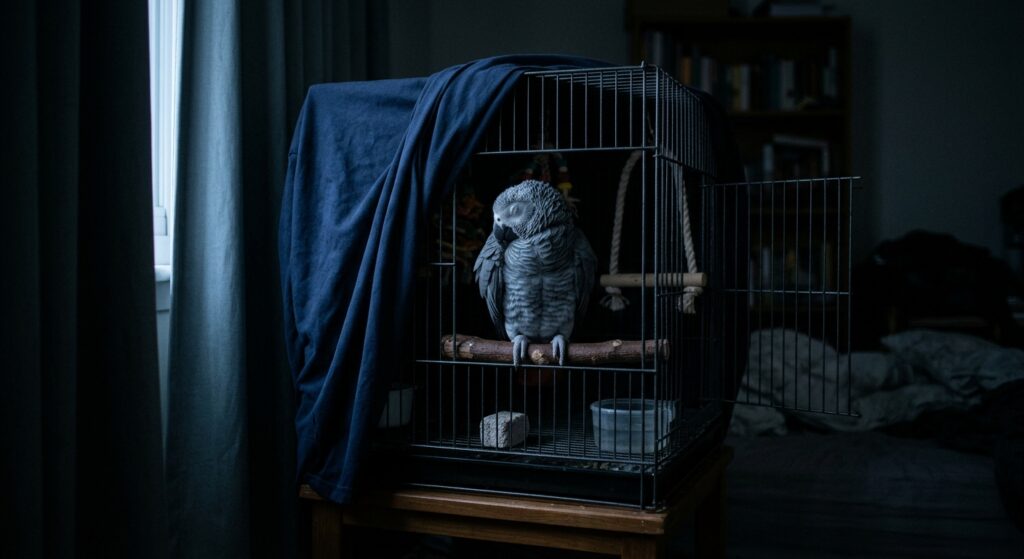
The Range That Keeps Coming Up
Across the roughly 80 shows we have hosted, engineered, and produced from our Kansas City studio since 2015, one recommendation surfaces more consistently than almost any other husbandry point: 10 to 12 hours of genuine darkness every night. It comes up when we talk to professional bird keepers, when we talk to rescue and sanctuary operators, and when training comes up with guests like Yvonne Patterson Burbach, whose Wings of Love birds have to be steady and focused in front of an audience.
What our guests mean by "dark" matters as much as the number. The figure they describe is uninterrupted darkness and quiet — not a living room with the television on, not a cage covered on three sides while a lamp burns on the fourth, and not a room where someone walks through at midnight and flips a switch.
Why Tropical Daylight Is the Reference Point
The reasoning guests give is straightforward. Most of the parrot species living in our homes trace back to equatorial and tropical regions, where day length barely shifts across the year. A bird evolved under that pattern gets roughly half a day of light and half a day of dark, every day, with very little seasonal drift.
A house in Kansas City — or anywhere in a temperate climate — does the opposite. Summer evenings stretch past nine o'clock, winter afternoons go dark at five, and artificial lighting extends the "day" well past both. Our guests describe the resulting long, variable photoperiod as something the bird's body reads as an endless breeding season, which is where the hormonal behavior, screaming, and feather issues owners call about so often tend to start.
Where the Number Shifts
The 10-to-12 range is a baseline, not a universal setting. Guests regularly describe three groups that sit at or above the top end:
| Bird | What guests describe | Typical adjustment |
|---|---|---|
| Young, still-growing birds | Higher rest needs during development | At or above the top of the range |
| Older or geriatric birds | Less stamina, more daytime napping | Toward 12 hours, plus undisturbed day rest |
| Recovering rescues | Depleted condition, stress, rehabilitation | Extended dark period while rebuilding |
A few points guests raise alongside those adjustments:
- Consistency of the schedule matters more than hitting an exact number.
- A separate, quiet sleep cage is mentioned often, especially for birds housed in a busy family room.
- Rescues coming out of neglect situations may need weeks of a settled routine before the benefit shows.
- Daytime napping does not substitute for a proper night.
If a bird is showing behavioral or health changes, the dark period is one of the first things our guests ask about — before diet, before toys, before training.
The most common mistake we hear described is not a bird getting too few hours in the cage, but a bird getting "dark" hours that are repeatedly interrupted by light, noise, or household traffic.
Why a Covered Cage in a Living Room Isn't Sleep
A cage cover is a visual barrier, not a sleep environment. Throw a blanket over a cage in a room where the television is on and the family is still moving around, and you have changed what the bird can see — you have not changed what the bird can hear, feel, or sense through the fabric. Most of the sleep complaints we hear described on the show trace back to this gap.
What a Cover Actually Blocks
Fabric cuts direct light. It does very little else. Think about what is still reaching a bird under a cover in an occupied living room:
- Television light. Screens flicker and shift brightness constantly. Even with a cover, light leaks around the bottom edge and off walls and ceilings, and the pattern keeps changing.
- Sound. Dialogue, laugh tracks, commercials at higher volume, sports crowds, streaming autoplay. A blanket muffles almost none of it.
- Household traffic. People walking past, the kitchen, doors, the dog, conversation at normal volume, someone stopping to say goodnight to the bird.
- Phone and tablet screens. Short, bright, close-range light in an otherwise dim room — and the owner leaning over the cage with it.
- Schedule drift. The living room cover goes on when the family goes to bed, which is rarely the same time two nights running.
A parrot under those conditions is resting with interruptions. That is not the same as a dark, quiet, uninterrupted block of sleep.
Living Room Cover vs. Separate Sleep Cage
| Covered cage in the living room | Sleep cage in a spare room | |
|---|---|---|
| Darkness | Partial; screen and lamp light leaks in | Full, once the door is closed |
| Noise | TV, conversation, kitchen, pets | Background household noise only |
| Bedtime consistency | Tied to the family's schedule | Set by the owner, same time nightly |
| Interruptions | Anyone walking past the cage | None until morning |
| Cost and space | None — uses the existing cage | A second, smaller cage and a spare room |
The Case Our Guests Make for a Second Cage
The recommendation that comes up repeatedly on our shows is simple: a small, plain sleep cage in a spare room, a bathroom, or any room that goes dark and stays dark. It does not need toys, foraging setups, or a large footprint. It needs a perch, water, darkness, and a door that closes.
The argument is about control. In the main cage, the bird's night depends on what the household happens to be doing. In a separate room, bedtime is a decision the owner makes and keeps — same hour, every night, regardless of what is on television. Owners who make that switch tend to report the behavior changes faster than they expected.
If your bird's bedtime moves whenever your bedtime moves, the cover is not the problem — the room is.
Light Cycles and Hormonal Behavior: What Breeder Guests Explain
Day Length Is a Signal, Not Just Lighting
The point breeder guests return to on our shows is that a parrot's body does not track the calendar — it tracks how many hours of light it gets. Lengthening days are one of the oldest, most reliable cues in the natural world that food is becoming abundant and conditions are right to raise chicks. A bird's reproductive system responds to that cue whether the bird is in a flight cage in an outdoor aviary or sitting on a perch in a den in Kansas City.
That is why experienced breeders treat the light switch as a management tool rather than a convenience. They are not guessing at a season. They are feeding the bird a specific photoperiod and watching the bird's body answer.
Why a Normal Human Evening Pushes a Companion Bird Over the Line
Most households run bright overhead lights and screens from dark until bedtime. For a bird whose cage sits in that room, the effective day stretches well past what any wild population of its species would ever experience. The bird is not being "spoiled" — it is being told, night after night, that the breeding season has arrived and is not ending.
| What the bird experiences | What the household calls it | What the bird's body reads |
|---|---|---|
| Uncovered cage in a lit room until 11 p.m. | A normal evening | A very long day — breeding conditions |
| Consistent sleep period of 10 to 12 hours of true dark | An early bedtime | A short day — off-season |
| Light period that shifts an hour or two every night | A busy family schedule | Mixed and unreliable signals |
Hormonal behavior that owners describe to us — chronic egg laying, territorial aggression at the cage door, regurgitation and masturbation directed at a person or a toy, sudden biting from a previously easygoing bird — frequently traces back to this one input before anyone changes the diet or the toys.
How Breeders Deliberately Turn Breeding Condition On and Off
Breeders who have joined us describe using light as a switch in both directions:
- To bring birds into condition: gradually extend the light period, usually paired with increased food availability and the introduction of a nest box.
- To shut breeding down: gradually shorten the light period back toward a long, uninterrupted night, remove nesting opportunities, and pull back the rich conditioning foods.
- To hold birds steady: keep the photoperiod consistent day to day, because erratic light is its own kind of stimulation.
For a pet owner, only the second and third items apply. You want the off-season setting, year-round, and you want it to be boring and predictable.
If your bird is showing hormonal behavior, count the hours of light it actually receives before you change anything else — the fix is often a bedtime, not a new diet.
Screaming, Nipping, and the Sleep Question We Hear Trainers Ask First
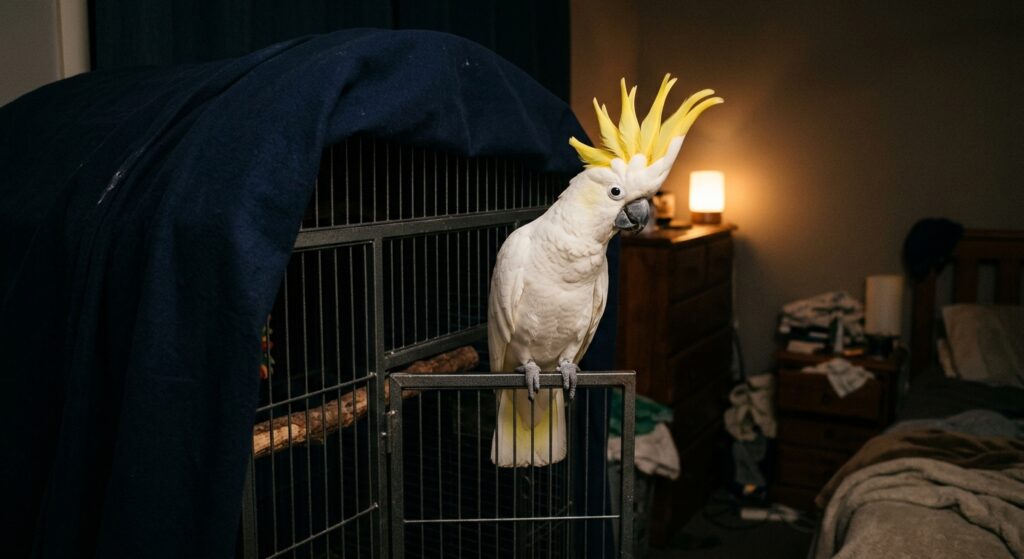
The Questions That Come In Before Anything Else
Across roughly 80 shows recorded in our Kansas City studio, two complaints arrive more often than all the others combined: the bird that screams, and the bird that has started nipping the hands it used to step onto willingly. Owners usually frame these as training failures. They ask about distraction techniques, about whether to react or ignore, about whether the bird has "turned" on one family member.
What we have watched happen repeatedly on air is that the trainer or keeper on the other end of the line does not answer the training question first. They ask what time the lights go out, what time the bird wakes up, and whether anything in the household changed about those two times in the last few weeks. Only after that do they move into method.
Why Trainers Treat Sleep as a Screening Question
The logic our guests describe is straightforward. A tired parrot has less tolerance for handling, less patience for being asked to step up, and a shorter fuse for ordinary household noise. Training protocols assume a bird that can focus and recover between sessions. If sleep is short or broken, you are drilling a bird that cannot hold the lesson, and the owner concludes the technique failed.
Common patterns guests raise when they screen for sleep:
- Screaming that starts in the late afternoon and intensifies into the evening
- Nipping that is new, sudden, and aimed at familiar people rather than strangers
- A bird that was steady for years and changed behavior after a household schedule shift
- Flock calling that no longer stops when the owner answers from the next room
- Escalation that does not respond to approaches that previously worked
Sorting Sleep-Driven Behavior From Training-Driven Behavior
The two look similar at the cage. They separate on timing and history, which is the distinction trainers probe for:
| What you're seeing | Points toward sleep | Points toward training or environment |
|---|---|---|
| Onset | Recent, tied to a schedule change | Gradual, present since the bird arrived |
| Time of day | Worsens late afternoon and evening | Spread evenly across the day |
| Target | Anyone handling the bird, including favorites | Specific person, hand, or situation |
| Response to technique | Technique works briefly, then stops holding | Technique produces steady, slow improvement |
| Nighttime | Household activity, TV, or lights run past the bird's bedtime | Nights are dark, quiet, and consistent |
Where This Leaves the Training Work
None of this replaces the approaches we cover in our screaming and biting material. Reinforcing quiet behavior, reading body language before a bite, and rebuilding step-up trust all still apply. The point our guests make is sequencing: fix the dark hours first, give it a couple of weeks, then judge whether a training problem remains. Many owners find the remaining problem is smaller than the one they called about.
Running a training protocol on a sleep-deprived parrot usually produces a failed protocol rather than a trained bird, so check the schedule before you change the method.
Building a Schedule That Survives a Real Household
Shift the Bedtime Gradually, Anchor the Wake Time First
The advice that comes up most often in our interviews is to stop treating bedtime as the fixed point. Wake time is easier to hold steady, because it can be handled by a timer, a lamp, or whoever is up first. Set the wake time you can realistically repeat seven days a week — including weekends — and then count backward to find bedtime.
If your bird currently goes dark at 11 p.m. and you want 9 p.m., don't do it in one night. Guests who work with behavior problems generally suggest moving in 15- to 20-minute steps every few nights until the new schedule holds. A bird that has been on a late cycle for months will protest an abrupt two-hour change, and the protest itself gets misread as a sleep plan that "didn't work."
Sequencing for Late Evenings, Shift Work, and Kids
A few patterns we hear repeatedly from working households:
- Put the bird to bed before the household winds down, not with it. The last hour of family noise should happen without the bird in the room.
- Split the responsibility. If one person works nights, the other owns lights-out. The bird needs consistency, not the same human.
- Give kids a job with a clock attached — carrying the bird to the sleep cage at a set time works better than asking them to be quiet.
- With multiple birds, move them as a group. Birds left in the main cage will call to the one that was taken out, and nobody sleeps.
- Accept one late night occasionally. Guests describe the damage as cumulative, not from a single holiday evening.
When the Bird's Room Doubles as Living Space
Most listeners don't have a spare bedroom. These are the workarounds that come up on air, with their real tradeoffs:
| Option | Effort/Cost | Best for | Main limitation |
|---|---|---|---|
| Separate small sleep cage in a quiet room | Low cost, needs a second cage | Households with any unused room, including a hallway or laundry area | Bird must be moved twice daily |
| Blackout curtains on the existing room | Moderate, one-time | Birds that resist being moved | Does nothing about noise or conversation |
| Cage cover plus relocating evening activity | Lowest cost | Single-bird homes with flexible routines | Only works if the family actually leaves the room |
| Room divider or screened corner | Moderate | Open-plan apartments | Blocks sight, not sound or light spill from screens |
| White noise source near the sleep cage | Low cost | Shift-work homes, thin walls | Masks noise; does not replace darkness |
A bathroom or walk-in closet can serve as a sleep room if it is safe, ventilated, and free of fumes, candles, and cleaning products — a point rescue guests raise every time this solution comes up.
The single most common failure we hear about is not the wrong room but the moving target: a bedtime that drifts by two hours on weekends undoes a week of consistency.
When It Isn't Sleep: What Guests Check Next
A fixed schedule solves a surprising number of problems, but it does not solve all of them. The clearest signal that you are looking at something other than a sleep debt is simple: you corrected the dark hours, held the routine for two or three weeks, and nothing changed — or the bird got worse. At that point the question stops being about lighting and starts being about health.
The Difference Between a Tired Bird and a Frightened One
Night frights are the most common thing our guests separate out from schedule problems, and cockatiels come up repeatedly in those conversations. A bird having night frights is not restless all evening; it is quiet, then explodes — thrashing, flapping against bars, sometimes landing on the cage floor with broken blood feathers or a scraped cere. That is a startle response in total darkness, not an overtired bird refusing to settle. Keepers who have worked through it describe testing a low night light, moving the cage away from headlight sweep and hallway traffic, and checking for anything that moves at night, including a cat with access to the room.
Signals That Point at the Bird, Not the Room
Sleep problems look like behavior. Illness looks like the body. Watch for the second category:
- Breathing you can hear — clicking, wheezing, open-mouth breathing, or tail bobbing at rest
- Discharge from nares or eyes, or matted feathers above the beak
- Sleeping on both feet, fluffed, during normal daytime hours
- Sitting on the cage floor, or refusing a perch the bird has used for years
- Any change in droppings, appetite, or weight you can feel over the keel
- Guarding a foot or wing, shifting constantly, or biting when a familiar area is touched
| What you see | More likely a | How fast to act |
|---|---|---|
| Thrashing in the dark, calm otherwise | Night fright or startle trigger | Address the room tonight; vet if injured |
| Clicking, wheezing, tail bobbing | Respiratory issue | Same day |
| Daytime fluffing, floor sitting, appetite change | Systemic illness | Same day |
| Favoring a limb, resisting touch, perch avoidance | Pain or injury | Within 24 hours |
| Cranky, loud, nippy on 7 hours of broken dark | Schedule | Fix the schedule first |
Have the Vet Relationship Before the Emergency
This is the point we keep returning to across the shows. Birds hide illness until hiding stops working, and by the time a parrot looks sick, you do not have time to search for a clinic that sees birds, confirm they take new patients, and find out their hours. Establish care with an avian veterinarian while your bird is well. A wellness visit gives you a baseline weight and a chart on file, and it gives you a phone number that means something at seven in the morning on a Sunday.
If you have fixed the dark hours and the behavior has not moved, stop troubleshooting the schedule and get the bird examined — a parrot that still looks wrong after good sleep is telling you something sleep cannot fix.