Across roughly 80 shows recorded in our Kansas City studio, one pattern repeats. When a guest describes a sudden loss, it almost never traces back to food or injury. It traces back to the air.
The reason is anatomy. A bird moves air through air sacs and lungs far more efficiently than we do, so fumes a person barely notices reach a parrot's bloodstream first. The smallest birds in the smallest, least-ventilated rooms are hit hardest.
What follows is a walkthrough of the house, room by room, covering what our guests have flagged as preventable. It builds on topics we've covered separately, like lining up an avian vet before an emergency. This is what comes up in guest conversations, not veterinary advice.
The Kitchen: Nonstick Coatings, Scorched Oil, and the Self-Cleaning Oven
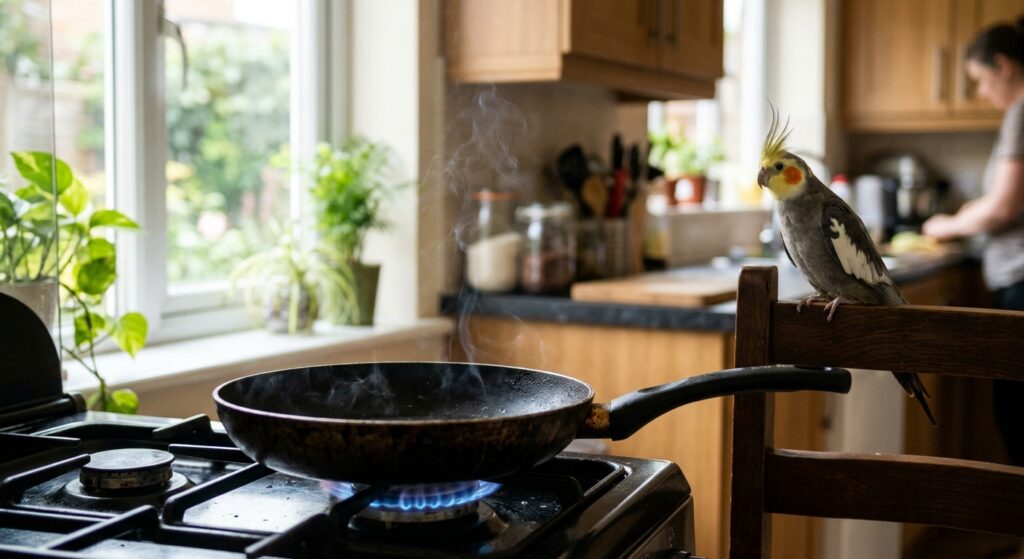
Coated Cookware Is the Hazard Guests Raise Most Often
Across the shows we have recorded since 2015, no single household risk comes up more than PTFE and similar nonstick coatings. The reason guests keep returning to it is that the danger is invisible, odorless to us, and fast. A pan does not have to smoke or burn for the coating to begin breaking down — it only has to get hotter than the manufacturer intended, which happens routinely with an empty pan on a hot burner or a preheat left running while someone answers the door.
What makes this so difficult for bird keepers is that the coating is rarely limited to the skillet. Our guests have pointed listeners toward a much longer list of coated and lined equipment hiding in the same room:
- Nonstick skillets, saucepans, and griddles
- Air fryer baskets and interior surfaces
- Oven drip pans and stovetop burner liners
- Bread makers, waffle irons, and sandwich presses
- Slow cooker inserts, electric skillets, and stand-alone grills
- Disposable oven liners and foil-style drip guards
Heat Sources That Don't Involve a Coating at All
Coatings get the attention, but guests are equally firm about combustion byproducts and burned organics. Scorched cooking oil, a smoking burner, food carbonizing under a broiler, and the high-heat burn-off of a self-cleaning oven cycle all put smoke and fine particulate into the air a bird's respiratory system is not built to filter.
| Kitchen source | Why it's a risk | What guests recommend |
|---|---|---|
| Overheated nonstick cookware | Coating breaks down and off-gasses when taken past its intended temperature | Replace with stainless or cast iron, or never leave it unattended |
| Scorched or smoking cooking oil | Smoke and fine particulate released into shared air | Cook at lower heat, vent before smoke builds |
| Self-cleaning oven cycle | High-heat burn-off of residue and liner materials | Move birds out of the home or run it only when the house can be fully aired |
| Burner drip pans and oven liners | Coated or lined surfaces heated directly and repeatedly | Remove liners; clean bare pans instead |
| Burnt food under a broiler | Dense smoke in an enclosed space | Watch it continuously, hood on |
Why the Kitchen Becomes a Bird-Free Zone
The practical advice our guests give is not complicated, and it is consistent: treat the kitchen as off-limits to birds entirely, run the range hood vented to the outside every time the stove or oven is on, and hold a hard rule that no pan is ever left unattended. Open a window if the hood is weak or recirculating. The rule about unattended pans exists because almost every incident described on our shows began with a cook who stepped away for a minute.
If you keep birds, the safest move is to stop buying coated cookware and appliances altogether rather than trying to manage the temperature of every pan you own.
The Living Room: Candles, Diffusers, Plug-Ins, and the Myth of "Natural" Scent
Anything That Burns, Evaporates, or Sprays Ends Up in the Air Sac
A bird's respiratory system is built to extract oxygen on both inhale and exhale, which means whatever is floating in a room passes through it continuously and efficiently. That design is why the living room — not just the kitchen — comes up so often when we talk with bird keepers and rescue operators on the show. The usual suspects are familiar household items nobody thinks twice about:
- Scented candles, three-wick jars, and wax warmers
- Essential oil diffusers, reed diffusers, and oil burners
- Incense sticks, cones, and resin
- Plug-in air fresheners, aerosol sprays, and "odor eliminators"
- Fabric and upholstery sprays, carpet powders, and linen mists
- Tobacco smoke, cannabis smoke, and vape aerosol
- Wood-burning fireplaces and wood stoves, especially ones that backdraft
The common thread is that all of them put particulate matter, combustion byproducts, or volatile compounds into shared air. Birds have no way to leave the room.
"Natural" Is a Marketing Word, Not a Safety Rating
This is the single most frequent assumption we hear from listeners: that soy wax, beeswax, plant-based oils, or a diffuser labeled "pure" and "chemical-free" must be safe because it came from a plant. Nicotine comes from a plant. So does pyrethrum. Being plant-derived says nothing about how a concentrated aromatic compound behaves in a small enclosed room occupied by an animal weighing a few ounces.
Essential oils are the clearest example. A diffuser's entire purpose is to aerosolize a concentrated extract so it stays suspended in the air you are breathing. "Unscented" is also not a free pass — fragrance-free products often contain masking agents, and the fine particulates from any combustion source are an irritant regardless of smell.
Sorting the Risks by Type
| Source | What enters the air | Lower-risk approach |
|---|---|---|
| Scented candles, wax warmers | Soot, combustion particulates, fragrance compounds | Skip entirely; ventilate and clean instead |
| Essential oil diffusers | Aerosolized concentrated plant oils | No diffusers in any room sharing air with birds |
| Incense | Heavy smoke and particulates | Avoid in the home while birds are present |
| Plug-ins, aerosols, fabric sprays | Continuous or burst fragrance release | Unscented cleaning, open windows, air filtration |
| Tobacco, cannabis, vape aerosol | Smoke, tar, propylene glycol aerosol | Outdoors only, then wash hands before handling birds |
| Fireplaces and wood stoves | Smoke and fine particulates, worse during backdraft | Verify draft, house birds well away, monitor for smoke smell |
"In another room" rarely means what people think it means. If the air circulates through the same HVAC system or an open doorway, the bird is in the room.
If you remember one rule from this section, make it this: plant-derived does not mean bird-safe, and a diffuser running down the hall is still running in your bird's lungs.
Bathroom and Laundry: Aerosols, Bleach, and the Vent That Does Not Exist
Aerosols Put Product Into the Air on Purpose
Every aerosol is engineered to hang in the air long enough to land where you aim it. That is fine for your hair and bad for a bird standing twenty feet away with a respiratory system built to extract oxygen on both inhale and exhale. Hairspray, dry shampoo, body spray, aerosol deodorant, spray sunscreen, and air fresheners all release propellants and carrier solvents along with the fragrance. Nail polish and polish remover do the same thing without a can — acetone and the solvents in polish evaporate fast at room temperature, which is exactly why the smell reaches the next room so quickly.
The practical rule we use: if you can smell it from the doorway, your bird has already been breathing it.
- Do personal grooming with the bathroom door closed and the bird on a different floor or at the far end of the house.
- Switch aerosols to pump, stick, roll-on, or cream versions where one exists.
- Do nails outdoors, in a garage, or in a room with a window open and the bird nowhere nearby.
- Run the exhaust fan during and for a good while after, then air the room out before the bird comes back into that part of the house.
Bleach, Ammonia, and the Combination That Makes Chlorine Gas
Chlorine bleach and ammonia-based cleaners are each respiratory irritants on their own. Mixed — including accidentally, when one product is used over the residue of another in the same tub, toilet, or laundry sink — they react and release chlorine gas. That reaction is dangerous to people. In a small closed bathroom with a bird in the house, it is not a risk worth taking at any dilution.
| Product | Where it shows up | Main concern |
|---|---|---|
| Chlorine bleach | Tubs, toilets, whites laundry | Irritant fumes; reacts with ammonia |
| Ammonia cleaners | Glass, floors, multi-surface sprays | Irritant fumes; reacts with bleach |
| Toilet bowl cleaners | Bathroom, often used with the door shut | Can contain either chemistry; labels vary |
| Oven and drain cleaners | Kitchen, utility sink | Caustic; strong vapor in enclosed space |
| Aerosol disinfectant sprays | Bathroom, laundry | Fine airborne droplets plus fragrance |
Read labels rather than assuming. Many "fresh scent" cleaners are bleach products wearing a floral name.
Scented Laundry and the Closet With No Vent
Detergent perfume, fabric softener, scent beads, and dryer sheets are designed to keep releasing fragrance after the wash — that is the product's entire selling point. A dryer that vents poorly, or a stacked laundry closet tucked into a hallway beside a bird room, pushes that warm scented air straight into the bird's space instead of outside.
Bathrooms and laundry closets are the two smallest, most closed-off rooms in most homes. The same spray that would dilute harmlessly in an open living room concentrates there and then drifts out as one strong plume when the door opens.
Never use bleach and ammonia products in the same session or the same basin, and never keep a bird in a room that shares air with a closed bathroom or an unvented laundry closet.
Bedrooms, Home Offices, and Craft Spaces: Slow Fumes Nobody Smells After Day Two
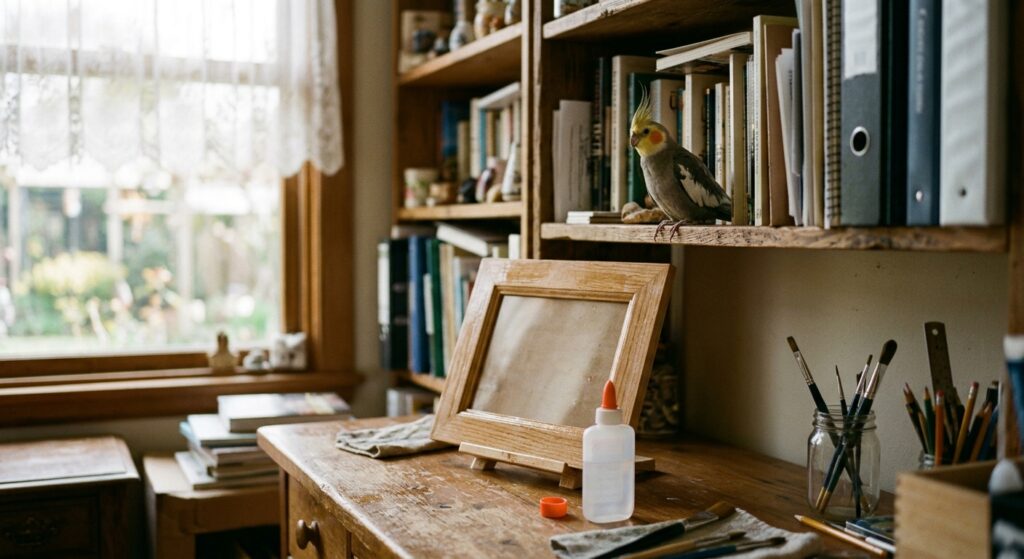
New paint, new carpet, and flat-packed furniture all keep releasing solvents and binders after the smell fades from your awareness. That is the problem. A bird's respiratory system moves air in one direction through a set of air sacs that extend into the body cavity, so it draws a steadier, more complete dose of whatever is in the room than you do — and it is doing that all night, in a cage that usually sits at the edge of a bedroom or office where the most recent renovation happened.
The materials that keep working after the job is finished
Off-gassing is not an event, it is a tail. The strongest release happens while the material is fresh, then drops off slowly over weeks or longer, and warmth and humidity speed it back up — which is exactly what a closed bedroom in summer provides.
| Source | Why it matters for a bird | Lower-risk approach |
|---|---|---|
| Fresh paint, primer, sealers | Solvents keep releasing after the surface is dry to the touch | Move the bird to another room entirely; ventilate hard for days, not hours |
| New carpet and carpet adhesive | Backing and glue release fumes into the floor-level air the cage often sits in | Air out the roll before installation if possible; keep the bird out until odor is gone to a visitor's nose |
| Particleboard and MDF furniture | Resin binders release formaldehyde, strongest when new and warm | Unbox and let it air in a garage or spare room first |
| New mattresses and foam | Same slow release, right beside a sleeping bird | Air out before the bed and the bird share a room |
Hobby and work tools that make fumes on purpose
Craft rooms and home offices are where people use heat and chemistry without thinking of it as chemistry. Treat every item on this list as a reason to relocate the bird before you start, not after:
- Soldering — flux fumes, plus leaded solder handling
- Epoxy and UV resin, including the curing stage
- Spray adhesive, spray paint, and airbrush work
- Model cement and solvent-based glues
- Wood finishing: stains, polyurethane, lacquer, and sanding dust
- Laser engraving and cutting, which vaporizes whatever material is on the bed
- Heated craft tools — wood burners, glue guns, heat guns, embossing tools, and any nonstick-coated plate on a press or iron
Why you are the worst judge of your own air
Nose blindness is the honest reason this category is so dangerous. You stop registering a smell you live with, so "I don't smell anything" tells you about your adaptation, not about the air. Ask someone who has not been in the house to walk in and describe what they notice. Better still, do not keep the bird's sleeping cage in the room where you renovate, paint, build, or make things — a bird that sleeps ten to twelve hours in that room gets the longest exposure of anyone in the household.
If you would not want a houseguest sleeping in that room on the first night, do not leave your bird in it either.
Garage, Basement, and Seasonal Projects: Carbon Monoxide and Combustion Byproducts
Birds have no warning system for carbon monoxide. It is colorless, odorless, and it binds to hemoglobin far more efficiently than oxygen — which is exactly why canaries were once carried into mines. That piece of history is not a quaint anecdote. It is the reason the garage, the utility room, and the holiday decoration box deserve the same attention you give the kitchen stove.
Anything That Burns Fuel Is an Air Quality Event
Combustion appliances produce carbon monoxide, nitrogen dioxide, and fine particulate as a normal part of operating. Properly vented, that exhaust goes outside. The trouble starts when venting fails, when the appliance is unvented by design, or when the engine is running somewhere it should not be.
- Attached-garage car exhaust. Backing out with the door up still pushes exhaust into the shared wall and any door or duct connecting the garage to the house. Never warm up a vehicle in an attached garage, even briefly.
- Gas furnaces and water heaters. Cracked heat exchangers, blocked flues, and bird nests in vent caps all push combustion gases back indoors. Service them on a schedule, not after a problem appears.
- Unvented kerosene and propane space heaters. These dump every byproduct directly into the room you are heating. There is no safe way to run one in a house with birds.
- Generators and pressure washers. Gas engines belong outdoors, well away from windows, doors, and intake vents — never in a garage, breezeway, or basement, even with the door open.
Projects, Pesticides, and the Holiday Box
| Project or item | Main concern for birds | Where the birds should be |
|---|---|---|
| Interior painting, staining, stripping | VOC solvent vapor, lingering off-gassing | Out of the home until surfaces are cured and the space has aired thoroughly |
| Pest foggers and bug bombs | Insecticide aerosol coats every surface; respiratory toxin | Out of the home, with cages, dishes, and perches removed beforehand |
| Generator or pressure washer use | Carbon monoxide intrusion | Interior room farthest from the equipment, windows closed on that side |
| Flocked artificial trees, scented pinecones, wax melts | Particulate from flocking, fragrance compounds | Skip these items entirely rather than relocating the birds |
| Furnace or water heater service | Temporary combustion byproducts and dust | A separate closed room, or off-site for major work |
Detectors and a Written Relocation Plan
Install working carbon monoxide detectors on every level, including the basement and near sleeping areas, and test them. A detector alarms at thresholds set for human safety, so treat any reading as an emergency for your flock and get them into fresh air immediately.
Before any project starts, decide in advance where the birds go: a friend's house, a boarding facility, or a sealed room on the opposite side of the home. Make that decision on a calm day, not while a contractor is unloading equipment.
Carbon monoxide detectors are calibrated to protect people, not parrots, so never wait for an alarm to decide your birds are in danger.
Within Beak Reach: Zinc, Lead, Hardware, and Houseplants
Air quality is only half the picture. A parrot explores with its beak, and anything within reach of a perch, a cage bar, or a favorite climbing route eventually gets chewed, scraped, or swallowed. Breeder guests who have built outdoor aviaries have raised this on our shows more than once: the hardware that holds a flight together is chosen for weather resistance, and weather resistance often means a zinc coating.
Metals: Zinc and Lead Hiding in Plain Sight
Galvanized and zinc-plated hardware is everywhere in bird housing because it does not rust. Quick links, snap clips, C-clamps, wire mesh, washers, and the chain hanging a swing are all common culprits. Lead turns up in older, heavier objects — the kind people do not think of as bird-related at all until a bird lands on one.
| Source | Metal of concern | Where it shows up around birds |
|---|---|---|
| Galvanized mesh and panels | Zinc | Aviary walls, flight cage sides, homemade enclosures |
| Quick links, snap clips, chain | Zinc | Toy attachment points, hanging perches, swings |
| Paint in older homes | Lead | Window sills, trim, door frames birds chew while out |
| Curtain weights, drapery hems | Lead | Floor level, reachable by climbing or ground-foraging birds |
| Stained glass, solder, came | Lead | Window hangings, lamp shades near play stands |
| Costume jewelry, zippers, keys | Lead, zinc | Shoulder-riding birds, earrings, necklaces, shirt buttons |
Stainless steel hardware costs more and is worth it. If you inherit a cage or build an aviary from galvanized stock, breeder guests have described scrubbing new mesh with vinegar and a wire brush to remove loose white oxide before birds move in, and swapping out every quick link for stainless.
Plants, Flowers, and Sticky Traps
A windowsill full of greenery is the first thing a flighted bird investigates. The same goes for cut flowers on the kitchen table, which may carry florist preservatives or pesticide residue in addition to whatever the plant itself contains. Treat anything unidentified as off limits until you have confirmed it.
- Move houseplants out of free-flight rooms rather than relying on the bird to ignore them.
- Skip cut-flower arrangements in any room where the bird is out of cage.
- Remove sticky traps and hanging fly paper entirely — a bird that lands on one can lose feathers, skin, or worse during removal.
- Check for self-watering spikes, decorative glass beads, and soil amendments in reachable pots.
If You Suspect an Exposure
Guests on our shows describe the same three steps, in the same order:
- Get the bird out of the area immediately — another room, a carrier, outside if the weather allows.
- Ventilate hard: windows open, doors open, air moving out of the house, not around it.
- Call your avian vet. Not a search engine, not a forum.
Put your avian vet's number on the refrigerator today, while nothing is wrong, because the moment you need it is the moment you will not be able to find it.