Most parrot owners only move their bird when something is wrong — an emergency vet run, a move across the country — and that's exactly when the bird has the least patience for a box it has never seen before. Performing birds don't have that problem. Birds in shows like Yvonne Patterson Burbach's Wings of Love travel between venues as a matter of routine, and the habits that make that safe are the same ones that make a Tuesday vet trip uneventful.
Since 2015 we've hosted and produced roughly 80 shows from our Kansas City studio, and transport keeps surfacing in conversations with professional bird keepers, wildlife biologists, and rescue organizations. What follows is practical guidance drawn from those conversations — carriers, carrier training, the car itself, what to pack, and how a short vet run differs from a multi-day move. It is not veterinary advice. Your avian vet has the final word on anything involving your bird's health.
Why Performing-Bird Handlers Think About Travel Differently
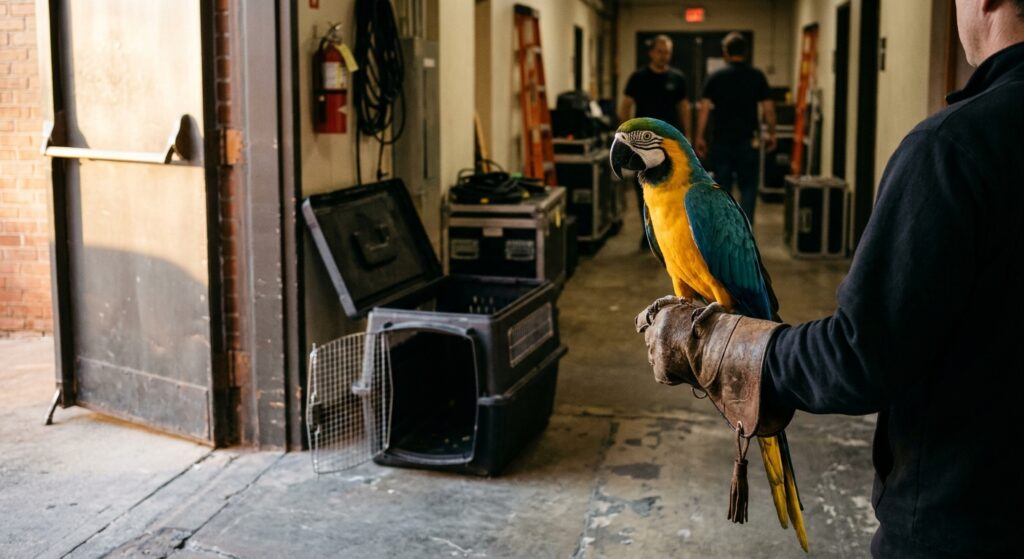
Across the shows we have recorded since 2015, one difference comes up again and again between pet bird homes and professional bird presentation work: the people who travel birds for a living do not treat a trip as an event. For them, loading a bird into a carrier and putting it in a vehicle is no more remarkable than refilling a water bowl. That is not because performing birds are born calm. It is because transport was built into their routine early and repeated often enough that it stopped carrying any meaning.
Transport as routine, not emergency
Most pet bird owners only move their birds under pressure — a vet visit, a move, a storm, an evacuation. The bird's entire experience of a carrier is therefore tied to something unpleasant happening next. Handlers who work shows invert that. The carrier is part of the week, the travel crate sits out in the room, and the bird goes places where nothing bad happens at all.
The practical difference looks like this:
| Dimension | Travel only when necessary | Travel built into routine |
|---|---|---|
| Carrier meaning to the bird | Predicts restraint or a vet | Predicts a normal part of the day |
| Frequency | A few times a year, if that | Regular and unremarkable |
| Owner stress level | High, which the bird reads | Low, which the bird also reads |
| First long trip | Rehearsal and real event at once | Just a longer version of something known |
Repetition is the thing that removes stress
The mindset shift our guests describe is less about gear and more about mileage. A bird that has made fifty uneventful short trips treats the fifty-first the same way. A bird making its first trip is coping with a stack of new variables at once: enclosure, motion, engine noise, temperature change, unfamiliar smells, and an owner who is tense about all of it.
Handlers break that stack apart and introduce the pieces separately:
- The carrier stays accessible at home, open, with no pressure to enter it.
- The bird eats or gets treats in and around the carrier.
- The carrier gets closed briefly, then opened, with nothing else happening.
- Short car trips begin — around the block, home again, no destination.
- Trip length and destination variety increase only after the shorter version is boring.
What this means for the average parrot owner
You do not need to perform with your bird to borrow the method. The goal is simply that your parrot's carrier has a long history of unremarkable outcomes before the day you genuinely need it. Evacuations, emergency vet runs, and relocations do not schedule themselves, and a bird with travel experience handles them with far fewer problems than one meeting the crate for the first time under duress.
The single biggest mistake is waiting until you have a reason to travel, because the first trip should never be both the rehearsal and the real thing.
Choosing a Carrier: What Actually Matters Inside the Box
The carrier is the only thing standing between your bird and a parking lot, a hotel hallway, or an open car door. Handlers who move birds regularly judge a carrier the way they'd judge a harness or a leg band: on whether it holds under pressure, not on how it photographs.
Containment Comes First
A parrot with time on its hands will test every seam of its enclosure. Screw-top beaks work zippers, mesh panels shred under a macaw's bite, and plastic snap latches are a puzzle toy to a cockatoo. Before anything else, ask whether the bird can climb out, chew out, or push out of the carrier while you are driving and not watching.
Look for:
- Latches that require two motions — a slide plus a lift, or a latch with a secondary clip the bird can't reach from inside
- A door frame with no exposed plastic lip for the beak to get purchase on
- Hardware the bird can't reach from a perch — if the bird can stand on the perch and work the door, the perch is in the wrong place
- Mesh or bar material rated for the species, not a generic small-pet panel
Ventilation, Visibility, and the Option to Go Dark
Airflow and sightlines pull in opposite directions, which is why the best carriers give you control over both. You want cross-ventilation on at least two sides so heat doesn't build in a parked car or a sunny back seat. But a bird that can see every passing truck may stay wound up for the entire drive. A carrier with solid panels on two sides and a cover you can drop over the front lets you dial the bird's world down to a manageable size without cutting off air.
| Feature | What it does | What to check |
|---|---|---|
| Cross-ventilation | Prevents heat and humidity buildup | Openings on two or more sides, not just the door |
| Clear front panel | Lets the bird orient and lets you check on it | Can it be covered quickly with a cloth? |
| Solid side walls | Reduces visual overstimulation | Do they block airflow entirely? |
| Removable cover | Settles a bird at rest stops or overnight | Breathable fabric, secured so it can't collapse inward |
Perch Height and Cleanup
Mount the perch low enough that the bird's head has clearance at the ceiling when it sits upright, and far enough from the door that it can't work the latch. The perch should be solid and fixed — a swinging or rotating perch becomes a hazard the moment you brake hard. A smooth, removable floor tray with a liner you can swap at a rest stop saves you from arriving with a soiled bird, and a carrier that comes apart for a full wipe-down matters more over a few years than any logo on the side.
A carrier your parrot can open is not a carrier, and no amount of ventilation, padding, or brand reputation makes up for a latch that fails on the highway.
Training the Carrier Before You Need It: Target, Step Up, Go In
The trainers who come on our show rarely talk about getting a bird into a carrier. They talk about getting a bird to choose the carrier. That distinction is the whole thing. A bird who has been grabbed, toweled, and stuffed into a plastic box twice a year learns exactly one lesson: the box means something bad is about to happen. A bird who has eaten breakfast in that box forty times learns something else entirely.
Start Before There's a Trip on the Calendar
Carrier training fails most often because it begins the week of the appointment. Put the carrier out as furniture first — door off or tied open, sitting somewhere the bird already spends time, for days, with nothing asked of it. Only once the bird ignores it do you start paying for interest in it.
Keep sessions short. Two or three minutes, once or twice a day, ending while the bird is still engaged rather than when it walks away bored. This is the same shaping logic the professional handlers we've hosted apply to any behavior: break it into pieces small enough that the bird succeeds on nearly every repetition.
A workable progression:
- Reinforce looking at the carrier.
- Reinforce stepping toward it, then touching it.
- Reinforce a head inside, then one foot, then two.
- Reinforce staying inside for one second, then five, then thirty.
- Close the door for one second while the bird is eating, then open it immediately.
- Pick the carrier up an inch. Set it down. Repeat.
- Carry it across the room, then to the car, then around the block.
Target and Step-Up Are the Tools That Get You There
If your bird already targets to a stick and steps up reliably, you have the two behaviors carrier work is built from. Targeting lets you guide a bird into a space without touching it — no hand near the body, no hand to bite. Step-up gives you a clean exit at the vet without a grab.
| Approach | What the bird learns | What happens at the vet |
|---|---|---|
| Grab and insert | Hands and carrier predict restraint | Escalating resistance, possible biting |
| Towel only, no prep | Towel predicts restraint | Stress stacking before the exam starts |
| Target into carrier | Entry earns reinforcement | Bird loads on cue, handler stays calm |
This Connects to Work You May Already Be Doing
In our coverage of free-flight preparation, the recall and recovery work depends on a bird that will enter a transport box without argument — there is no free-flight program without a reliable crate. And in our material on biting, the pattern is the same: most bites in handling contexts come from a bird with no way to say no. Carrier training gives the bird a yes worth choosing.
If your bird only sees the carrier on vet days, you have trained the carrier to mean fear — fix that before you need to travel, not after.
The Car Itself: Securing the Carrier, Heat, Cold, and Fumes
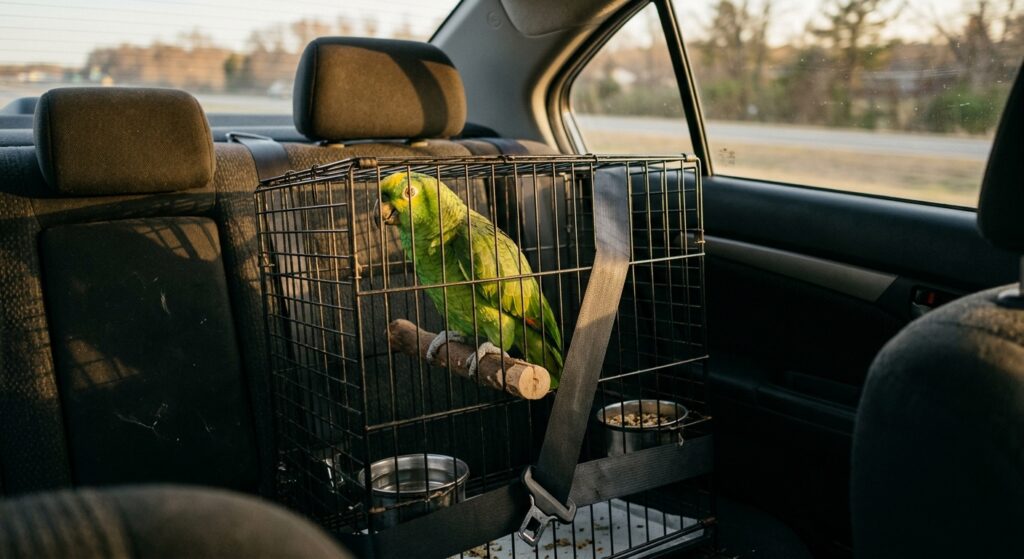
Anchoring the Carrier So It Cannot Move
A carrier that slides during a stop turns into a tumbling box with a bird inside. Treat the carrier as cargo that has to be restrained, not luggage that happens to be in the back seat.
- Run the seat belt through the carrier's belt loops or handle, then tighten it until the carrier does not rock when you push it.
- If the carrier has no belt path, wedge it on the floor behind a front seat so it is boxed in on all four sides.
- Keep perches low and the carrier upright; a bird thrown off a high perch during braking has farther to fall.
- Never place a carrier on a front seat with an active airbag.
A bird riding loose on your shoulder or on the dashboard has no protection at all. One hard stop, one sudden horn, one open door at a gas station, and the bird is either injured or gone. Flighted parrots have been lost in parking lots in the time it takes to reach for a wallet. The performers we have talked with on the show move their birds in carriers between the vehicle and the stage area for exactly this reason — the handling happens where it is controlled, not where traffic is.
Temperature: The Parked Car Problem
The single rule with no exception is that the bird does not stay in a parked car. Not with the windows cracked, not in shade, not for five minutes. Car interiors heat and cool far faster than the outside air, and a parrot has no practical way to shed heat once the air around it is hotter than it is.
Moving air is the other hazard. Dashboard vents blow directly at the height most carriers sit, and a stream of air conditioning or heat aimed at a bird creates a localized temperature very different from the cabin reading on your display.
| Situation | What goes wrong | What to do instead |
|---|---|---|
| Parked car, warm day | Interior temperature climbs quickly with no escape | Take the bird with you or do not make the stop |
| Parked car, cold night | Cabin loses heat fast after the engine is off | Same — the bird comes inside |
| Vent aimed at carrier | Chilling or overheating one side of the bird | Angle vents away; pre-condition the cabin before loading |
| Loading from a cold house into a hot car | Abrupt swing with no adjustment period | Run the climate control for a few minutes first |
Air Quality Inside the Cabin
Parrots have respiratory systems that react to fumes long before people notice a smell. Keep exhaust out of the cabin by not idling in a closed garage and by keeping the carrier away from a tailgate in traffic. Skip air fresheners, aerosol upholstery sprays, and strong cleaning products in the vehicle on travel days, and let the car air out if it has recently been detailed.
If you cannot take the bird with you when you step out of the vehicle, do not make that stop at all — a parked car is never a safe holding place for a parrot.
Food, Water, and Timing on the Road
Why the Water Dish Comes Out
A bowl of water in a moving vehicle does two things, and neither of them is hydration. It sloshes out on the first turn and soaks the bird, which strips body heat fast in an air-conditioned car. It also turns the cage bottom into a wet, cold surface for the rest of the drive. Handlers who move birds regularly take the dish out before the engine starts and put it back when the carrier is stationary.
Common substitutes while in motion:
- A water bottle or sipper tube, but only if the bird already drinks from one reliably at home — a travel day is the wrong time to introduce it
- Juicy produce offered at stops instead of standing water
- A dish clipped in only during rest breaks, then removed again before pulling out
- A spare towel on the cage floor to absorb anything that does spill
Hydrating Foods and Pellets at Stops
At each stop, park, cut the engine, and let the carrier settle for a minute before opening anything. Offer a small amount of water, then something with moisture in it: orange or apple segments, grapes, melon, cooked sweet potato, or soaked pellets. Many birds will not eat while the car is moving but will take food readily once the motion stops. Keep the regular pellet ration available in the carrier throughout the trip anyway — some birds nibble steadily and some do not touch anything until they are home.
Avoid sudden new foods on travel days. A bird that has never eaten melon is unlikely to start in a strange carrier, and an unfamiliar item can upset digestion on top of travel stress.
Judging Trip Length Against the Eating Schedule
Think in terms of how long your bird normally goes between meals, not how long you can go between gas stations. A bird that eats first thing in the morning and again in the late afternoon can handle a few hours without much fuss. Smaller species with faster metabolisms need shorter gaps. Plan a stop at least every two to three hours on longer drives, and build the route so the bird's normal feeding times fall at a stop rather than in the middle of a highway stretch.
Signs to Check on the Bird Sooner
| What you see or hear | Likely concern | What to do |
|---|---|---|
| Open-beak breathing, wings held out | Overheating | Stop, shade, lower cabin temp, offer water |
| Fluffed and still, eyes closing | Chilled or unwell | Stop, warm the cabin, check for drafts |
| Sitting on the cage floor | Stress, illness, or lost footing | Stop and inspect the perch and the bird |
| Sudden silence from a normally vocal bird | Stress or a real problem | Check visually, do not assume it settled |
| Wet chest feathers | Spilled water, chilling risk | Dry the bird, remove the water source |
Do not wait for the next planned stop when something looks wrong — a bird that is overheating or chilled loses ground in minutes, not hours.
The Go-Bag: Packing for a Vet Run Versus a Multi-Day Move
A 20-minute run to the avian vet and a three-day drive to a new home are not the same packing problem. The vet run is about control and containment for a short window. The multi-day trip is about keeping a bird fed, clean, rested, and legally documented across unfamiliar rooms, weather, and schedules. Build two kits, keep the short one assembled at all times, and treat the long one as the short one plus everything that handles time.
The short-trip kit: grab it and go
This is the bag that sits by the door. If you have to think about what goes in it, it is not ready.
- A towel sized to your bird, used for restraint only if the situation demands it
- A small water dish and a few familiar food items, even if the trip is short
- Paper towels and a roll of paper liners for the carrier floor
- A copy of your bird's health records, including recent test results and any medication list
- Your vet's phone number written down, not just stored in a phone that can die
- Your parrot first aid kit, which we have covered in detail in a separate article — keep it in the car or by the carrier, not in a closet
What a multi-day move adds
| Item | Short vet run | Multi-day or relocation |
|---|---|---|
| Paper liners | A few sheets | Enough for two changes per day, plus extra |
| Perch | Carrier perch only | Spare perch in case one cracks or fouls |
| Cleaning supplies | Paper towels | Bird-safe cleaner, trash bags, disposable gloves |
| Food | A snack portion | Full diet for the trip plus three extra days |
| Water | One dish | Jugs of the bird's usual water source |
| Records | Health record copy | Health records, ownership and purchase paperwork, band or microchip numbers, photos of the bird |
| Housing | None | Travel cage or collapsible cage for overnight stops |
Overnight stops and the new-home routine
Call ahead and confirm the property accepts birds before you arrive; a parrot discovered at check-in becomes a problem at 10 p.m. with no alternatives. At the room, inspect for ceiling fans, open windows, and plug-in air fresheners before the carrier door ever opens. Set the travel cage away from the HVAC vent, cover part of it, and give the bird quiet rather than attention.
At the new home, pick the bird's room before unpacking anything else. Set the cage up in its permanent spot, put familiar perches and dishes in familiar positions, and let the bird watch the chaos from a space that already looks like its own. Resume the normal feeding and lights-out schedule on day one, even if the rest of the house is still in boxes.
The one item people skip and regret is paperwork — carry physical copies of health records and proof of ownership, because a bird without documentation is difficult to board, treat, or transport across a state line.