You came here for a list. Species one through ten, ranked, with a recommendation at the bottom. We're not going to give you one.
Across roughly 80 shows recorded and produced from our Kansas City studio since 2015, we've put that exact question — "what's the best first parrot?" — to professional bird keepers, breeders, wildlife biologists, rescue operators, and trainers like Yvonne Patterson Burbach of Wings of Love. Almost none of them answer it. They ask questions back.
What follows are those questions, in roughly the order our guests tend to raise them. Answer them honestly and the field narrows faster than any ranking will do it for you. Sometimes the honest answer is "not yet."
"How Long Do You Expect to Own This Bird?"
The First Question Is Never "Which Species?"
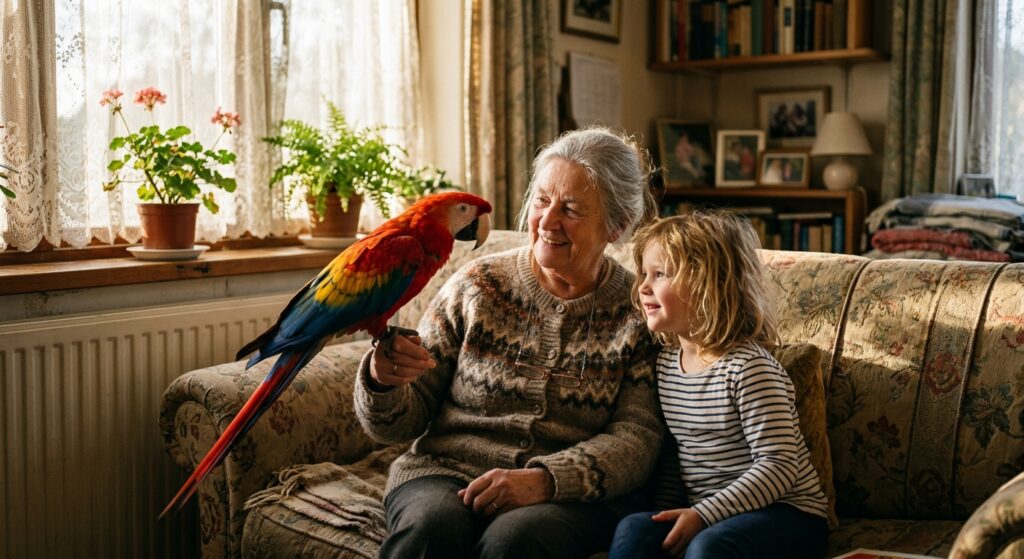
Across the shows we've recorded since 2015, the breeders, rescue operators, and trainers who sit down with us almost never open by recommending a bird. They open by asking how long you expect to keep one. It sounds like a dodge. It isn't. A parrot is not a purchase with a warranty period — it's a household member whose needs are still going to be there long after the enthusiasm that prompted the search has cooled.
Small birds can share a good stretch of your life. Larger parrots — macaws, cockatoos, amazons — can share the whole of it, and in plenty of cases outlast the person who brought them home. Our guests from rescue and sanctuary work see the result of that arithmetic more often than anyone: birds surrendered not because they were bad birds, but because nobody planned past the first few years.
Why Decades Change the Math for a First-Time Owner
A first bird is usually chosen against your life as it looks right now — current apartment, current schedule, current relationship, current job. A long-lived parrot has to fit your life as it will look through several versions of all four. That's why so many of the keepers we interview steer newcomers toward asking a harder question than "can I handle this bird?" The question is "can I handle this bird during the years I'm least able to?"
| Life change | What our guests ask you to think through |
|---|---|
| Moving | Will the next place allow a loud bird, and can you transport a large cage and stand? |
| A new partner or marriage | Does the other person accept the bird, allergies included, before it's a crisis? |
| Children | Who supervises, and does the bird lose the attention it's used to? |
| Career shift or travel-heavy work | Who provides daily food, water, and out-of-cage time when you're gone for weeks? |
| Illness, aging, or your own death | Who takes the bird, and have they agreed in writing? |
Naming the People Who Come Next
Breeders and rescue operators raise succession planning before they'll name a single species, and the good ones want specifics, not intentions. Before you shop, work through:
- A named caretaker who has met the bird and said yes out loud.
- A backup to that person, because one name is a single point of failure.
- Written instructions — diet, vet, cage setup, quirks, bite history.
- Provision in your will or estate documents, including funds for food and veterinary care.
- A relationship with a rescue or sanctuary now, not at the moment you need one.
Answering these doesn't lock you into a large parrot. Often it points a first-time owner toward a smaller, shorter-lived species — and our guests treat that as a good outcome, not a lesser one.
If you cannot name, today, the specific person who would take this bird if something happened to you tomorrow, you are not ready to bring one home.
"What Does Your Building Sound Like at 6 a.m.?"
Start With the Room, Not the Bird
The first question our guests tend to ask a prospective owner isn't "what species do you want?" It's "who else hears it?" Parrots call loudest at dawn and again near dusk. That means the honest test of your home isn't how the bird sounds at 2 p.m. while you're at the desk — it's what your building sounds like at 6 a.m. when a bird wakes up, notices the light, and calls to find its flock.
Walk the situation through concretely:
- Apartment or condo: shared walls, shared ceilings, and a lease that may include a nuisance clause. Sound travels through structure, not just air, so headphones and closed doors do less than people expect.
- Detached house: far more forgiving, though open windows in summer put a loud bird into conversation with the neighbors.
- Work-from-home space: if you take client calls, a contact call in the background is not something you can mute your way out of every morning.
- Roommates and partners: the person who did not choose the bird is the person most likely to resent it at 6 a.m.
- Night-shift neighbors: someone sleeping days changes the math entirely.
A Quick Comparison Before You Commit
| Living situation | What dawn calling actually means | Question to settle first |
|---|---|---|
| Apartment with shared walls | Neighbors hear it whether or not you do | Does your lease or HOA allow birds, and have you asked the neighbor directly? |
| Detached house, close lots | Manageable indoors; carries outdoors in warm months | Where will the cage sit relative to open windows? |
| Detached house, acreage | Least friction | Do you still want to live with the volume yourself? |
| Shared home office | Interrupts calls, not just sleep | Can the bird's room be genuinely separate from your work room? |
| Household with a night-shift worker | Daytime calling hits their sleep hours | Is there a room that stays dark and quiet on their schedule? |
Why Training Won't Remove a Contact Call
This is where our guests are consistent, and it's worth repeating. A contact call is species-typical behavior — it's how a parrot locates its flock. Wild-type behavior doesn't disappear because a bird lives in a living room. What training and good management can do is shape the pattern: reduce screaming that's been accidentally reinforced, build a quieter call-and-response with you, adjust light and cover schedules, and address boredom, diet, and cage placement. What they can't do is delete the underlying behavior.
We've covered this at length in our existing material on why parrots scream, and the distinction matters when you're choosing a species: pick a bird whose baseline volume you can live with, then manage the excess. Choosing a loud bird and planning to train the volume out of it is the mistake that fills rescue intake forms.
Choose the species whose natural voice your building can absorb on its worst morning, because training reduces screaming but never removes a parrot's contact call.
"How Many Hours a Day Will the Bird Be Alone?"
Do the Audit Out Loud, Not in Your Head
When a caller says "I'm home a lot," our guests almost always stop and ask them to count it hour by hour, out loud. The number people say is rarely the number they live. Work through it the way our bird keepers, rescue volunteers, and biologists do on air:
- Weekday departure and return. Door closing to door opening, including commute — not just the shift itself.
- Overtime and second jobs. How many weeks last year did the schedule blow past normal?
- Evenings out. Class, gym, church, kids' activities — hours the bird is uncovered but alone.
- Travel. Nights away per year for work and for pleasure, counted honestly.
- Vacation coverage. Name the actual person who feeds and checks the bird. If you cannot name them, you do not have coverage.
- Weekends. Are they home days or errand days?
Add it up. That total, not your intentions, is what our guests respond to.
The Honest Number Redirects the Species Conversation
A nine-hour empty house is not a disqualification, but it changes what belongs in it. This is where callers who arrived asking about a cockatoo often leave asking about something else.
| Your honest daily pattern | Direction guests point you | What has to be in place |
|---|---|---|
| Someone home most of the day | Larger, highly social parrots become a fair conversation | Structured out-of-cage time, independent play training from day one |
| Out 8–10 hours, home evenings and weekends | Smaller companion species, or a compatible pair | Foraging built into every feeding, reliable evening routine |
| Frequent overnight travel | A species that tolerates a caretaker's routine, or a delayed decision | Named, trained sitter who has met the bird before you leave |
| Unpredictable schedule week to week | Wait, or work with a rescue on a bird already used to variability | Written care instructions, backup caretaker |
Enrichment and Out-of-Cage Time Are Part of the Answer
Trainers we host — Yvonne Patterson Burbach among them — describe alone time in terms of what the bird is doing, not just how long the room is empty. A parrot that has to shred, unwrap, and dig for breakfast spends the morning working. A parrot handed a full bowl at 7 a.m. spends it waiting for you.
So the follow-up questions come fast: Where does the food go — bowl, or hidden in foraging toys? What does the bird do in the first hour after you leave? When you get home, is out-of-cage time a scheduled block or whatever's left before bed? Beginners who can answer those three concretely usually do fine with a longer workday than they expected.
The most common failure we hear about is not too many hours alone — it is unenriched hours alone with no named person covering vacations.
"What Do You Actually Want From a Parrot?"
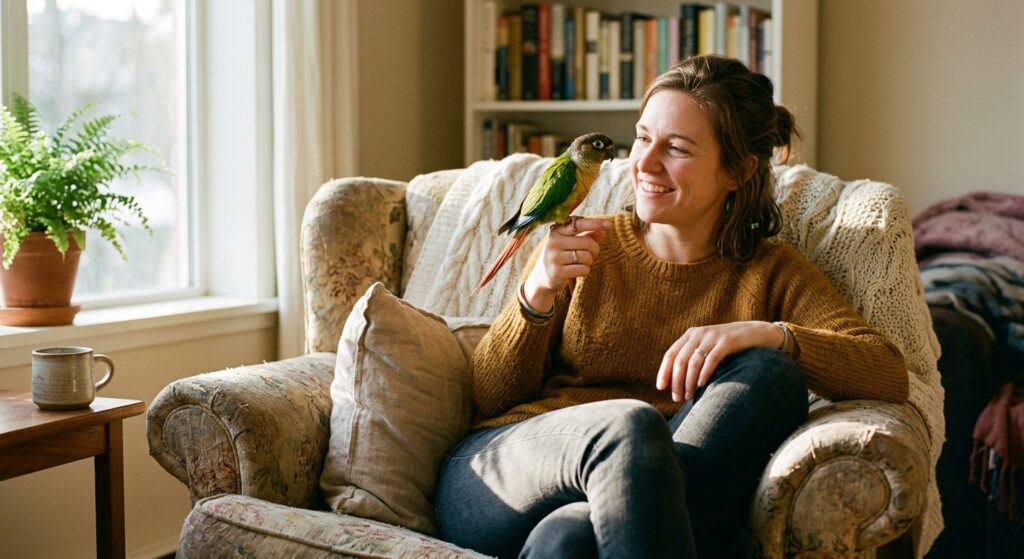
The first question that comes up on air, before species, before cage size, before budget, is why you want a bird at all. People rarely have a clean answer ready, and that is fine — but working it out before you buy saves a bird from being rehomed later.
Four Common Motivations, Honestly Compared
Most first-time buyers we hear from fall into one of four camps. They are not equally easy to satisfy.
| What you want | What it actually asks of you | Realistic outcome |
|---|---|---|
| A bird that talks | Daily repetition, patience, and acceptance that talking cannot be guaranteed in any individual | Some birds speak clearly, some mimic sounds only, some never talk at all |
| A trick-trained companion | Short, consistent training sessions most days, plus study of positive reinforcement | Achievable with commitment — this is a skill you learn, not a trait you buy |
| A quiet bird to sit with you | Handling from the start, and tolerance for a bird that also chews, screams, and molts on you | Common and rewarding, but "quiet" is relative to the species |
| An aviary pair to watch | Space, appropriate housing, and letting go of the idea that they will be hands-on pets | Very satisfying for observers; bonded pairs usually prefer each other to you |
Why Performing Birds Look Easy
Trainers who work performing birds — Yvonne Patterson Burbach of Wings of Love has been a regular guest on our shows — spend their working lives with birds that are conditioned, well fed, well exercised, and doing behaviors they have practiced hundreds of times. What an audience sees is the finished product of a professional routine, not a Saturday afternoon with a bird you bought last month.
The gap between the two is worth spelling out:
- A show bird has a trainer who works with it as a job, not as an evening hobby.
- The behaviors on stage were shaped in small steps over weeks or months.
- Off-camera, that bird still has feeding, cleaning, health, and enrichment needs identical to yours.
- The bird was almost certainly selected for temperament and suitability for the work.
None of that means you cannot train your own bird. It means the video is a demonstration of what trained behavior looks like, not a preview of what a bird does on its own.
Test Your Answer Against Daily Life
Take the motivation you landed on and picture it on an ordinary Tuesday, not a good weekend. If you want a talker, are you willing to talk to a bird for months with no return? If you want tricks, will you run a five-minute session before work? If you want a bird to sit with you, will you still want that when it prefers your shoulder to your hands?
Buy the bird for the way it will actually live in your home, because a bird acquired to fulfill an expectation it cannot meet is the one most likely to end up in a rescue.
"Have You Priced the Bird or the First Year?"
The purchase price is the number most people have already looked up. It is also the number our guests spend the least time on. On show after show, professional keepers, rescue operators, and avian veterinary voices steer the conversation away from the sticker and toward the twelve months that follow it — because that is where households get surprised, and where birds end up back in rescue.
The Setup Costs Are Real, but They Are Finite
Housing is a one-time expense you should plan to overbuy. A cage that fits the bird today rarely fits the bird once it is flapping, climbing, and hanging sideways from the bars. Our guests consistently advise buying for wingspan and bar spacing appropriate to the species rather than to the price point, because a replacement cage six months later costs more than buying correctly once.
Perches are the piece first-time owners underspend on. A single dowel perch of uniform diameter is a foot-health problem waiting to happen. Varied diameters, natural branch, and materials the bird can chew and destroy are part of the setup, not an upgrade.
The Recurring Costs Are the Ones That Decide the Outcome
| Cost | How often | What people underestimate |
|---|---|---|
| Cage and perches | Once, plus replacements | Sizing for the adult bird, not the bird in the store |
| Pellets | Ongoing | Quality base diet is not the cheap seed mix |
| Fresh produce | Weekly, indefinitely | Prep time and waste, not just grocery cost |
| Enrichment and toys | Continuous replacement | Destroyed toys are a success, not a loss |
| Routine avian vet care | Annual | Finding an avian vet at all in your area |
| Emergency avian care | Unpredictable | It arrives with no warning and no payment plan |
The two lines people mentally delete are enrichment and veterinary care. Both are the ones that matter most.
Enrichment Is Consumable and Vet Care Is Not Optional
A toy your parrot shreds in three days did its job. If you find yourself resenting the replacement cost, the honest answer is that the species is too destructive for your budget, not that the bird is wasteful. Budget enrichment the way you budget food — as something that runs out.
On diet, we have covered elsewhere why a pellet base plus fresh foods is the standard our guests keep returning to, and why an all-seed diet costs less at the register and far more at the clinic. On veterinary care, we have said it plainly before and will keep saying it: establish a relationship with an avian veterinarian before you need one. Locate the practice, book the new-bird exam, and get into their system while nothing is wrong. Avian vets are not evenly distributed, and the night your bird goes quiet on the bottom of the cage is not the night to start searching.
If an unexpected avian emergency bill this month would be impossible for your household, you are not ready for the bird yet — you are ready to keep saving.
"Who Are You Getting the Bird From, and Have You Handled One?"
What a Responsible Breeder Expects From You
The breeders and professional bird keepers who have come on our shows since 2015 tend to interview the buyer harder than the buyer interviews them. That is a good sign, not an insult. Expect questions about your housing, your daily schedule, your other pets, and what happens to the bird if your circumstances change. Expect to be told to wait — for a clutch that has not weaned yet, or until you have handled the species in person.
A few things worth insisting on in return:
- See where the birds are kept, not just a sales area or a parking-lot handoff.
- Ask to meet the parent birds when the seller has them on site.
- Confirm the chick is fully weaned before it goes home with you, and ask who did the weaning.
- Get the hatch date, band or microchip details, and any veterinary records in writing.
- Ask what support you get after the sale — good breeders expect your phone calls for years.
Why Rescue Often Fits a First Home Better
The rescue and sanctuary people we have interviewed make a point that surprises new keepers: an adult bird with a known personality is frequently an easier first bird than a baby whose adult temperament is still unformed. A rescue that has fostered a bird for months can tell you whether it steps up, whether it screams at dusk, whether it tolerates men or women or neither, and whether it has a plucking history. That is real information. A weanling gives you a guess.
| Sourcing route | What you know up front | Typical age | Screening you should expect |
|---|---|---|---|
| Breeder | Hatch date, parent stock, early handling | Weanling | Buyer interview, contract, return clause |
| Rescue or sanctuary | Observed behavior, bite and noise history, known baggage | Adult, often unknown hatch date | Application, home check, adoption fee, follow-up |
| Pet store or online seller | Usually very little | Varies | Often none — treat that as the warning |
Quarantine and Screening Are Not Optional
Every avian health discussion we have hosted lands in the same place: new birds are quarantined before they meet birds you already own. Separate air space, separate room, separate cleaning tools, and you service the established flock first and the newcomer last. Our guests pair that with a new-bird veterinary workup — an avian vet exam plus the disease screening your vet recommends for the species and source. Quarantine protects the bird you are bringing home as much as the ones already in the house.
Handle Several Species Before You Commit
Video does not convey a cockatoo's volume, a macaw's beak pressure, or the weight of an amazon on your hand. Volunteer at a rescue, attend a bird club meeting, or go see a working bird program — the kind of hands-on exposure Yvonne Patterson Burbach's Wings of Love shows put in front of people. Handle several species, more than once, before money changes hands.
Never bring a new bird straight into the room where your existing birds live, no matter how healthy it looks or how much you trust the source.