Ask ten bird people whether to clip a parrot's wings and you will get ten answers, delivered with conviction. That is not a failure of research on your part. It is a genuine disagreement.
Across roughly 80 pre-recorded shows produced from our Kansas City studio since 2015, we have had free-flight trainers, breeders, rescue operators, and wildlife biologists sit down with us, and we have heard this argument made well from several directions. What follows is each camp's actual reasoning, not a verdict.
We are summarizing positions we have heard on air, not issuing a recommendation. The right answer usually turns on species, household, and the keeper's skill — and none of it replaces your avian vet's judgment.
What a Clip Actually Is – and Why "Clipped" Means Five Different Things
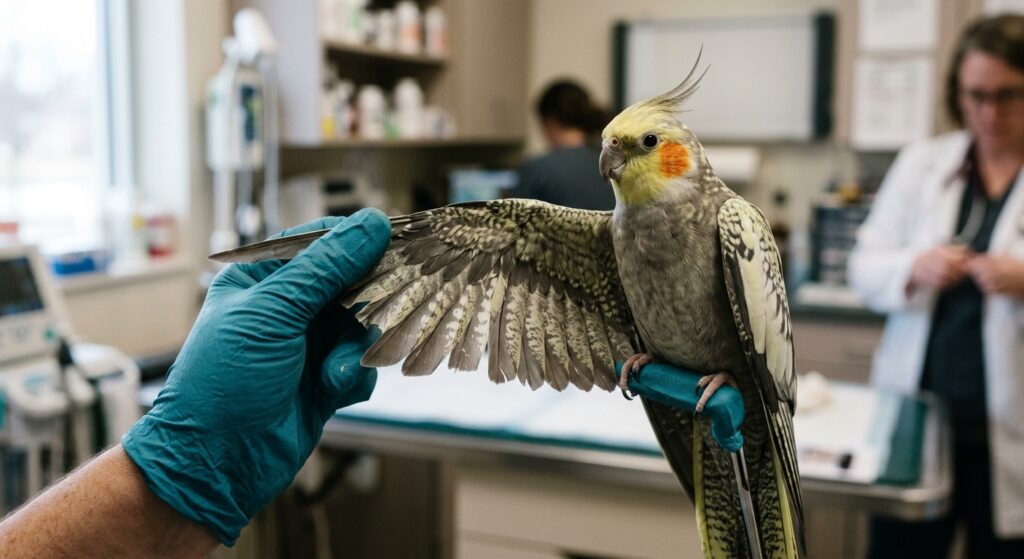
The Physical Procedure
A wing clip is the trimming of flight feathers — normally the primaries, the long outermost feathers that generate lift and thrust. The feather shaft is cut below the level of the covert feathers with scissors or shears. A mature feather is dead keratin, so cutting it is not painful in itself. A blood feather — one still growing, still supplied with blood at the base — is a different matter entirely, and the single most common injury associated with clipping comes from cutting one. Clipped feathers are not permanent; they are shed and replaced at the bird's next molt, which is why clipping is a recurring decision rather than a one-time one.
That much is not controversial. Almost everything after it is.
Five People, Five Definitions
Across roughly 80 shows, we have heard "my bird is clipped" used to mean wildly different things. When a parrot owner, a breeder, a wildlife biologist and a rescue intake coordinator all use the same word for different procedures, the argument that follows is usually not about ethics at all — it is about vocabulary.
The variables that change what a clip actually does:
- How many primaries are cut on each wing
- How far up the shaft the cut is made
- Whether both wings are trimmed, or only one
- Whether the outermost two primaries are left intact for appearance
- Whether the clip is matched to the bird's body weight, species and flight style, or done to a fixed formula
| Approach | Typical trim | Effect on flight | Common concern raised on air |
|---|---|---|---|
| Light / graduated | A few outer primaries, shortened | Lift reduced; bird can still glide and descend under control | Bird may regain lift quickly as it builds strength |
| Moderate | More primaries trimmed, both wings evenly | Sustained or climbing flight largely prevented | Needs re-checking as feathers molt in unevenly |
| Severe | All primaries cut short, close to the coverts | Lift essentially eliminated; bird drops | Hard landings, keel and chest injuries |
| Single-wing | One wing only | Asymmetrical — bird spins or veers | Widely criticised by our guests as unbalanced and unsafe |
| Cosmetic | Outer two primaries left long, inner ones cut | Flight reduced but wing looks "normal" folded | Long outer feathers unsupported and prone to breaking |
Why This Has to Be Settled First
When one guest defends clipping, they are often picturing the first row of that table. When another condemns it, they are often picturing the third or fourth. Both can be entirely consistent and still appear to be shouting past each other on tape. Before you weigh any of the arguments in the rest of this article, decide which clip the speaker is actually describing.
If you cannot say how many feathers were cut, how short, and whether both wings were done, you do not yet know whether your bird is "clipped" in any meaningful sense.
The Safety Case: Ceiling Fans, Open Doors, and the Window Pane Argument
The Hazards Guests Name Most Often
When a breeder or a long-time pet-bird keeper argues for clipping on our show, the reasoning almost always starts with the house itself rather than with the bird. A home is not an aviary. It has moving parts, reflective surfaces, and doors operated by people who are not thinking about a parrot at that moment. The list we hear repeated across shows is short and consistent:
- The unlatched or propped-open door. Groceries, a delivery, a child letting the dog out — a flighted bird on a shoulder can be outside before anyone registers the movement.
- Ceiling fans. A startled bird gaining altitude in a room with a fan running is the scenario keepers describe most vividly.
- Window panes and mirrors. A bird flying full speed at what looks like open sky can hit hard enough to cause serious injury.
- Open water and hot surfaces. Toilets, sinks, pots on a stove, and uncovered cookware come up regularly from guests who keep birds in kitchens.
- Ordinary household traffic. Other pets, slamming doors, and people who do not know a bird is out of the cage.
What Clipping Actually Changes — and What It Doesn't
The honest version of this argument is narrower than "clipping keeps birds safe." Clipping reduces sustained, powered, altitude-gaining flight. It does not remove the bird from the room or the hazard from the home.
| Hazard | Does clipping reduce the risk? | What it does not solve |
|---|---|---|
| Escape through an open door | Partially — less distance covered | A draft or wind gust can still carry a clipped bird away |
| Ceiling fan strike | Yes, if the bird cannot gain height | A bird on a high perch can still glide into the blade path |
| Window or mirror collision | Yes, speed is reduced | Low-level impacts still happen |
| Pots, sinks, open water | Minimally | The bird is still at floor and counter level |
| Falls and hard landings | No — increases the risk | Clipped birds crash-land; keel and beak injuries follow |
The Counterargument We Always Raise
The point we return to on air is the one that undercuts the escape argument most directly: a clipped bird outdoors is not a grounded bird. Wind does not care about trimmed primaries. A startled parrot that would barely clear the sofa indoors can be lifted over a rooftop by a gust, and unlike a fully flighted bird, it has no reliable way to turn, climb, or come back down where it chose. Keepers who have lost clipped birds describe exactly that sequence.
The second counterargument is injury. Trading flight for a hard landing is still a trade, and the vet bill lands in the same household either way.
Treat clipping as one layer of risk management, never as a substitute for closed doors, covered windows, and a ceiling fan that stays off whenever the bird is out.
The Free-Flight Trainers' Objection: Flight as Muscle, Balance, and Confidence
Trainers who work with birds in open-air performance settings come at this question from a different direction than the safety argument. They are not asking how to keep a bird out of trouble inside a house. They are asking what a bird's body and brain need in order to function the way the species evolved to function — and their answer is that flight is not a switch that turns on at fledging. It is a skill built through repetition.
Flight as physical conditioning
Yvonne Patterson Burbach, the owner and trainer behind the Wings of Love bird shows and a regular guest on our programs, works with flighted birds that perform outdoors in front of audiences. In that environment, a bird that cannot sustain controlled flight simply cannot do the job. The conditioning argument that free-flight trainers make runs roughly like this:
- Flight loads the pectoral muscles, the keel, and the cardiovascular system in a way that climbing and flapping on a perch does not replicate.
- A bird that never flies does not develop the stamina to recover altitude after a drop or a gust.
- Body condition and weight management become harder to read when a bird has no flight output to measure against.
- Landing is its own muscular skill — braking, flaring, and absorbing impact on the feet and legs.
Landing, spatial judgment, and the learning window
The second half of the objection is cognitive rather than muscular. Trainers argue that a fledgling learns distance, lift, drag, and stopping points by failing at them repeatedly in a safe space — clumsy landings, short hops, overshoots, corrections. A bird clipped before that process finishes never banks the experience.
| What trainers say develops with flight | What they say happens when it doesn't |
|---|---|
| Braking and flare on approach | Hard, uncontrolled landings on the chest or keel |
| Judging gaps, perch height, and distance | Misjudged launches and crash landings |
| Recovery from a startle or a missed grab | Panicked, directionless flight when feathers regrow |
| Confidence in leaving and returning to a perch | Reluctance to move independently at all |
The "learned ability" claim
This is the sharpest version of the objection and the one that generates the most disagreement on air: that flight is a learned ability, not an automatic one, and that a bird denied the chance to develop it may never fly well even after a full molt restores the feathers. The consequence trainers point to is a bird with adult-sized wings and a fledgling's skill set — arguably more at risk in the house than a bird that learned to fly properly in the first place.
If you are considering a clip on a young bird, understand that the free-flight position is not about aesthetics — it is the claim that the window for learning to land safely closes, and a later molt does not reopen it.
What Rescues Tell Us They See Walk Through the Door
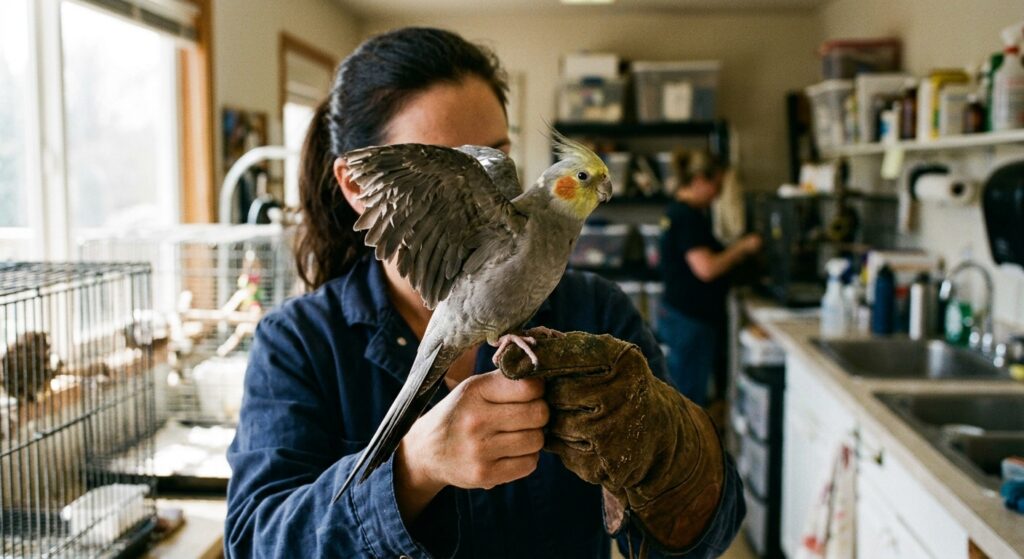
The Pattern Rescue Guests Describe
When we have had rescue operators on the show — Ginger's Parrot Rescue among them — the conversation about clipping rarely starts with philosophy. It starts with the bird standing in the carrier at intake. The stories that come up again and again follow a recognizable arc: a bird was clipped, often more aggressively than the owner expected, and the household relationship changed afterward.
The specific outcomes rescue folks tell us they see:
- Crash landings and keel injuries. A bird that steps off a cage top expecting lift and gets none hits the floor chest-first. Repeated hard landings leave a bruised or damaged keel.
- Birds surrendered after a bad clip. The owner describes a bird that "changed" — less willing to come out, less interactive, more likely to bite — and concludes the bird is no longer a fit for the home.
- Feather-destructive behavior. Chewing at the cut shafts is sometimes where it starts; the pattern can broaden from there.
- Fear of hands. The clip itself may have involved toweling, restraint, or a struggle. Afterward, the bird reads an approaching hand as the start of that experience.
- Dependence that looks like tameness. A bird that cannot leave is not the same as a bird that chooses to stay, and new adopters are sometimes surprised when flight returns and behavior shifts with it.
Why This Is a Selected Population
We say this on the air every time the topic comes up: rescues are not seeing a random sample of clipped birds. They are seeing the ones where something went wrong badly enough that a home gave up. The thousands of clipped birds living uneventfully in ordinary households do not pass through an intake room, and no one calls a rescue to report that nothing happened.
That does not make the intake stories false. It makes them evidence of what a poor clip can produce, not a measure of how often it does.
| What you're hearing | What it can tell you | What it can't tell you |
|---|---|---|
| Rescue intake accounts | The failure modes of a bad clip | How common those failures are overall |
| Free-flight trainers' results | What a conditioned flighted bird can do | How a typical pet home will fare |
| "My bird's been clipped for years, fine" | One bird, one clipper, one home | Whether the technique generalizes |
Rescues Clip Too — and Say So
The part that surprises listeners is that the same organizations describing clip-related injuries will sometimes clip an intake bird themselves. The reasoning they give us is short-term and situational: an unknown bird in an unfamiliar building, with volunteers moving through doors, needs to not be airborne on day one. That is a containment decision with a defined end point, not a permanent husbandry position.
If you take one thing from the rescue perspective, take the failure modes — not a head count — and ask whether your own clipping plan has an end point the way a rescue's intake clip does.
Where the Camps Quietly Agree: Species, Body Type, and the Individual Bird
Across roughly 80 shows since 2015, the arguments on this topic have been loud and genuinely opposed. But when we listen back, the disagreement narrows considerably once a guest is asked about a specific bird instead of birds in general. Almost nobody on either side defends a blanket rule.
Body Type Changes the Math
The first thing nearly every guest raises — trainers, breeders, avian care professionals, and rescue volunteers alike — is that a wing is attached to a body, and bodies differ enormously.
A heavy-bodied bird carries more weight per inch of wing. Guests who clip and guests who don't both tend to agree that removing flight feathers from that kind of bird changes a controlled glide into a drop. A slender, long-winged, high-energy flyer has a different problem: it is built to move, and guests describe those birds as the ones most likely to show frustration behaviors when movement is taken away.
| Bird profile | How guests describe flight | Most-cited concern when clipped | Where guests tend to converge |
|---|---|---|---|
| Heavy-bodied (Amazons, greys, cockatoos) | Short bursts, limited glide | Hard landings, keel and leg injury | Minimal trim at most; weight management matters more |
| Slender high-energy flyers (cockatiels, conures, macaws) | Sustained, fast, directional | Loss of an outlet for energy; screaming, feather damage | Keep flight where the home can be made safe |
| Small birds in open rooms | Fast, hard to recall | Collisions; escapes through doors | Environment changes before feather changes |
| Nervous or newly rehomed birds | Startle-driven, panicked | Flight into windows or walls during fright | Time and stability first, decisions second |
The Rehomed Bird Is Its Own Category
Rescue guests return to this point more than any other: a bird that has just changed homes is not showing you its normal behavior. It is startling at new sounds, mapping an unfamiliar room, and often grieving a person it will never see again. Trainers who otherwise argue strongly for full flight have told us they slow down with these birds, and clip advocates have told us the same thing in reverse.
What guests across both camps have suggested watching before deciding anything:
- How the bird reacts to a dropped object or a sudden entry into the room
- Whether it can land where it aims, or only where it lands
- Whether it is eating and sleeping on a predictable schedule
- How much of the house it actually has access to
- Whether the people in the home agree on door and window habits
The Individual Overrides the Category
Yvonne Patterson Burbach, who trains the birds in the Wings of Love shows, works with animals conditioned over time for controlled flight — a situation most listeners do not have. That gap is the real source of the disagreement. The principle underneath it, though, is shared: you assess the bird in front of you, in the home it actually lives in.
The guest who tells you to clip every bird and the guest who tells you to clip none are both skipping the step that matters most — looking hard at this particular bird, its body, and its household.
Questions to Ask Before You Decide, and How to Keep Listening
Start With the House, Not the Bird
Almost every guest who has talked us through this decision, whichever side they land on, starts in the same place: the room the bird actually lives in. Before you book a trim or commit to full flight, work through these honestly.
- Who else lives here? Toddlers, elderly relatives, roommates who don't own the bird, dogs, cats. A household where only one adult comes and goes is a different risk picture than a house with five people and a screen door.
- Can everyone hold door and window discipline, every single time? Not you on a good day — the teenager carrying groceries, the delivery driver, the visiting in-law. One lapse is the whole argument.
- Is recall training realistic for your schedule? Flight as a management strategy only works if someone is doing the training. Be honest about whether you have the time, the indoor space, and the consistency to teach and maintain a reliable recall.
- Who would do the trim, and how much? "A clip" is not a standard service. Ask the specific person what they remove, how many feathers, whether they leave the outermost primaries, and whether they will let the bird keep enough lift to glide down instead of dropping.
- What is your plan for the molt? Feathers grow back unevenly. Decide now whether you are committing to a repeating decision or using one trim as a bridge while you build other systems.
Matching the Answer to the Household
| Your situation | What guests tend to point toward | The thing to shore up first |
|---|---|---|
| Busy entryway, multiple people, no training time | A conservative trim, not a severe one | Written door rules everyone follows |
| Committed trainer, controlled room, time daily | Full flight with recall work | Window coverings and fan discipline |
| New rescue bird, history unknown | Wait and observe before changing anything | Cage setup and routine |
| Heavy-bodied species that drops rather than glides | Caution with any trim at all | Landing surfaces and floor hazards |
Keep Listening Around the Question
Wing clipping is rarely the real problem by itself. A bird that has nowhere good to perch, or that screams because nothing in the day is predictable, will not be fixed by feathers one way or the other. Our archive includes shows on cage setup, on screaming and what drives it, and on rescue adoption and what newly placed birds need in their first weeks — all of that is context for this decision, not a side topic.
Bird Talk Radio streams 24/7/365 at birdtalkradio.com. Our guests — professional bird keepers, wildlife biologists, trainers like Yvonne Patterson Burbach of Wings of Love, and rescue organizations — do not agree with each other, and that is the point. Listen to several before you decide.
The most common mistake we hear described is treating the trim as the decision itself, when the real decision is what systems you are willing to maintain in your home afterward.