By the time your bird looks sick, it has probably been sick for a while. That's the point our guests — professional bird keepers, wildlife biologists, and rescue organizations — have made again and again across the shows we've produced since 2015. Birds mask illness. Owners see it late.
Which means the search for a qualified avian veterinarian usually starts on a Saturday night, with a bird on the bottom of the cage and a phone in hand.
This is that same search, done early. Not veterinary advice — just what we've heard on the air. The goal is simple: a name, a number, and a chart on file in your bird's first week home.
Why Our Guests Keep Repeating the Same Warning
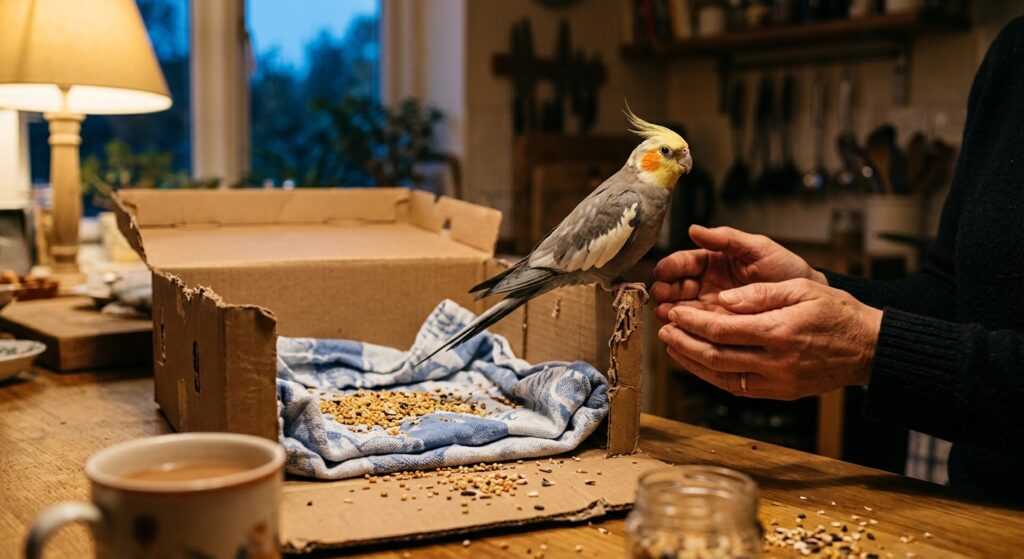
A Bird's Biology Works Against You
Across roughly 80 shows recorded in our Kansas City studio since 2015, we have had professional bird keepers, wildlife biologists, and rescue and sanctuary operators in the guest chair. They come from different corners of aviculture and they disagree about plenty. The one point they return to almost without fail is this: parrots and other pet birds are prey animals, and prey animals hide illness.
In the wild, an obviously sick bird is the one a predator selects from the flock. A bird that keeps perching normally, keeps eating in front of the group, and keeps its feathers tight has a better chance of not being singled out. That instinct does not switch off in a living room. Your bird is still running the same software, and it will spend real energy looking fine for you.
The practical consequence is uncomfortable: by the time a bird looks sick to its owner, it has often been unwell for a while and can no longer keep up the performance.
What You Actually See — And What It Can Mean
Most of the early signals our guests describe are not dramatic. They are small deviations from that particular bird's normal.
| What you notice | Why it gets dismissed | Why it may matter |
|---|---|---|
| Sitting lower on the perch, fluffed | "He's just cozy" | Effort to conserve heat and energy |
| Quieter, less talking or singing | "She's mellowing out" | Reduced energy or discomfort |
| Changes in droppings | Not looked at closely | One of the few things a bird can't mask |
| Eating less, or picking at food | "Bored with the mix" | Weight loss can be hidden under feathers |
| Sleeping more during the day | "Bad night" | General decline |
None of these is a diagnosis. They are reasons to call someone who knows birds — and that only works if you already have someone to call.
Why That Makes the Vet a Husbandry Item
Owners tend to file "avian vet" alongside insurance and jumper cables: a thing you sort out when something goes wrong. The biology argues for filing it alongside diet, cage setup, and training instead — part of routine husbandry, handled while nothing is wrong.
The reasons are practical:
- A baseline exists. A vet who has examined your bird healthy has weights, notes, and bloodwork to compare against later.
- You're already a client. Many practices prioritize established patients, and you are not explaining your species over the phone during a crisis.
- You've done the driving once. You know the route, the hours, and the after-hours arrangement before you need them.
- Small changes get triaged. You'll actually call about a subtle sign instead of waiting to see if it becomes obvious.
Do not build your bird-care plan around noticing symptoms early, because the whole point of prey-species behavior is that you probably won't — build it around having a relationship with an avian vet before there is anything to report.
What "Avian Vet" Actually Means: Specialists, Exotics Practices, and General Clinics
Not every clinic that will see a bird is a clinic that regularly treats birds. The word "avian" gets used loosely on websites and phone greetings, and the difference between the three common situations below is the difference between a diagnosis and a guess.
The three tiers you will actually encounter
Board-certified avian practitioners. These veterinarians have completed additional training and examination in avian practice through the American Board of Veterinary Practitioners. They are the smallest group and, in much of the country, the hardest to reach without driving. If you live near one, that clinic is your baseline.
Exotics practices. These clinics see birds, reptiles, and small mammals as a routine part of the schedule. The veterinarian may not carry a specialty credential, but the caseload is real, the staff knows how to restrain a parrot without injuring it, and the equipment on site was bought with small patients in mind.
General small-animal clinics that accept birds. Dogs and cats are the business. A bird is an occasional appointment. Some of these veterinarians are genuinely good with birds and keep current; others will do their best with limited exposure and limited tools.
| Board-certified avian | Exotics practice | General clinic seeing birds | |
|---|---|---|---|
| Bird caseload | High and continuous | Regular | Occasional |
| Handling experience | Extensive | Routine | Varies widely |
| Bird-scaled equipment | Expected | Usually on hand | Often not |
| In-house avian bloodwork | Common | Sometimes | Usually sent out |
| Availability | Limited, may require travel | Moderate | Widely available |
| Best role for you | Primary or referral | Primary for most owners | Stabilize and refer |
Why the distinction changes the diagnosis
Birds mask illness, so the exam has to extract information the bird is actively hiding. That depends on things a low-caseload clinic may not have:
- Gram stains and cytology read on site, so a crop or fecal sample gives an answer during the visit rather than days later.
- Blood draw technique and volume math for a small patient — the safe draw from a cockatiel is not a scaled-down version of a cat draw.
- Radiographs positioned and read for avian anatomy, including air sacs, which look like nothing a dog-and-cat practice reads daily.
- Species-specific reference ranges for interpreting results, since normal for an African grey is not normal for an Amazon.
- Familiarity with diet-driven disease, which comes up constantly in the nutrition conversations we host on the show.
How to sort clinics before you call
Ask what percentage of appointments are birds, whether a Gram stain can be run in-house, and how many of your species the clinic sees in a typical month. Vague answers are answers. A clinic that says "we'll take a look and refer you if needed" is being honest, and that is worth knowing before the bird is sick.
A general practice that treats your bird once a year is not a substitute for an avian or exotics clinic — it is a stopgap, and you should know which one you have before an emergency forces the question.
Where to Start Looking: Rescues, Breeders, and Bird Clubs as Referral Networks
A search engine will give you a list of clinics. It won't tell you which of those clinics has a vet who can restrain a frightened Moluccan without breaking a blood feather, or who returns calls at 9pm when a hen goes egg-bound. The people who already know that live in your local bird community, and most of them will tell you for free.
Rescues and Sanctuaries Know Who Takes the Hard Cases
Parrot rescues and sanctuaries run on thin budgets and see birds arrive in rough shape — malnourished, feather-destructive, sometimes with old untreated injuries. That means they have a working relationship with at least one avian practice, and they know which one gives them straight answers. In the shows we've recorded with rescue organizations, the same theme comes up: their vet relationship is operational infrastructure, not a convenience.
If you adopted through a rescue, ask before you leave with the bird. If you haven't adopted yet, this is one more question to add to the list in our post on adopting from a rescue.
Breeders, Clubs, and Trainers Each See a Different Slice
Not every referral source is equally useful for every question. Here's how they differ:
| Referral source | What they see most | Best for | Watch for |
|---|---|---|---|
| Rescues and sanctuaries | Neglect, malnutrition, chronic conditions | Vets willing to handle complicated, low-budget cases | May only know one clinic well |
| Breeders who quarantine properly | Incoming disease testing, chick issues | Vets who run PBFD, psittacosis, and polyomavirus panels routinely | Breeders who don't quarantine won't have a testing vet |
| Bird clubs and avicultural societies | The widest range of species and owners | Cross-checking a name across many owners | Opinions vary; look for repeated names |
| Free-flight and bird-show trainers | Athletic, high-condition birds, injuries | Vets comfortable with soft-tissue and orthopedic work | Fewer of them locally |
Trainers are the most overlooked group here. Our recurring guest Yvonne Patterson Burbach of Wings of Love works with birds performing physically demanding routines — that kind of program depends on a vet who understands condition, weight management, and injury, not just sick-bird triage.
The Questions Worth Asking
When you get a name, ask the person who gave it to you:
- How long have you used this vet, and how many birds have you taken there?
- Have they handled an emergency for you, and how did that go after hours?
- Do they run their own diagnostics, or send everything out?
- Which species do they see most?
- Have you ever had a bad experience there?
A breeder who quarantines properly — the practice we cover in our post on quarantining a new bird — will usually answer question three immediately, because they've paid for those panels repeatedly.
One enthusiastic recommendation from a single person is a lead, not an answer — wait until you hear the same clinic name from three unrelated sources before you commit to it.
Questions to Ask Before You Book the First Appointment
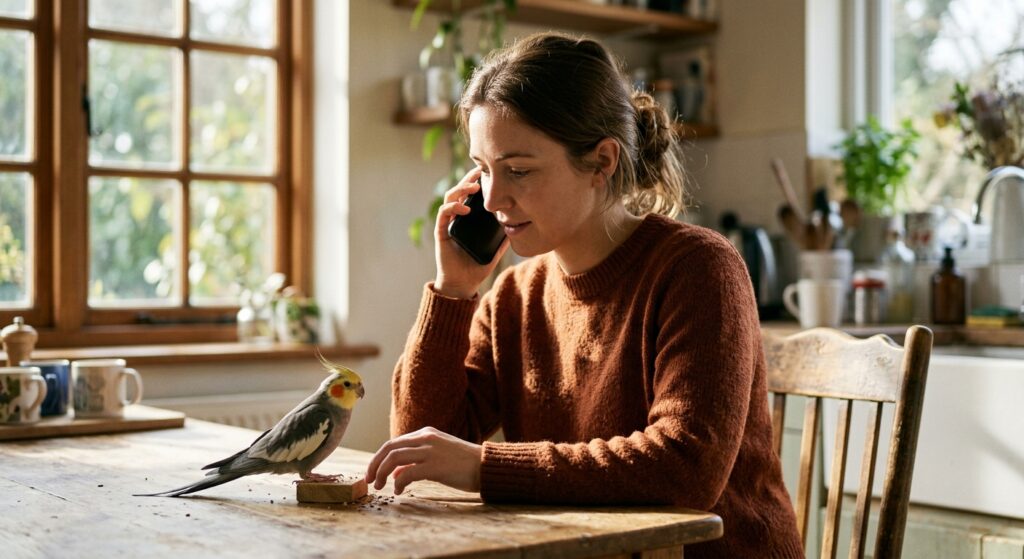
The point of this call is not to be difficult. It is to find out, in five minutes, whether this practice can actually handle your bird before you are sitting in a parking lot with a fluffed, silent parrot in a carrier.
Start With Species and Caseload
Ask the receptionist to connect you with a technician or the doctor if possible, then work through the basics:
- Which vets here see birds, and do they see my species? A clinic comfortable with cockatiels and budgies may not be set up for a Moluccan cockatoo or a macaw with a serious bite reach.
- How many bird appointments does that vet see in a typical week? You are listening for a real number, not "we see everything."
- Do you do wellness exams on healthy birds? A practice that only sees birds in crisis has less baseline experience reading a normal one.
- Who handles restraint — the doctor or a trained tech? Ask how they towel and how long they keep a bird restrained.
- What is the wait for a routine new-patient appointment versus a sick bird?
Diagnostics You Want Under One Roof
Turnaround time is everything with birds. Send-out labs can take days, and a bird that is visibly ill has often been sick for weeks already. Ask specifically what happens in-house versus what leaves the building.
| Capability | Why it matters | What to ask |
|---|---|---|
| Gram stain | Fast read on crop and cloacal flora | "Can you run and read a gram stain during my visit?" |
| CBC and chemistry | Baseline organ and immune picture | "In-house or send-out, and what's the turnaround?" |
| Radiographs | Air sacs, GI, egg binding, fractures | "Do you have digital x-ray, and who reads it?" |
| Anesthesia | Needed for imaging and many procedures | "What agent do you use, and do you monitor under gas?" |
| Cultures and PCR panels | Infectious disease workup | "Which lab, and how many days?" |
| Fluids and heat support | Stabilizing a collapsing bird | "Do you have an incubator or heated cage?" |
Emergencies, Boarding, and Referrals
Ask whether they hospitalize birds overnight and whether someone is physically present, or whether patients are left unattended after closing. Ask if they board birds — some avian practices do, and it tells you they have appropriate caging and food on hand. Then ask the two questions people skip: who covers after-hours and weekend emergencies, and which specialist or teaching hospital they refer to for surgery, endoscopy, or complex cases. A vet with an honest referral relationship is a good sign, not a weak one.
Finally: "If I walk in with a bird that is on the cage floor and barely responsive, what happens in the first ten minutes?" You want to hear about oxygen, heat, and stabilization before handling — not a request to schedule an appointment.
If a clinic cannot tell you who sees birds, how fast bloodwork comes back, and what they do with a critical bird on arrival, keep calling — those three answers separate a real avian practice from one that simply accepts birds.
Nailing Down After-Hours Coverage Before You Need It
Most avian practices keep ordinary business hours. Birds do not. A hen goes egg-bound on Saturday night, a parrot gets a toe caught in a toy on Thanksgiving, a cockatiel comes off the cage bottom fluffed and quiet at 11 p.m. — and the number you have been calling for two years rings into a voicemail greeting. The time to solve that is at your first well-bird visit, not in the car.
Ask These Four Questions at the Front Desk
Do not settle for "we have an answering service." Get specifics, and write the answers down while you are still standing there:
- Who actually takes the call after hours? A doctor from this practice, a rotating on-call vet, or a paging service that only relays messages the next morning?
- Which emergency hospital do you refer to? Ask for the name, not just a direction. Then ask the second half of the question that people forget: does that hospital see birds, and is anyone on their overnight staff comfortable handling them? Plenty of 24-hour emergency hospitals are dogs and cats only, or will take a bird in and stabilize it without any avian experience on the floor.
- How far is the drive, at night, from my house? Look it up yourself rather than trusting a guess.
- Will you send records or take a call from that hospital? Continuity matters when someone unfamiliar with your bird is making decisions at 2 a.m.
Map Your Coverage on Paper
Once you have answers, lay them out so the gaps are obvious.
| Situation | Who to call | Sees birds? | Drive time |
|---|---|---|---|
| Weekday, business hours | Your regular avian vet | Yes | |
| Weeknight / after close | On-call line or referral hospital | Confirm | |
| Weekend | Confirm | ||
| Major holiday | Confirm |
If a row comes back blank or "not sure," that is your homework. Bird clubs and rescues in your area usually know which emergency hospital actually handles birds well, because their members have already been through it. This is the same referral network worth tapping when you were choosing a regular vet in the first place.
Post It Where Anyone Can Find It
The person home alone with the bird may not be you. A spouse, a teenager, a house sitter, or a neighbor watering plants needs to act without hunting through your phone.
- Tape a printed card to the front of the cage or the inside of a nearby cabinet door.
- Include clinic names, phone numbers, street addresses, and hours — addresses matter when someone is navigating in a hurry.
- Add your bird's species, approximate age, weight, and current diet.
- Put the same card in a carrier bag by the door, along with a towel.
The most common failure we hear about is not choosing the wrong hospital — it is discovering at midnight that the 24-hour clinic ten minutes away does not treat birds at all.
The Well-Bird Visit: What to Bring and What to Have Recorded
Getting There Safely
A well-bird visit starts before you leave the house. Use a carrier your bird cannot chew out of, with a low perch or a towel-padded floor rather than a swinging perch that turns the trip into a wrestling match. Cover the carrier partway to cut visual stress, keep the car temperature moderate, and skip the open-cage-in-the-back-seat approach entirely — the exam room door opens, and an unrestrained bird is a lost bird. Pull food and water dishes for the drive, but bring familiar food with you so the bird can eat while you wait.
The Paperwork and Samples Your Vet Actually Wants
Most of what makes a first appointment productive is information you gather at home, not anything the clinic can generate on the spot. Bring:
- A fresh dropping sample. Line the cage floor with wax paper or a clean plastic sheet the morning of the visit and collect droppings from the last few hours, kept cool and sealed.
- A current weight in grams. A gram scale with a perch is one of the most useful things a bird owner can own. Weigh at the same time each day, ideally in the morning before the first meal.
- A written diet summary. Brand and type of pellet or seed, the actual fresh foods offered, what the bird eats versus what gets flung, treats, and any supplements.
- Cage and environment details. Cage dimensions, perch materials, toys, substrate, where the cage sits, lighting, and any candles, cookware, or air fresheners used in the home.
- Acquisition and quarantine history. Where the bird came from, when, whether it was quarantined from other birds, and any prior testing or vet records.
- Band or microchip numbers. Photograph the band rather than relying on memory — many are hard to read on a moving bird.
- Behavior notes. Sleep schedule, vocalizing, plucking or chewing, changes in temperament, molting, and for hens, any egg-laying history.
Why the Baseline Chart Is the Whole Point
None of this is busywork. What you walk out with is a baseline: a documented normal weight, a normal dropping, a normal exam, and a diet and housing record your vet can reference later. When a bird is sick, it hides it — that is the point our guests come back to over and over. A three-gram drop means nothing without a baseline and means a great deal with one.
| What you have on file | What it lets the vet do in an emergency |
|---|---|
| Baseline weight and weight trend | Judge severity fast instead of guessing |
| Diet and supplement record | Rule in or out nutritional causes |
| Cage and household details | Identify fume, toxin, or hazard exposure |
| Quarantine and acquisition history | Assess infectious disease risk |
| Band or microchip number | Confirm identity, aid recovery if lost |
Pair that chart with a stocked first aid kit and the carrier already assembled, and an emergency becomes a drive rather than a scramble.
The single most common mistake is showing up with a bird and no numbers — without a baseline weight from your own gram scale, your vet is working blind on the day it matters most.