A bigger cage is a purchase. An outdoor flight is a structure, and the questions it raises have almost nothing in common with the indoor cage setups we've covered elsewhere on the site.
Over roughly a decade of shows produced from our Kansas City studio, the breeders, wildlife biologists, and bird keepers who join Mike Kiger keep returning to the same structural points: how long a flight has to be before it's actually a flight, what wire survives a parrot beak, where shade comes from at two in the afternoon, what comes sniffing at night, and where the water goes.
This is design discussion, not a build permit. Your local codes and your climate decide the final shape.
Why an Outdoor Flight Is a Different Build Than a Bigger Cage
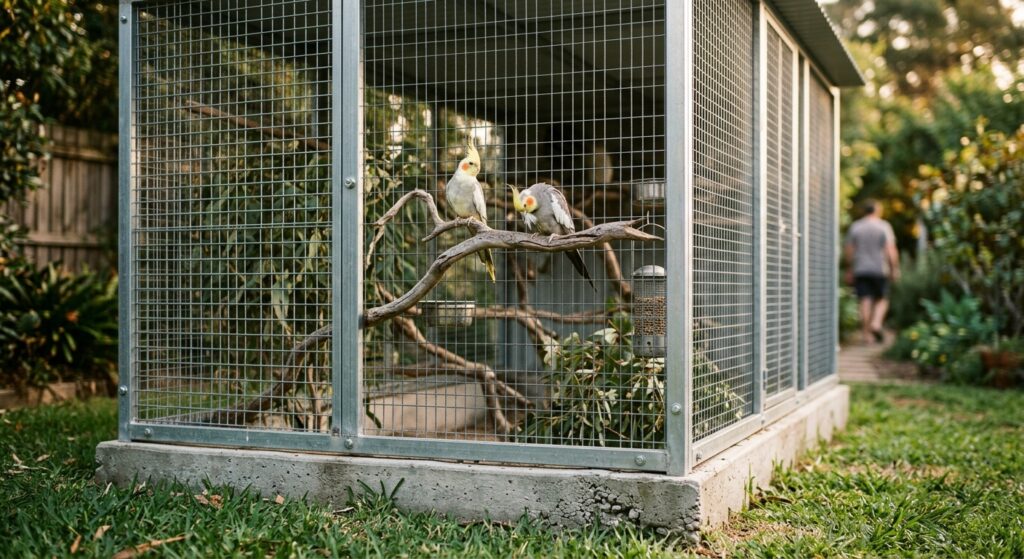
Indoors, the house does most of the work. The walls hold a temperature range, the roof handles the rain, the floor is sealed and sweepable, and the only animals with access are the ones you let in. A cage inside that envelope is really just a perch-and-feed arrangement. Move the same structure into the yard and the cage itself becomes the envelope — it has to handle weather, soil, wildlife, predators, and the people who live next door, all at once.
The House Was Doing More Than You Think
Once a structure leaves the building, every variable you used to ignore becomes a design decision:
- Sun and shade. A flight needs shaded sections birds can retreat to, and that shade has to work in the afternoon, not just at noon.
- Wind and driven rain. Rain rarely falls straight down. Solid panels on the prevailing-weather side matter more than total roof area.
- Temperature swings. Overnight lows and daytime highs in the same 24 hours are a real load on birds that have only known a climate-controlled room.
- Snow and ice. Roof loading and drainage become structural questions, not housekeeping questions.
Ground Contact Changes the Whole Equation
A cage sits on a floor. An aviary sits on dirt, and dirt is alive. Soil holds moisture against framing, it hosts parasites and bacteria that cycle through droppings, and it gives rodents and digging predators a route in underneath the walls. That is why footings, buried wire skirts, and a substrate plan show up in nearly every serious outdoor flight conversation — and why none of it ever comes up when you are setting up a cage in a spare bedroom.
Where Our Cage Setup Advice Stops Applying
| Design point | Indoor cage | Outdoor aviary |
|---|---|---|
| Climate | Handled by the house | Handled by roof, windbreaks, shelter section |
| Floor | Sealed, wiped down | Soil, gravel, or slab — needs a cleaning and drainage plan |
| Wire | Bar spacing for the bird | Spacing for the bird and mesh fine enough to exclude wild birds and rodents |
| Threats | Household pets you control | Hawks, raccoons, snakes, cats, rodents — none of which you control |
| Access | Open the door | Double-door safety porch |
| Materials | Powder-coated, indoor-rated | UV, moisture, and rust exposure year-round |
| Neighbors | Not a factor | Noise, sightlines, setbacks, and local ordinances |
Wild birds deserve their own line on that list. They land on the roof, drop waste through open mesh, and compete for spilled feed, which is how disease crosses from outside to inside a flight. A single layer of wide wire does not stop that.
And then there is the human side. A flight of conures at sunrise carries a lot farther in open air than it does through drywall. Neighbor relations and zoning are part of the build, not an afterthought.
Do not scale up an indoor cage design and set it on the lawn — an outdoor aviary is a weatherproof, predator-proof, wildlife-proof structure that happens to hold birds, and it needs to be engineered that way from the footings up.
Flight Length First: Sizing the Aviary Around How the Bird Actually Moves
One Long Run Beats a Bigger Square
The question breeders ask on our shows is almost never "how many square feet?" It's "how far can the bird go before it has to turn?" Square footage counts corners, and corners are where a bird brakes. A flight that measures the same in both directions gives a bird a handful of wingbeats and then a wall. The same area stretched into one long, uninterrupted run gives the bird a takeoff, a cruise, and a controlled landing — the three parts of flight that actually build muscle and keep weight in check.
That's why the first number to settle is the longest clear dimension, and the second is how clear it really is. A run that's interrupted by a divider, a service door that swings inward, a feeding station, or a thick branch at mid-height is not one long flight. It's two short ones.
Protect the long axis by keeping it free of:
- Perches mounted anywhere except the two ends
- Hanging toys, swings, or foraging rigs in the middle third
- Safety-porch walls or shift doors cutting across the run
- Support posts, misting lines, or feed hoppers inside the flight envelope
Species Size and Wing Loading Move the Target
Heavier birds with higher wing loading need more distance to get up and more distance to stop. A small, light, maneuverable bird can change direction in tight space without slamming a wingtip. A large bird carrying more weight per square inch of wing commits to a line and needs room to shed speed. Fast, direct fliers burn the run; climbers and clamberers use it less.
| Bird type | Flight style | What drives the long dimension |
|---|---|---|
| Finches, canaries, small softbills | Short darting hops, frequent direction change | Enough run to avoid constant braking; width matters more than usual |
| Budgies, cockatiels, small conures | Fast, direct, repetitive laps | Longest practical run — these birds will use every foot |
| Amazons, African greys, medium cockatoos | Powerful but shorter bursts, heavier landings | Takeoff and braking distance at both ends |
| Macaws and large cockatoos | High wing loading, long committed glides | The longest run you can afford; clearance for full wingspan on turns |
Height Adds Comfort, Not Flapping Distance
A tall flight gives birds vertical escape room, a place to roost above human eye level, and headroom for planting. What it does not give them is sustained flapping. Birds climb in a tall aviary; they don't cruise. Height also tends to push cost into structure — taller posts, more framing, harder netting and cleaning — money that usually buys more conditioning if it goes into length instead.
If you have to choose between a taller aviary and a longer one, choose longer, because height stores birds while length exercises them.
Wire Gauge, Mesh Spacing, and What Parrot Beaks Do to Cheap Panels
Beak Strength, Not Body Size, Sets the Gauge
One of the most consistent points breeders raise on our shows is that a bird's length tells you very little about what its beak can do to wire. A cockatiel and a caique are not far apart in body size, but they do not test a panel the same way. The question builders ask is how much leverage the bird can generate and how persistent it is about working one spot.
| Beak pressure group | Typical wire gauge specified | Mesh opening commonly used |
|---|---|---|
| Budgies, cockatiels, small conures | 16 gauge | 1/2" x 1" |
| Amazons, African greys, Eclectus, large conures | 14 gauge | 1" x 1/2" or 1" x 1" |
| Macaws, large cockatoos | 12 gauge or heavier | 1" x 1" |
Lower gauge numbers mean thicker wire. Where a species sits in the chart matters less than observing the individual bird: a determined chewer in a mixed flight will set the specification for everyone in it.
Welded Versus Woven, and How Each One Fails
Welded mesh holds its shape and resists a beak working a single intersection. Woven or chicken wire flexes, and a parrot that can twist one strand can usually unwind the next one. The more serious objection guests raise to woven wire is what happens when it breaks: loose ends create cut hazards and toe traps. Welded panels fail differently — a weld pops and the opening widens — which is easier to spot during a weekly walk-around.
Galvanizing, Zinc, and What Ends Up in the Mouth
Parrots climb aviary walls with their beaks, so coating is not a cosmetic decision.
- Galvanized after welding has heavier zinc coverage but leaves beads, drips, and rough spots that birds pick at.
- Galvanized before welding is smoother, though the weld points themselves carry less protection and rust first.
- Stainless steel removes the zinc question entirely and costs considerably more.
- New galvanized wire is routinely scrubbed with a wire brush and vinegar, then rinsed and weathered before birds go in.
Zinc ingestion is a real concern with heavy chewers, which is why builders keeping macaws and cockatoos tend to accept the stainless price rather than inspect panels for flaking every season.
Opening Size Carries Half the Load
Heavy gauge with the wrong opening is still a failed panel. Openings large enough for a bird to push its head through invite entrapment, and openings large enough for a raccoon paw or a snake defeat the purpose of building outdoors at all. Tight spacing also keeps wild birds and rodents out of feed stations, which is where most disease exposure starts.
Buy wire for the strongest beak and the smallest head in the flight, because a panel that satisfies only one of those two numbers will eventually cost you a bird.
Shade, Shelter, and Sun: Building a Thermal Range Into the Enclosure
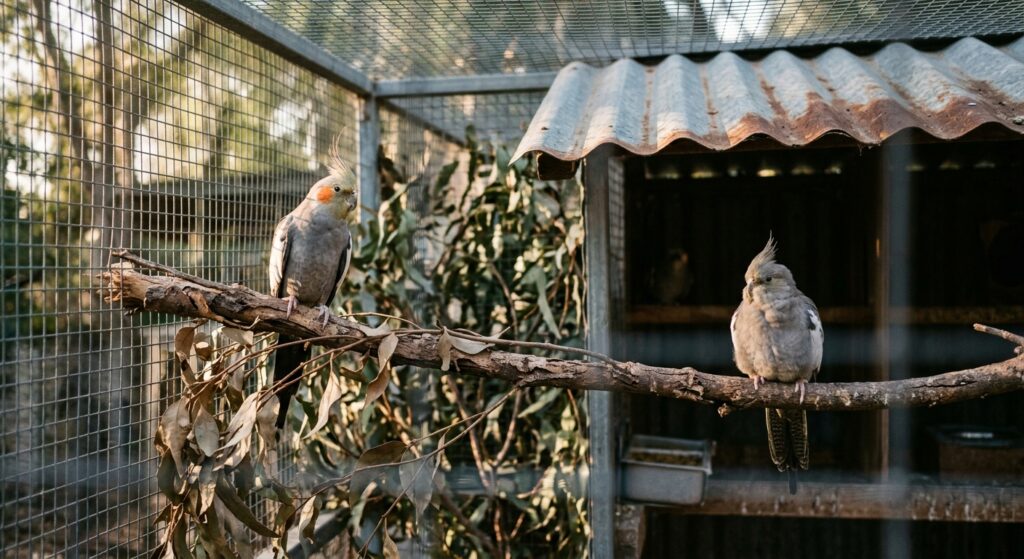
The single most repeated point from the breeders who have come on the show is that an outdoor flight should not be one uniform environment. It should be several environments stacked into one footprint, so the bird moves to the conditions it wants instead of enduring the conditions you built.
Let the Bird Choose Its Own Microclimate
Sunlight matters — unfiltered natural light is one of the main reasons to put birds outside in the first place — but it only works when escape from it is three wingbeats away. Guests describe laying out the flight so that at any hour of the day, a bird can find:
- Direct, unscreened sun for basking and preening
- Dappled or filtered light under shade cloth or foliage
- Full shade with overhead cover
- A wind-sheltered corner with a solid wall at its back
- A dry perch that stays dry in blowing rain, not just vertical rain
If a bird is panting, holding its wings away from its body, or sitting pressed into a single corner all afternoon, the range is too narrow. That behavior is the design feedback.
Roofing and Solid Walls Against the Prevailing Wind
A common build is a partly roofed flight: solid covered section at one end, open mesh over the rest. The covered end is where food, water, and the primary night perches go, because it keeps droppings out of dishes and keeps the roost dry. Solid walls go on the prevailing wind side and on whichever side takes the harshest afternoon sun — in most of the country, that is the west. Mesh stays on the sides that give the bird sightlines and airflow.
Comparing Overhead Cover
| Cover type | Rain protection | Heat reduction | Main caution |
|---|---|---|---|
| Solid roof panel over one end | Full | High in shade, can radiate heat if dark and low | Needs enough pitch to shed water away from the flight |
| Shade cloth over part of the run | None | Moderate, filtered light | Must be tensioned and edge-secured so it cannot sag or fray into a snag |
| Deciduous tree canopy overhead | Partial | Seasonal — shade in summer, light in winter | Falling limbs, and it drops predator cover right above the flight |
| Adjacent building wall | None overhead | Blocks low sun from one direction | Can trap heat and block airflow if it closes off two sides |
Natural Shade Has to Be Vetted
Planted shade is attractive and it works, but breeder guests are consistent that every plant in or near the flight gets checked for toxicity before it goes in, and that vines are kept off the mesh where they give a climbing predator a ladder and hide chew damage from view. Shade that you cannot see through is shade you cannot inspect.
Build the shaded, wind-blocked section first and the open sun second — a bird can survive a shortage of sun far longer than it can survive a flight with nowhere to get out of the afternoon heat.
Predator-Proofing: Double Doors, Skirting, and the Night-Time Threats
Across the shows we've recorded since 2015, breeder and sanctuary guests return to the same point: an outdoor flight is not just a cage in the yard, it is a structure sitting inside a local food web. The birds are visible, audible, and awake at dawn. Something will come to look.
Know Which Predator You're Building Against
Different animals get in different ways, and the fix for one does nothing for another. Guests have named raccoons, snakes, rats, hawks, and loose or household dogs as the recurring offenders.
| Predator | How it gets in | Structural answer |
|---|---|---|
| Raccoon | Hands through mesh, opens latches, works seams | Small mesh plus double-wire standoff, locking hardware not slide bolts |
| Snake | Through any gap wider than its head, often at ground seams | Fine mesh at the base, sealed wire-to-frame joints |
| Rat | Digs under the footprint, chews feed stations | Buried wire or a wide surface apron, sealed feed storage |
| Hawk | Strikes from above, panics birds into wire | Solid roof sections over perching and feeding zones |
| Dog | Hits panels at speed, digs at corners | Strong framing, perimeter apron, no bird perching within reach of the wall |
Double Doors and the Ground Seam
Two details do most of the work. The first is a double-entry safety porch: a small vestibule with an outer and inner door, so the bird is never one latch away from open sky and nothing follows you in while your hands are full. The second is wire skirting — the aviary floor line extended outward or downward so a digging animal hits mesh instead of soil.
Practical points guests keep repeating:
- Make the porch big enough to close the outer door fully before touching the inner one.
- Never have both doors swing on the same self-closing spring.
- Bury skirting or lay it flat as an apron and pin it; a loose edge is a ramp, not a barrier.
- Fasten wire to framing with screws and washers, not staples that raccoons can peel.
- Keep feed inside sealed containers, away from the flight, so you aren't baiting the perimeter.
Standoffs, Solid Roof, and the Night Shelter
A double-wire standoff — an outer barrier set a few inches off the main mesh — stops the classic injury where a raccoon reaches through and a curious bird comes to the wire. Solid roof panels over the sheltered end give cover from hawks overhead and keep droppings out of the flight below.
Finally, breeders who have lost birds tend to adopt the same habit: a night-time lockdown shelter. Birds are called or trained into an enclosed, solid-walled night room at dusk and shut in. The flight can be mesh; the sleeping quarters should not be.
Most predator losses we hear described on the show happened through a gap the builder already knew about and meant to fix later.
Drainage, Flooring, and Keeping the Aviary Sanitary Year-Round
Everything that makes an outdoor flight good for a bird — open air, sun, weather, insects, space — also makes it harder to keep clean than an indoor cage. The floor is where that problem concentrates. Droppings, dropped fruit, seed hulls, rainwater, and anything a wild bird leaves behind all end up on the same surface, and whatever surface you choose decides the cleaning routine you are signing up for.
Slope Before Substrate
The decision that matters most is made before any material goes down: the aviary pad should shed water, not hold it. A gentle slope away from the shelter end, with the ground around the structure graded so runoff moves away rather than pooling at the footings, prevents the standing water that turns a floor sour. Flat pads in low spots stay wet for days after rain, and wet floors are where bacteria, fungus, and biting insects set up.
Keep the feeding stations under cover and off the ground. Dropped food on a wet floor is the single biggest draw for rodents, roaches, and wild birds, and wild-bird traffic is the main route for parasites and disease pressure into an outdoor flight. Covered feeding, prompt pickup of discarded produce, and solid roofing over the perch cluster do more for sanitation than any disinfectant.
Comparing Floor Materials
| Floor | Drainage | Cleaning method | Commits you to | Main weakness |
|---|---|---|---|---|
| Sealed concrete | Needs built-in slope and a drain | Scrape, hose, disinfect, squeegee dry | Frequent hosing; fast and total cleanup | Hard surface, no give; cost and permanence |
| Gravel over base | Excellent if the base drains | Rake out solids, flush periodically, replace layer | Periodic gravel replacement | Fines clog over time and trap organics |
| Natural earth | Variable; depends on soil | Rake, spot-remove, rotate or replace topsoil | Ongoing soil turnover and parasite monitoring | Hardest to disinfect; holds parasite load |
| Sand over drainage layer | Good when kept dry | Sift like a litter box | Daily sifting | Compacts and sours if it gets wet |
The Routine You Are Signing Up For
Pick the floor that matches the cleaning schedule you will actually keep:
- Daily: remove dropped and spoiled food, especially fresh produce in warm weather.
- Weekly: scrape or rake solids off the whole floor, not just under the perches.
- Monthly: check for low spots holding water after rain and correct the grade.
- Seasonally: disinfect hard surfaces, replace or turn loose substrate, and have fecal checks run if the birds are on earth.
Earth floors are the most natural and the most work, because the parasite load you cannot see is the one you have to test for rather than scrub away.
A floor that cannot be fully dried out or fully replaced will eventually hold a disease load you cannot clean off, so choose the substrate by how you will sanitize it, not by how it looks on day one.