A macaw screams three feet from your guest's microphone, the rescue's phone line rings mid-answer, and the breeder is talking to you from an aviary with forty birds in it. That is a normal recording day here, and it is why a bird interview is not like any other interview.
Since 2015, Mike Kiger has hosted, engineered, and produced roughly 80 pre-recorded live bird talk shows from a Kansas City studio, and built birdtalkradio.com to carry them.
Here's our room, our gear philosophy, how we prep and record guests remotely, how we edit, and how episodes reach the 24/7 stream — written for aviculturists and rescues starting a show, and for anyone who wants to sound good as a guest.
Why We Record "Pre-Recorded Live" Instead of Going Live
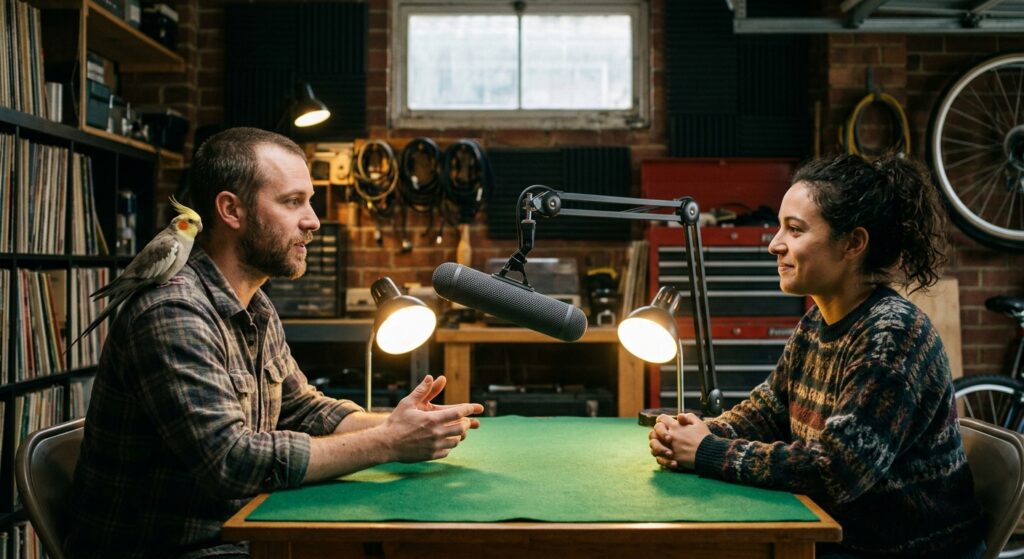
We run each show as one continuous conversation. The guest and host talk straight through, the way they would on a live broadcast, with no stopping to re-do answers or re-frame questions. The difference is what happens next: the file goes into production before it goes out to listeners. Across roughly 80 shows recorded since 2015, that single decision has done more to protect the quality of the finished program than any other choice we've made.
Scheduling Guests Instead of Chasing Them
Aviculture experts are not sitting by the phone. Bird keepers, wildlife biologists, rescue operators, and trainers like Yvonne Patterson Burbach of Wings of Love work around show seasons, breeding schedules, and daylight hours in whatever time zone they live in. A fixed live slot asks all of them to bend to our clock. Recording lets us take the hour when the guest actually has it — early morning, late evening, or a weekday afternoon — and still release the show on a schedule that suits listeners.
Birds Interrupt, and That's Fine
Anyone who has interviewed a parrot owner in their own home knows how this goes. A macaw decides the conversation needs backup vocals. A phone rings. A guest loses their thread and asks to start the answer again. On a live feed, all of that is permanent.
Here is what recording lets us recover from without ever stopping the conversation:
- A bird screaming over the guest's best explanation of a diet change
- A guest coughing, sneezing, or stepping away for thirty seconds
- Background noise from an aviary, a doorbell, or a household
- A misspoken name, date, or species that deserves a clean correction
- Long dead air while a guest looks something up
What the Two Formats Actually Trade
| Consideration | True live | Pre-recorded live |
|---|---|---|
| Guest scheduling | Guest must match the broadcast slot | Booked whenever the guest is free, any time zone |
| Bird or household interruptions | Broadcast as-is | Trimmed in production |
| Audio levels between host and guest | Fixed at whatever the connection gives you | Balanced before release |
| Guest nerves | High — no second chances | Lower, because the guest knows we'll clean it up |
| Real-time listener calls | Possible | Not part of our format |
| Consistency across 80 episodes | Varies by broadcast day | Held to one standard |
The trade we accept is losing live call-ins. What we get back is a catalog where episode 12 sounds like episode 78.
The point of pre-recorded live is to keep the conversation unbroken while removing the accidents — if you start stopping and restarting the interview, you lose the natural flow that made the format worth choosing.
Inside the Kansas City Room: Treating a Space That Was Never a Studio
The Room Fights You Before the Microphone Does
A spare room in a Kansas City house is not built for audio. Drywall, a window, a hard floor, and a flat ceiling all reflect sound back at the microphone, and what returns is a thin slapback that makes a voice sound like it was recorded in a hallway. Add the furnace or air conditioning cycling on mid-answer, and a good interview picks up a low hum that no amount of post-processing removes cleanly.
We treat the room as the first piece of gear. Before spending anything on hardware, sit in the chair you will actually record in, clap once, and listen. If you hear a ring or a flutter after the clap, that is what your guest's voice is landing on top of.
The Fixes That Actually Change the Recording
| Problem | What you hear in playback | Low-cost fix |
|---|---|---|
| Bare walls and hard floor | Hollow, echoey voice | Blankets, a rug, a bookshelf full of books behind you |
| Window glass | Sharp reflections, street noise | Heavy curtain closed during recording |
| HVAC running | Steady low hum under the whole show | Turn the system off for the recording block |
| Computer fan | Whirring that rises during long sessions | Move the machine off the desk or out of the room |
| Bird room activity | Contact calls, seed cracking, cage bar noise | Schedule around the flock and mic tightly |
Microphone Placement and the Bird in the Corner
Most bird people are recording in a room that also houses birds. That is a real constraint, not a hypothetical one. A dynamic microphone placed close to your mouth is far more forgiving than a sensitive condenser set back on a boom, because closeness lets you record at a lower gain and everything behind you drops away.
A few placement habits that carry the most weight:
- Get within a fist's distance of the mic and stay there for the whole session.
- Speak across the capsule rather than straight into it to control plosives.
- Aim the back of the microphone toward the cages, since that is where a cardioid pattern rejects the most.
- Record a minute of room silence at the start of every session so you have a noise profile to work from.
- Keep the mic off the desk surface on a stand or arm so typing and bumps do not travel up into it.
The single biggest gain in a home bird room is not a better microphone but getting your mouth closer to the one you already own.
The Signal Chain: Microphone, Interface, and Monitoring Choices That Hold Up Over Years of Shows
A Microphone That Ignores the Room
Our Kansas City studio is a working room, not a purpose-built broadcast booth, so the first job of the host microphone is rejection. A cardioid dynamic sitting close to the mouth hears the voice and very little else — the furnace cycling, the chair, the reflections off the far wall. A large-diaphragm condenser will sound more open and detailed, but it also picks up everything we spent time trying to tame.
| Mic choice | Room pickup | Works close (2–4 in.) | Plosive/handling risk | Where it fits our shows |
|---|---|---|---|---|
| Cardioid dynamic | Low | Yes, and rewards it | Low with a pop filter | Our default host mic |
| Large-diaphragm condenser | High | Yes, but reflections follow | Higher, needs shockmount | Only in the quietest sessions |
| Headset mic | Low | Fixed distance, consistent | Low | Useful when a guest can't hold position |
Pattern matters as much as capsule type. Cardioid keeps the null pointed behind the mic, so we aim the back of the capsule at the noisiest wall and let physics do work that no plugin can undo later.
Gain Staging Into the Interface
Getting level right at the interface is cheaper than fixing it in the edit. Our routine before every show:
- Set the mic distance first, then the gain — never the reverse.
- Speak at show volume, not test volume, since guests get louder once the conversation warms up.
- Aim for peaks well below clipping and leave headroom for a laugh or a raised voice.
- Confirm the interface, not the software, is doing the analog gain work.
- Re-check after any mic or chair adjustment.
A dynamic mic often needs more gain than a budget preamp can give quietly, which is why the interface is the piece we would not economize on.
Closed-Back Monitoring and Local Tracks
Open-back headphones leak, and that leak lands right back in a cardioid capsule two inches from the mouth — echo on the guest's return feed and a smeared host track. Closed-back headphones, worn at a conservative level, solve it.
We also record a separate local track wherever possible. Across roughly 80 shows, connection quality has been the single most variable factor we do not control. A locally captured file on each end is immune to dropouts, codec artifacts, and bandwidth dips, and it's the reason a great conversation with a bird keeper or wildlife biologist survives a bad internet day.
If you only change one thing, record a local track on both ends — no amount of good microphone technique can rebuild audio that never made it across the connection.
Recording Guests Who Are Standing Next to a Macaw
The Pre-Call Sound Check
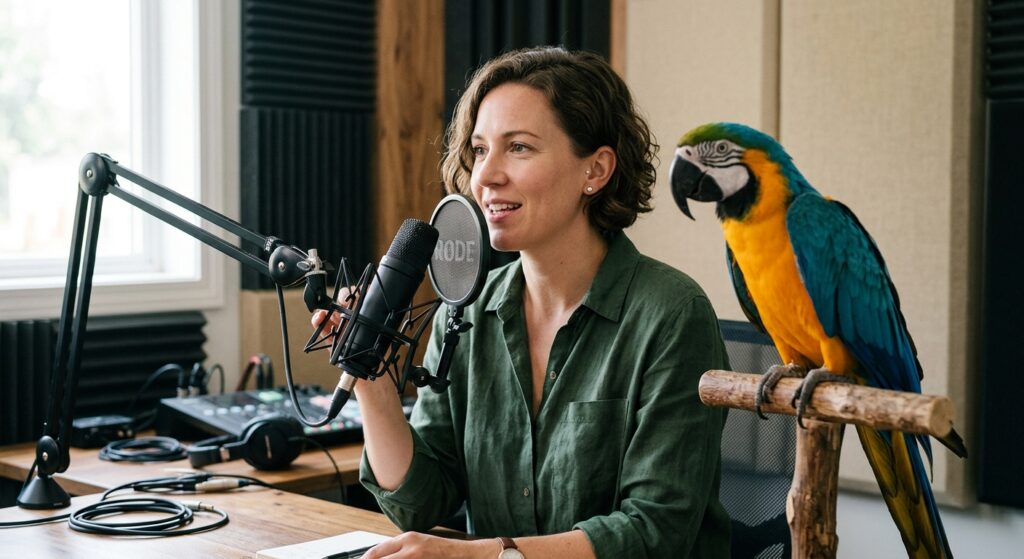
Almost every guest we book — professional bird keepers, wildlife biologists, rescue and sanctuary staff, and trainers like Yvonne Patterson Burbach of Wings of Love — is sitting in a room with birds in it. That is the point. We are not trying to record a sterile room; we are trying to record a person who works with parrots every day. But we do want to know what the room sounds like before we start rolling.
Our pre-call check runs the same way every time:
- Guest connects five to ten minutes early, on the device they will actually use for the show.
- They talk normally for thirty seconds while we listen for room echo, hum, and background birds.
- They move the mic or headset until their voice sits clearly above the room.
- We ask who else is in the room — species, cage location, distance from the mic.
- We agree on what happens if a bird gets loud mid-answer.
Headsets, Laptops, and Speakerphones
The device choice matters more than anything else the guest can control, because a mic close to the mouth simply hears less of the room.
| Guest setup | Bird noise pickup | Room echo | Echo/feedback risk | How editable |
|---|---|---|---|---|
| Wired headset mic | Lowest — voice dominates | Low | Low | Easy |
| Laptop built-in mic | High — picks up the whole room | High | Moderate | Difficult |
| Phone held to the ear | Low to moderate | Low | Low | Usually fine |
| Phone on speakerphone | Highest | Highest | High | Often unusable |
Speakerphone is the one we ask guests to avoid outright. It opens the mic to the entire room, adds its own hollow quality, and can loop our audio back into the recording.
When a Bird Screams Mid-Answer
It will happen. A macaw contact call over a guest's sentence is not a mistake, it is content — but only if the guest handles it right. We ask guests not to apologize. An apology stops the answer cold and reads as embarrassment. Instead, we ask them to name the bird: species, name, and what the call means. The interruption becomes a teaching moment, and it gives us a clean edit point either way.
The quieter sounds are the ones guests never think about. Contour feather rustle from a bird on the shoulder sits right on top of the voice. Beak-on-cage-bars rings metallic and cuts through compression. A bird climbing bars behind a laptop mic can be louder than the guest.
If a guest has a bird on their shoulder, ask them to move it to a perch a few feet away before recording — feather rustle against a mic is the one noise no amount of editing will separate from the voice.
Booking and Briefing Experts: How We Prepare Trainers, Breeders, and Rescues
The Pre-Show Call Comes Before the Outline
Every guest gets a conversation before a microphone is ever opened. That call is not the interview and we say so plainly — we are listening for what the person actually knows firsthand, which is almost never the same thing as what their bio says. A breeder who was pitched to us as a "hand-feeding expert" may turn out to have twenty years of practical experience on incubation humidity and very little interest in weaning protocols. We would rather find that out on the phone than fifteen minutes into a recording.
Out of that call we build a pre-show outline: four to six topic areas in the order we plan to walk through them, with a note under each about the specific story or example the guest already told us. The outline goes to the guest before the session. The point is not to rehearse — it is so nobody is surprised by a question.
The Topics We Return To Across Shows
After roughly 80 shows, certain subjects come back constantly because listeners keep asking about them. We prepare each one differently depending on who is sitting across from us.
| Topic area | What we ask the guest to bring | Where it usually goes wrong |
|---|---|---|
| Diet and nutrition | Specific species, specific foods, what they feed and why | Guests generalize across all parrots instead of naming a species |
| Training and behavior | One bird, one behavior, start to finish | Abstract theory with no example the listener can copy |
| Rescue and intake | What actually arrives at the door and in what condition | Emotional appeals that skip the practical intake steps |
| Breeding and husbandry | Setup details, timelines, record-keeping | Advice that assumes the listener already owns a flight cage |
Yvonne Patterson Burbach of Wings of Love is a recurring guest for exactly this reason. She trains and performs with her birds, so training questions get answered with a bird she has personally worked, not a principle from a book. Returning guests also let us pick up a thread from an earlier show instead of starting over at the basics.
Briefing a First-Time Guest
For someone who has never done a talk show, we cover five things:
- There is no script, and reading one will sound like reading one.
- Answer as if talking to one person, not an audience.
- Say the species name out loud — listeners keep birds we may not name for them.
- Restarting a sentence is fine; we can edit.
- Tell us before we record if any topic is off-limits.
The pre-show call is where you find out whether a guest can talk about their subject conversationally, and skipping it means discovering the answer while you are already recording.
Post-Production: Editing an Hour of Bird Talk Into a Publishable Episode
The First Pass: Cutting Silence Without Cutting the Conversation
Our editing pass starts with the parts nobody misses. A guest reaching for a water glass, the pause after a question that landed wrong, the two seconds where a trainer walks across the room to quiet a bird — all of that comes out. What stays is the rhythm of two people actually talking about aviculture.
The temptation, especially on a pre-recorded show, is to tighten everything until it sounds like a scripted read. We don't. When a breeder pauses to think about a diet question, that pause is information: it tells the listener the answer is considered rather than rehearsed. We cut dead air, not thought.
Crosstalk gets the same judgment. If we talked over a guest and buried a useful sentence, we edit to recover the sentence. If we talked over each other because the conversation got enthusiastic, that usually stays.
Leveling Two Sources That Never Matched to Begin With
The host mic in the Kansas City room and a guest calling in from a bird room are never going to arrive at the same level or tone. We handle them as two separate tracks before we touch anything else:
- Level each speaker on its own so neither one makes the listener reach for the volume knob.
- Match perceived loudness between the two, not just peak level — a bright guest line can measure the same and still sound louder.
- Roll off what the guest's room added that carries no speech, then re-check against the host track.
- Set the finished episode to a consistent loudness across the catalog, since shows stream back to back 24/7/365.
Which Bird Noise Earns Its Place
This is a bird show. Scrubbing every squawk out would be dishonest and, frankly, less interesting.
| Sound | Decision | Reason |
|---|---|---|
| A contact call under a sentence | Keep | It's atmosphere, and it's the point of the program |
| A scream that buries the answer | Cut or tighten | Content loss outweighs charm |
| Wing flap, beak on cage bar | Keep | Adds room and reality |
| Continuous flock noise across a full answer | Reduce | Fatigues the listener over an hour |
Intro, Outro, and Crediting the Guest Properly
The last step is the wrapper: the show open, the close, and a clear spoken credit for the guest — who they are, what they do, and where their work can be found. When Yvonne Patterson Burbach joins us to talk about the Wings of Love bird shows, that credit is part of the episode, not an afterthought.
Never edit out a bird's voice just because it interrupted a clean take — the listener came for aviculture, and the sound of a real bird room is credibility you cannot add in post.
From Finished File to 24/7 Rotation: Publishing, Streaming, and Archiving
Naming and Tagging Before Anything Gets Uploaded
An episode is not finished when the edit is done — it is finished when it can be found again. Every master leaves the Kansas City studio with a filename that tells us what it is without opening it: show number, guest surname, and topic keyword. That single habit is what makes a catalog of roughly 80 shows searchable years later instead of a folder of numbered exports.
From there, each file gets:
- Embedded metadata — show title, guest name, episode number, and Bird Talk Radio as the program, so the information travels with the file into any player.
- Show notes written while the interview is still fresh, naming the guest, their organization, and the specific subjects covered — diet, training, housing, rescue work.
- A topic tag set that lets a listener searching for macaw nutrition or free-flight training land on the right episode rather than scrolling a list.
Three Destinations for One Recording
The same edited episode serves three different jobs, and each one wants a slightly different treatment.
| Destination | What it is for | What we send |
|---|---|---|
| Continuous stream | 24/7/365 rotation on birdtalkradio.com | Level-matched broadcast copy so one show doesn't jump in volume against the next |
| Podcast catalog | On-demand listening and subscription | Tagged episode file with full show notes |
| Studio archive | Re-edits, clips, future reference | Untouched master plus the edit session |
The archive copy is the one people skip, and it is the one that saves you. Masters are kept in their original recorded form, separate from the published versions, so a show can be re-exported or re-cut without going back to a compressed file that has already been processed once.
Why an Aviculture Library Keeps Working
Bird talk ages well. A conversation with a professional trainer about reading body language, or with a wildlife biologist about wild parrot behavior, is as useful to a first-time cockatiel owner today as it was the week it was recorded. Interviews recorded years ago with guests like Yvonne Patterson Burbach of Wings of Love still earn listeners because the subject matter — diet, enrichment, training, rescue — does not expire.
That evergreen quality is exactly why the stream runs around the clock rather than on a schedule. For how to actually tune in and move between the live stream and the on-demand catalog, see our listening guide.
Archive the untouched master separately from every published copy, because the day you need to re-cut an interview is the day you discover a compressed upload is all you kept.