Your bird's cage looks fine to you. It probably is fine — but the same handful of setup problems come up in nearly every conversation we record.
Since 2015, Mike Kiger has hosted, engineered and produced roughly 80 pre-recorded live shows from a Kansas City studio, talking with professional bird keepers, wildlife biologists, rescue operators and trainers like Yvonne Patterson Burbach of Wings of Love. Different birds, different backgrounds, same complaints.
What follows is a collection of those recurring themes from guest discussions — not veterinary instruction, and not a product roundup. Most of it is fixable without buying a new cage. For the full conversations, listen to the episodes.
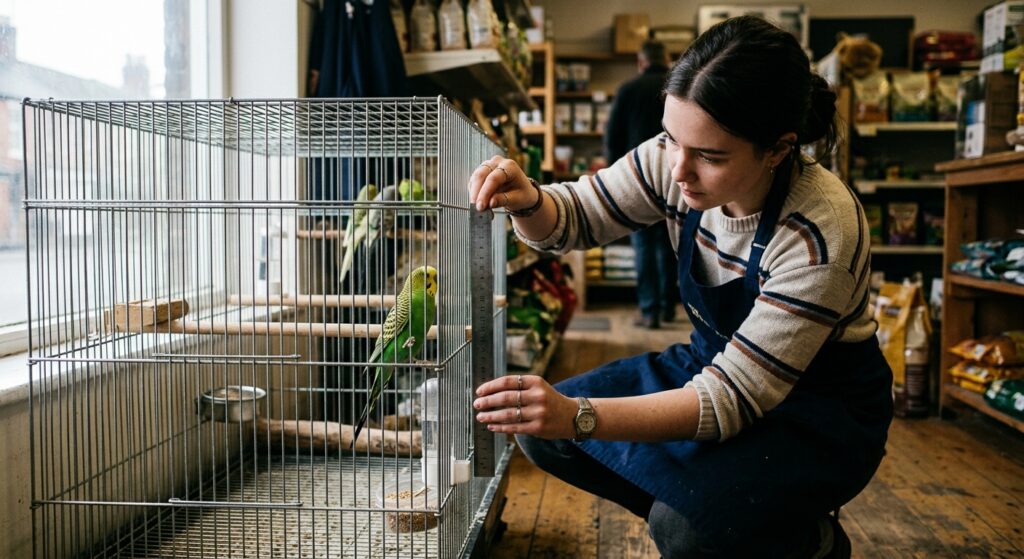
Bar Spacing: The One Measurement Guests Say Buyers Get Wrong
Why This Comes Up On Almost Every Show
When a guest is asked what buyers get wrong most often, the answer is rarely food bowls or toy placement. It is bar spacing. Cage height and width are easy to eyeball, and most people size those up generously. Spacing between the bars is the one specification that gets skipped, because it is a small number printed in a product listing rather than something you notice standing in front of the cage.
The problem is that spacing is not a comfort feature. It is a containment and safety specification, and it has to be matched to the head and body of the specific bird living in it — not to the general category of "parrot."
What Goes Wrong In Each Direction
Spacing can fail two ways, and the failure modes are completely different. Our guests describe both.
| Spacing relative to the bird | What tends to go wrong | Who it affects most |
|---|---|---|
| Too wide | Bird pushes its head through and cannot pull it back; escape; access to hazards outside the cage | Small birds — budgies, parrotlets, lovebirds, cockatiels |
| Too wide, larger bird | Beak or toes wedged between bars; leverage for bending or working bars loose | Medium parrots in a cage built for macaw-sized birds |
| Too narrow for the bird's size | Toes and nails catching; cramped climbing; heavier gauge often absent, so bars flex under a strong beak | Larger parrots placed in small-bird cages "temporarily" |
The head-through-the-bars scenario is the one that comes up with real urgency on air, because a bird that gets its head through and panics is an emergency, not an inconvenience.
"For Parrots" Is A Marketing Category, Not A Fit
A cage described as a parrot cage is telling you almost nothing. Parrots range from birds you can hold in a closed hand to birds that can bend hardware. The same label covers all of them. Before buying, work through this:
- Identify the species — and if you have a mixed-size flock, size the cage to the smallest bird in it.
- Find the manufacturer's stated bar spacing, not the reviewer's guess or the photo.
- Compare that number to guidance for your species specifically, from a source that keeps your species.
- Check bar gauge and material as a separate question — spacing and strength are not the same specification.
- Look at the door, seed skirt, and cage top separately; spacing often changes at those points on the same cage.
That last point catches people. We have heard guests describe cages with correct spacing on the main panels and wider spacing on a play top or around the door frame. The bird finds the gap long before the owner does.
Measure the spacing on the actual cage you are buying, including the door and the top, and match it to your specific species — not to the word "parrot" on the box.
Why "Dowel Perch In The Middle" Comes Up On Almost Every Episode
The Cage Comes With One Perch, And It's The Wrong One
Walk through almost any pet retailer and pull a cage off the shelf, and the accessory bag contains the same thing: one or two smooth hardwood dowels, perfectly round, identical in diameter end to end. It is cheap to manufacture, it ships flat, and it slots into the pre-drilled holes. That is the entire reason it exists.
The complaint we hear from keepers and trainers on the show is not that dowels are dangerous on their own. It is that a bird standing on a single uniform diameter holds its foot in exactly the same position, with the same pressure on the same points, for most of its waking life. Birds in the wild move constantly across branches that change thickness, angle, and surface with every step. A cage furnished with one dowel removes all of that.
What Guests Suggest Instead
The recommendations that come up repeatedly across our episodes are consistent, whatever the species:
- Vary the diameter. Perches that let the foot wrap differently — some where the toes nearly meet, some where they don't come close — spread pressure across the whole foot rather than concentrating it.
- Use natural branch. Untreated wood from bird-safe species keeps the irregular taper and knuckles that a lathe removes.
- Add texture. Bark, ridges, and slight surface irregularity give the foot something to grip instead of a polished cylinder.
- Mind the placement, not just the perch. Perches directly above food and water bowls create the soiling problem keepers then blame on the bird.
- Keep one perch the bird can rest on comfortably. Variety is the goal, not a cage where every surface is a challenge.
Comparing What Goes In The Cage
| Perch type | Foot position | Texture | Best role in the cage |
|---|---|---|---|
| Smooth dowel | Fixed, identical every time | None | Limited — replace or supplement |
| Natural branch, untreated | Changes along the length | Bark, knots, taper | Primary perching and sleeping |
| Rope perch | Flexible, foot adjusts | Soft, gripping | Movement and play areas |
| Concrete or grooming perch | Fixed, abrasive | Rough | Short segment near a bowl, never the sleeping perch |
Why This Turns Into A Health Conversation
The reason this topic keeps surfacing on air is that perching is rarely the first thing an owner asks about. They call in about a foot problem, a balance issue, or a bird that will not settle at night — and the conversation works backward to a cage furnished exactly as it shipped, years earlier. Guests who work in rescue and sanctuary settings tell us they see the same pattern in birds surrendered from long-term homes.
If your bird has spent its whole life on the dowel that came in the box, replacing that single perch with two or three of varied diameter and natural texture is the cheapest meaningful upgrade you can make to the cage.
Perch Placement, Not Perch Count: Traffic Patterns Inside The Cage
A cage is not a container you fill with accessories. It is a space the bird moves through, dozens of times a day, on a route it chooses. Most of the layout problems our guests describe are not caused by owners buying bad perches — they are caused by good perches installed without thinking about where the bird is going next.
The Three Layout Problems That Come Up Most
Across the shows we have recorded since 2015, the same three complaints surface almost every time cage setup comes up:
- Stacked perches. Two or three perches installed one directly above another. The bird on the top perch soils the bird — or the perch — below it. In a single-bird cage this means the owner is scrubbing a perch daily that never needed to get dirty.
- Perches across the door. A perch mounted directly behind or through the door opening turns every step-up into a negotiation. The bird has to be lifted over or around it, and a bird that already dislikes handling now has a physical excuse to refuse.
- Perches crowded against food and water. When a perch sits above or immediately beside a bowl, the bowl catches droppings, shed feather dust, and dropped food. Owners then describe water that has to be changed three times a day and blame the bird.
Think In Routes, Not In Parts
The useful mental exercise is to trace the path. Start where the bird sleeps at night — usually the highest comfortable spot — and walk it down to food, over to water, across to a toy, and finally to the door for step-ups. If any leg of that route puts the bird directly over a bowl, another perch, or the doorway, the layout needs to move.
| Route point | What it needs | Common mistake |
|---|---|---|
| High resting perch | Clear space beneath it | Sits above a second perch or a bowl |
| Food and water station | A perch beside it, not above it | Perch mounted overhead |
| Door approach | An open landing spot near the opening | Perch bolted across the door |
| Play and chew area | Room to turn and hang | Toys packed against the perch, blocking passage |
Give The Bird Room To Turn Around
Guests who train birds professionally return to the same point: the bird needs to be able to turn on the perch, open both wings partway, and step to the next surface without brushing anything. If a perch is so crowded with toys and neighbors that the bird can only face one direction, it will stop using that perch entirely — and the cage effectively shrinks to whatever is left.
Fewer perches placed deliberately almost always beat more perches placed wherever there was an open bar.
If a perch sits directly above a food bowl, a water bowl, or another perch, move it before you buy anything else — that one change eliminates most of the daily cleaning complaints we hear.
Cage Location: Corners, Windows, Kitchens And Household Traffic
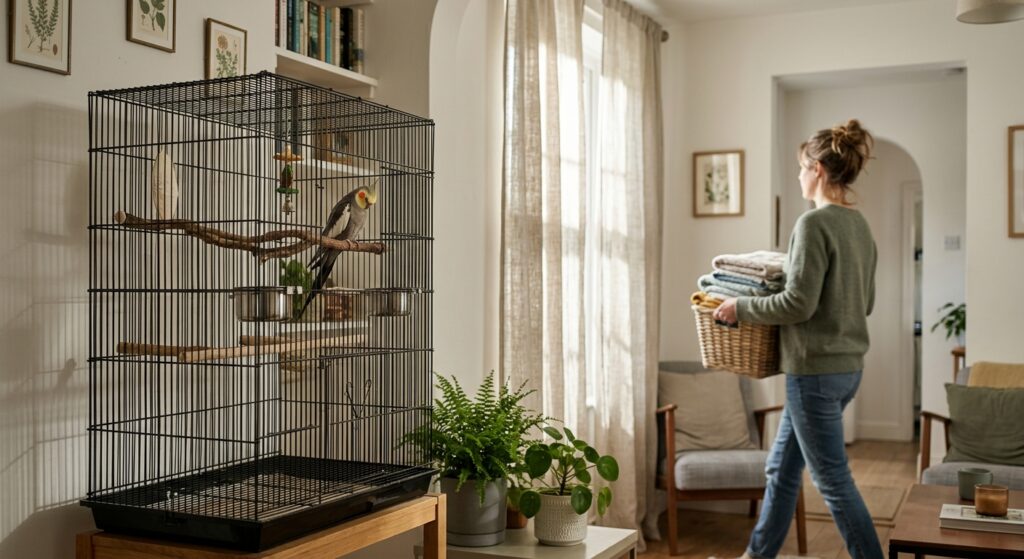
Where a cage sits gets less attention than what's inside it, but across the shows we've recorded since 2015, placement comes up in almost every conversation about screaming, feather issues, and birds that "changed" after a move. Guests who work with parrots professionally tend to talk about location before they talk about toys.
The Isolated Cage Versus The Cage In The Family's Orbit
The recurring theme from bird keepers and rescue people we've had on is the difference between a bird that can watch its household and a bird parked somewhere quiet because the noise bothered someone. Parrots are flock animals. A cage in a spare bedroom, a basement, or a back hallway removes the bird from everything it is wired to pay attention to, and guests consistently link that isolation to the behaviors owners later call problems.
The other extreme comes up too. A cage in the middle of a hallway, or directly against a walkway where people pass within inches all day, gives the bird no ability to settle. What trainers describe as the workable middle is a spot where the bird can see the family, has a solid wall or corner at its back, and can retreat visually when it wants to.
| Placement | What guests say happens |
|---|---|
| Back bedroom, door usually closed | Bird calls constantly to locate the flock; owner only visits at feeding time |
| Direct hallway traffic path | No rest, startle responses, bird never fully relaxes |
| Corner of a living room, wall behind | Bird watches the household, can turn away, gets included in normal routine |
| Directly in front of an unshaded window | Sun exposure with no shade option, plus outside triggers the bird can't escape |
Why Kitchen Proximity Keeps Coming Up
Kitchen placement seems convenient — the family is there, the bird is included — but it is the location our guests flag most often on safety grounds. The concerns that get raised repeatedly:
- Fumes from overheated non-stick cookware and self-cleaning oven cycles
- Aerosol cleaners, oven sprays, and scented products used in a closed room
- Smoke and airborne grease from cooking, which a bird's respiratory system handles poorly
- Hot surfaces, open pots, and running water within reach of a bird out of the cage
- Onion, avocado, chocolate, and other kitchen foods offered casually as scraps
Adjacent to the kitchen, with real airflow separation, is what most guests suggest instead of in it.
The Link To Screaming And Boredom
Placement and behavior are the same conversation. A bird that can't see anyone screams to find the flock, and a bird facing a blank wall with nothing to watch has nothing to do but chew itself or call. Before adding foraging toys or starting a training plan, the practical first step our guests recommend is moving the cage to where the household actually lives.
Never place a cage in the kitchen — the fumes from overheated cookware and cleaning products are a documented risk to birds that no amount of family togetherness makes up for.
Food, Water And Foraging: Setup Habits That Undo A Good Diet
Diet comes up on nearly every show we record, and the conversation almost always turns from what you feed to how it is presented. Guests who work with birds daily — trainers, rescue operators, wildlife biologists — keep landing on the same point: a good diet can be undone by where the bowls sit, how they are cleaned, and whether the bird has anything to do besides eat.
Bowl Placement And The Contamination Problem
The most common setup error our guests describe is a food or water bowl positioned directly under a perch. Birds droop droppings straight down, and a bowl in that path collects them all day. The bird then drinks and eats out of it. Owners often notice water going cloudy fast and assume the bird is dunking food, when the real cause is the perch above.
A few placement habits that come up repeatedly:
- Keep every bowl out from under a perch, not just the water dish.
- Do not put water directly beside a bowl of soft or wet food.
- Give the bird a landing spot next to each bowl so it is not forced to hang off the bars to eat.
- Check placement again after you move any perch — the traffic pattern changes and so does what is underneath.
Refilling Is Not Washing
Topping off a dish that still has yesterday's food in it is a habit that builds slowly and is hard to see. Dry seed hulls, fruit residue, and pellet dust collect in the bottom of the bowl while the visible surface looks clean. Guests who run sanctuaries and rescues are blunt about this: bowls come out, get washed, and go back — they do not get refilled in place.
| Habit | What it looks like day to day | What guests recommend instead |
|---|---|---|
| Topping off dry food | Fresh pellets poured over old hulls | Empty, wash, dry, refill |
| Wiping the water bowl | Quick rinse, back in the cage | Wash and change at least daily |
| Leaving fresh food in | Chop or fruit sitting for hours | Remove on a set schedule |
| One bowl for everything | Water, pellets and soft food mixed | Separate dishes, separated positions |
Making The Bird Work For Food
The second half of the diet conversation is foraging. A full bowl of seed sitting in the same corner every day gives the bird no reason to do anything. Our guests describe building the work back in: food wrapped in paper, tucked into cardboard, hidden in safe toys, or spread across more than one location so the bird has to search. Foraging opportunity is a cage furnishing decision, not a toy purchase — it depends on having the space, the perch access, and the willingness to let the bird spend time on it.
If you only change one thing after this section, move every food and water bowl out from under a perch — placement undoes more good diets than ingredient choices do.
Toys, Hardware And Hazards Rescue Operators Keep Flagging
Rope, Fiber And The Toys That Outlive Their Safe Life
The single most repeated toy complaint from our rescue and rehoming guests is not the toy itself — it is the calendar. Rope, cotton and sisal toys start out fine and become dangerous as they wear. Loose fibers unravel into loops that catch a toe, wrap a leg, or get swallowed by a bird who shreds and gulps rather than shreds and drops. Guests who take in surrendered birds describe the same pattern over and over: a toy that was appropriate on the day it went in and hazardous six months later because nobody was watching it fray.
The practical response is a habit, not a purchase:
- Trim frayed rope back to tight fiber every time you do a cage clean, and retire the toy when trimming stops helping.
- Watch birds who chew fabric and fiber and swallow it — those birds are better served by wood, cardboard and paper shreddables.
- Check toe-sized loops: if a nail or toe can slip in and not slip out, cut the loop.
- Look at the toy from the bird's stance, not from outside the bars. Hanging things sit differently when a bird is on top of them.
Hardware, Clips And Cage Finishes
Hardware is where a good toy gets undone. Rescue guests flag the same fasteners repeatedly, usually because they arrived attached to a bird that came in with an injury.
| Hardware | The problem guests describe | What they use instead |
|---|---|---|
| Split keychain rings | Beaks and toes wedge into the gap | Stainless quick links with a screwed collar |
| Dog leash clips / snap hooks | Spring gate pinches; tongues and toes get caught | Quick links or nickel-free C-clamps |
| Open S-hooks | Toy drops when the hook works open | Closed, screw-shut links |
| Unknown chain plating | Chipping finish of unknown metal content | Stainless steel chain |
The same "unknown metal" caution applies to the cage itself. Chipping paint, flaking powder coat, and secondhand or antique cages with no known finish come up constantly in rehoming conversations, because a chewing parrot works on exactly the spots that are already failing. If you cannot identify what a finish is, treat it as something to remove from the bird's reach rather than something to monitor.
Clutter: When A Full Cage Becomes An Unsafe One
Enthusiastic owners hang everything at once, and the bird ends up with no clear lane to move, no place to open wings, and nowhere to land that is not occupied. Guests describe birds who fall through a maze of toys instead of stepping across it. Rotate toys; do not stack them.
When something does go wrong anyway, the response depends on what you already own. Our first aid kit article covers what to keep stocked and where, and our quarantine article covers the isolation setup you need on hand before you need it.
If you cannot identify the metal or finish on a clip, chain or cage, do not wait to find out — remove it from the bird's reach today.