You've found the bird you want, and everything in you wants to bring it home and set it beside the flock you already have. That's the moment quarantine exists for.
Since 2015 we've hosted around 80 shows with breeders, professional bird keepers, wildlife biologists, and rescue operators. They disagree on plenty. They don't disagree on this: a newly acquired bird stays fully separated from your existing birds for a set period, so anything it's carrying shows itself before it can spread.
What follows is a summary of what those guests have described on air. It isn't veterinary advice — your avian veterinarian sets the actual protocol. A new bird can look perfectly healthy and still be a risk, and your established flock is what's on the line.
What Quarantine Actually Means to a Breeder
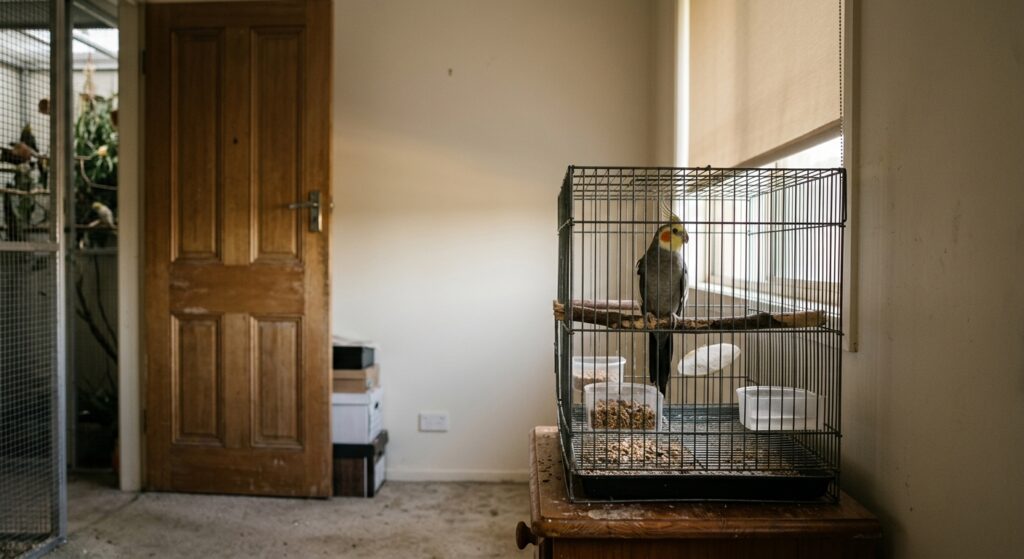
When breeders come on the show and say a bird is "in quarantine," they are not describing a cage pushed against the far wall. They mean the new bird is living in a separate room, breathing separate air, and being cared for on a separate routine — treated, for the length of the quarantine period, as if it belongs to someone else's flock entirely.
The working definition we hear most often on air comes down to four things:
- Its own room — a door that closes, not a divider or a screen.
- Its own air space — separate ventilation where possible, since many of the things breeders worry about travel as dust, dander, and aerosolized droplet.
- Its own caretaking routine — the new bird is fed, watered, and cleaned last, after the resident flock, with hand washing and ideally a change of clothes in between.
- Its own everything else — bowls, perches, toys, cleaning tools, and food scoops that never rotate back into general use until quarantine ends.
The distinction matters because "different corners of the same room" fails on every one of those points at once. It looks like separation and functions like an open cage.
| Practice | Physical barrier | Shared air | Shared equipment | Cross-contact by hands and clothing |
|---|---|---|---|---|
| Separate room quarantine | Closed door | No | No | Controlled by order of care and hand washing |
| Cages across the same room | None | Yes | Often | Constant |
| Cages side by side, covered | Cover only | Yes | Often | Constant |
There is also a behavioral half to this that breeders raise almost as often as the health half. A new bird in a quiet, low-traffic room settles faster, eats sooner, and shows you a truer baseline than one parked in the middle of an established flock's noise. That baseline is the whole point — quarantine is a period of observation, and you cannot observe a bird well when a dozen others are screaming over it.
If your new bird can hear, see, or share air with your existing birds, you are not quarantining it — you are just delaying the introduction.
Why a Bird Can Look Perfectly Healthy and Still Be a Risk
Birds are prey animals, and prey animals that advertise weakness get picked off. That instinct doesn't switch off in a living room or a breeder's flight cage. A bird carrying a low-grade infection, a parasite load, or an early respiratory problem will often sit upright, eat in front of you, and step up on cue — right up until it can't compensate anymore. By the time the feathers are fluffed and the bird is sitting on the cage floor, the problem is usually well advanced.
That masking ability is the entire reason quarantine is measured in weeks rather than days. You are not waiting for a bird to "clear" anything. You are waiting for the bird to stop hiding.
Transport and rehoming apply exactly the kind of pressure that strips away the act:
- A car or cargo trip, with noise, vibration, and temperature swings
- A new cage, new perches, and a new view out the window
- Different food, different water, different feeding times
- New people, new voices, and often new household sounds
- Loss of the flock or cagemates the bird was used to
Any one of those raises stress hormones. Stacked together over a few days, they can suppress an immune system that was holding a subclinical problem in check. That's when something that was invisible at pickup starts to show.
What that means practically is that observation is the work. Daily, boring, written-down observation:
| What to watch | What you're actually looking for |
|---|---|
| Droppings | Changes in color, volume, or consistency day over day |
| Weight | A gram scale trend, not a guess by eye |
| Breathing | Tail bobbing, clicking, open-mouth breathing at rest |
| Appetite | Food eaten versus food shredded and dropped |
| Posture and activity | Sleeping more, sitting low, reduced preening |
| Eyes and nares | Discharge, crusting, matted feathers around the face |
A single day's snapshot tells you almost nothing. A two-week or longer record of the same six items tells you whether a bird is settling in or going downhill.
Assume the new bird is hiding something until several weeks of daily observation say otherwise — a healthy-looking bird on pickup day is the normal starting point, not proof of anything.
Setting Up the Quarantine Room: Air, Distance, and Separate Everything
The single most important feature of a quarantine space is not the cage — it's the air. Feather dust, dander, and respiratory droplets travel on air currents, which is why a new bird parked across the living room from the flock is not quarantined in any meaningful sense. What you want is a room with a door that closes, its own window or exhaust, and as little shared airflow with the rest of the house as you can manage.
| Setup | Shared air with flock | Distance | Practical verdict |
|---|---|---|---|
| Separate building, garage, or outbuilding | None | Greatest | The gold standard most breeders describe |
| Spare bedroom, door closed, different floor, HVAC vent closed | Minimal | Good | Workable for most homes |
| Spare bedroom on the same forced-air system, vent open | Substantial | Moderate | Better than nothing, but air is still mixing |
| Same room, cage in another corner or a cover over the cage | Full | None | Not quarantine, regardless of the cover |
Everything the new bird touches should stay in that room for the entire quarantine period. Duplicating supplies is cheap compared to treating a flock-wide outbreak.
- Separate food and water bowls, and a separate scoop for seed or pellets
- Separate cleaning supplies — brush, bucket, spray bottle, paper towels
- Separate perches, toys, and cage papers that never rotate into the main flock
- A dedicated set of clothes or a smock left hanging inside the room
- Hand sanitizer or a sink stop just outside the door
Order of operations matters as much as equipment. Feed, water, and clean the established flock first, then go to the quarantine room last and stay out of the bird room for the rest of the day. Dust settles on skin, hair, and shoes, and it moves with you.
Keep the new bird's room quiet enough to allow real rest, but not isolated to the point of neglect — daily observation is the whole point of the setup, and you can't watch droppings, breathing, and appetite from the hallway.
Covering a cage or putting a bird in the next room does nothing to stop airborne dust and dander, so if you cannot close a door between the new bird and your flock, you have not quarantined anything.
The Order of Operations: Caring for the New Bird Last
A separated room does very little if the keeper walks straight from the new bird back to the established flock. Guests on our shows have made this point over and over: in most household outbreaks, the person is the vector. Feather dust, dried droppings, and food debris travel on hands, sleeves, shoes, and towels far more reliably than they travel through the air.
The fix is a fixed order of operations. Every day, in this sequence:
- Feed, water, and clean the established flock first, while your hands and clothes are still "clean."
- Handle any birds you plan to handle — training, out-of-cage time, nail work — before you go near quarantine.
- Change into clothing reserved for the quarantine room, or put on a dedicated smock over what you are wearing.
- Service the quarantined bird last: food, fresh water, cage paper, floor.
- Remove the smock, wash hands and forearms with soap and warm water, and do not return to the flock room until you have changed.
Nothing crosses the threshold in either direction. That means duplicates of the everyday items, kept in the quarantine room and never carried out:
| Item | Established flock | Quarantine bird |
|---|---|---|
| Food and water dishes | Flock set only | Its own set, washed separately |
| Perches and toys | Rotated within flock | Stay in the room until quarantine ends |
| Scrub brush and sponge | Flock kitchen | Dedicated, stored in the room |
| Broom, dustpan, vacuum | Household set | Separate tools or thorough disinfection after |
| Towels for restraint | Flock towels | Its own towels, washed hot and alone |
Wash dishes for the quarantined bird after everything else, not in the same sink water. If you use a shared vacuum, run it in quarantine last and empty and disinfect it afterward. Shoes are worth attention too — droppings on a sole get tracked room to room without anyone noticing.
None of this is complicated. It is simply discipline repeated daily for the full quarantine period.
The most common way quarantine fails is not a bad room setup but a keeper who tends the new bird first because it was on the way.
What Breeders Watch For, and What They Write Down
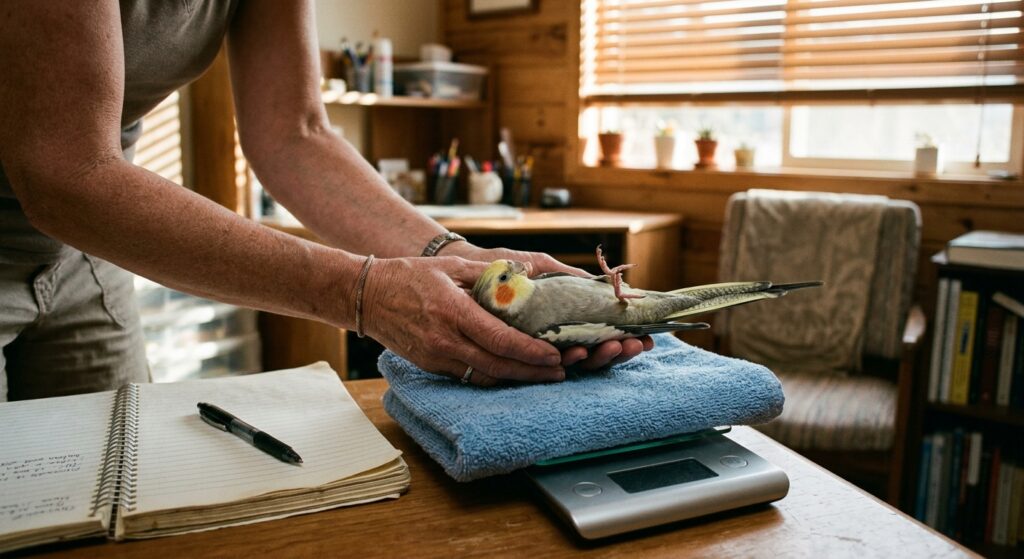
Quarantine is not just separation — it is a watching period. The value comes from looking at the same bird, at the same time, every day, and writing down what you see before you decide what it means.
A daily record usually covers:
- Droppings — count, color, consistency, and the volume of urates and liquid; note anything undigested or unusually dark.
- Weight — grams on a perch scale, taken at the same time each morning before the first feeding.
- Food and water intake — what was offered, what was actually eaten versus shredded and dropped, how much water is gone.
- Breathing — tail bobbing, open-beak breathing, clicking, sneezing, or any sound that changes when the bird settles down at night.
- Discharge — around the nares, eyes, or vent, including matted feathers above the beak.
- Feather and skin condition — stress bars, frayed edges, bald patches, flaking, or feathers left wet or soiled around the vent.
- Behavior — perching position, sleep during daylight, fluffing, activity level, vocalizing, and how the bird responds when you enter the room.
| What you log | Normal-day entry | What a shift may signal |
|---|---|---|
| Weight | Steady within a few grams | Ongoing loss over several days, even while eating |
| Droppings | Consistent count and form | Fewer, wetter, discolored, or undigested seed |
| Breathing | Quiet, no tail movement | Clicking, bobbing, or noise that persists at rest |
| Behavior | Alert, active, vocal | Quiet fluffing, sleeping low on the perch, hiding |
The reason to write it down is simple: memory smooths things out. A bird that drops two grams a day for a week looks fine every single morning, because two grams is invisible. On paper, that same bird has lost fourteen grams and the pattern is obvious well before it collapses. Notes also give an avian veterinarian something concrete to work from — dates, numbers, and a timeline instead of "he's been a little off lately."
A written quarantine log turns a slow decline into information you can act on, while relying on memory turns it into an emergency you did not see coming.
Vet Work During Quarantine and Why It Comes Before Introductions
Quarantine is the window in which a veterinary workup is most useful, because the bird is already separated and a positive result does not force you to unwind an introduction you have already made. Book the avian vet appointment before the bird comes home, not after something goes wrong. Many practices are booked weeks out, and a general small-animal clinic is not the same as a vet who sees parrots regularly.
A first exam usually covers weight and body condition, a look at the eyes, nares, choana, feathering, feet, and vent, and a listen to the air sacs. From there the vet decides what testing the bird's history and species warrant. Common recommendations include:
| Test | What it screens for | Why it belongs in quarantine |
|---|---|---|
| Fecal gram stain or culture | Bacterial and yeast overgrowth, parasites | Cheap, fast, and often the first sign something is off |
| CBC and chemistry panel | Infection, organ function, anemia | Gives you a baseline to compare against later |
| Chlamydia psittaci testing | Psittacosis, which can pass to people | Zoonotic risk changes how you handle the bird |
| PBFD and polyomavirus DNA testing | Viral disease common in psittacines | A positive here would end any thought of flock contact |
| Crop or choanal swab | Upper respiratory and crop pathogens | Catches problems before visible symptoms |
Bring your written quarantine notes — weights, droppings, appetite, anything you flagged — to the appointment. That log is often more useful to the vet than the bird's five minutes on the exam table.
The other thing that belongs in the quarantine room before the bird arrives is a stocked first aid kit. Set it up in that room, not in the main bird area, so you are not walking back and forth through the house when a blood feather breaks at ten at night. Our separate piece on building one walks through what goes in it. Assembling a kit while a bird is bleeding is the wrong time to discover you are out of styptic powder.
A clean vet exam does not shorten quarantine, because incubating disease and low shedding levels can both produce a normal-looking bird and a normal-looking test result.
What Skipping Quarantine Costs an Established Flock
The math is unforgiving. A quarantine period costs one cage, one room, and a few weeks of extra work. An outbreak in an established collection costs birds — and in a breeding program, it costs bloodlines that took years to assemble and cannot be replaced by buying a replacement pair.
Guests on our shows have returned to this point again and again: the loss is rarely a single bird. Once something moves through a flight or a bird room, keepers are dealing with every bird that shared the air, the food, or the hands that fed them. Breeding stops. Pairs that were sitting on eggs come off them. Chicks in the nest are the most vulnerable birds in the building.
The birds that survive can be the harder problem. A bird can recover from an illness, look and act completely normal, and continue shedding the organism that made it sick. That bird is now part of the collection, and every future addition, sale, or loan carries the risk forward.
| Situation | What it involves | Practical burden |
|---|---|---|
| Isolating one new bird | One separate room, dedicated bowls and cleaning supplies, a vet workup for one bird | Weeks of extra routine; contained cost |
| Treating an exposed flock | Medicating every affected bird, repeat testing, disinfecting all cages and equipment, halting breeding | Ongoing cost across the whole collection, with no guarantee of clearing carriers |
Rescues and sanctuaries operate under the strictest protocols for a straightforward reason: the birds arriving almost never come with a history.
- No record of where the bird came from or what it lived with
- No vet history, no prior testing, no vaccination or treatment records
- Often no accurate age, and sometimes no confirmed species background
- Birds arriving from estate situations, surrenders, or seizures, sometimes several at once from different sources
A sanctuary intake room may hold birds from four unrelated homes in the same month. Those organizations are also housing birds that other people could not care for — older birds, birds with existing health issues, birds with less margin if something spreads.
The cost of quarantine is measured in weeks of inconvenience, while the cost of skipping it is measured in birds you cannot get back.
Hear It From the Aviculturists Themselves
Everything above comes out of the same conversations we have been recording since 2015. From the Kansas City studio, we have hosted, engineered, and produced roughly 80 bird talk shows, and the full archive streams free at birdtalkradio.com, 24/7/365. If you would rather hear husbandry discussed by the people who practice it than read another checklist, that archive is the place to start.
A few of the voices you will find there:
- Tony Silva, whose work in aviculture covers species management and the practical realities of keeping birds in collections.
- Yvonne Patterson Burbach, owner and trainer behind the Wings of Love bird shows, who appears regularly and speaks from the perspective of someone responsible for a working flock of performing birds.
- Professional bird keepers, wildlife biologists, and bird rescue organizations, discussing diet, training, and the day-to-day decisions that keep a collection stable.
Because the shows are conversations rather than lectures, flock health rarely gets its own tidy segment. It surfaces inside discussions of diet, of intake at rescues, of moving birds between environments. That is why we built a listening guide — so you can find the episodes where these subjects actually come up instead of scrubbing through the whole catalog.
| Guest background | What they tend to speak to | Why it bears on quarantine |
|---|---|---|
| Aviculturists and breeders | Species-specific management, pairing, collection growth | How new birds enter an existing collection |
| Trainers | Handling, behavior, conditioning routines | Reading a bird's normal baseline before and after isolation |
| Wildlife biologists | Population health, wild-bird context | Why pathogens move the way they do |
| Rescue organizations | Intake, rehoming, unknown histories | Managing birds whose background you cannot verify |
Use the guide to queue up two or three episodes while you are cleaning cages or preparing food. The value is not a single rule you can copy down — it is hearing how different keepers reason through the same problem, and noticing where they all land in the same place.
If you take one thing from the archive, let it be this: experienced keepers across breeding, training, and rescue arrive at the same isolation practices independently, which is the strongest argument there is for not skipping them.