A broken blood feather at 9 p.m. is not the moment to learn that you own no styptic powder and no towel you trust. That is the whole problem: the search happens exactly when you have the least attention to spare.
Across roughly 80 shows recorded in our Kansas City studio since 2015, emergency preparedness keeps surfacing with the professional keepers, wildlife biologists, and rescue operators we host. The pattern is consistent — the people handling the most birds have the most supplies already staged.
What follows is an assembly list, not veterinary advice. Every item here exists to buy time until an avian veterinarian takes over.
Why Our Guests Build the Kit Before the First Emergency
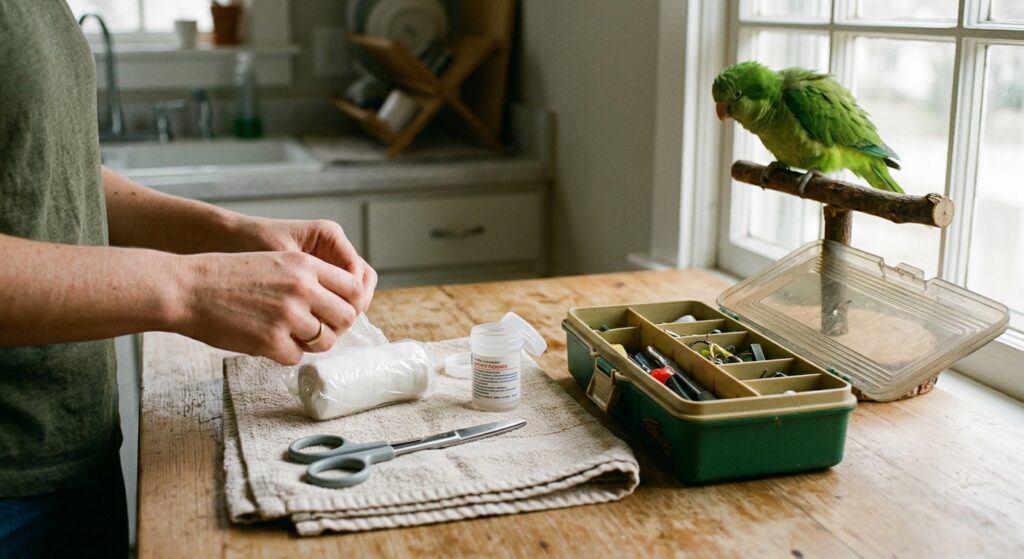
Birds Are Built to Look Fine Until They Aren't
Across roughly 80 shows since 2015, one point comes up more than almost any other from the professional keepers, wildlife biologists, and rescue operators who join us: a parrot that looks "a little off" is often a parrot that has been unwell for some time. Prey animals don't advertise weakness, and captive birds are no exception. Our guests describe the same pattern again and again — the bird holds its normal posture, keeps eating in front of you, and then one morning it is on the cage floor.
That compression of the timeline is the whole argument for building a kit in advance. You are not preparing for a slow decline you can watch and plan around. You are preparing for the point where the bird finally stops compensating.
| What you notice | What guests say it often means | Time you likely have |
|---|---|---|
| Subtle changes in droppings, quieter than usual | Something has been developing already | Call the vet now, during business hours |
| Fluffed, sitting low, tail bobbing | The bird has stopped masking | Hours, not days |
| On the cage floor, unresponsive | Late-stage presentation | Immediate transport |
Emergencies Keep Inconvenient Hours
The second recurring theme is scheduling. Broken blood feathers, night frights, toe injuries, and escapes from a cage don't wait for Tuesday at 10 a.m. Rescue operators who take in birds at all hours have told us the same thing: the call comes in on a holiday weekend, at 2 a.m., or on the drive home. If the kit is something you plan to assemble "soon," it will not exist when the moment arrives.
Build the Plan Alongside the Kit
Supplies alone aren't the answer. The keepers we've hosted treat the kit and the written plan as one item:
- The name, address, and after-hours protocol for an avian vet you have already visited
- A backup clinic, in case the first one is closed or full
- A travel carrier staged and ready, not buried in a closet
- A heat source you know how to set up quickly and safely
- A single sheet listing your bird's species, age, weight, and any known conditions
Assemble it on a calm afternoon. Store it where anyone in the household can find it without asking you.
The most common mistake our guests describe is waiting for obvious symptoms to justify preparation — by the time a parrot looks visibly sick, the window for a relaxed trip to the store has already closed.
Bleeding: Broken Blood Feathers, Cracked Beaks, and Torn Nails
Blood is the one emergency where the clock starts the moment you notice it. A parrot is small, and the margin between "bleeding" and "in trouble" closes faster than most owners expect. That is why nearly every professional keeper, rescue operator, and biologist we've had on the show gives the same answer when asked what belongs at the very top of the kit: something to stop bleeding, something to hold pressure with, and a phone number.
What Goes in the Bleeding Section of the Kit
Keep these together in their own pouch so you are not digging through the whole kit one-handed:
- Styptic powder — for nails and beak tips only
- Cornstarch or plain flour — the gentler option for skin and feather shafts
- Sterile gauze pads and cotton swabs for direct pressure
- A small towel for controlled restraint
- Hemostats or needle-nose pliers (see the caution below)
- Sterile saline for rinsing away blood so you can actually see the source
- A bright penlight
- Your avian vet's number and after-hours number, written on the lid — not stored only in your phone
Matching the Response to the Injury
| Injury | First response | Do not | Vet call |
|---|---|---|---|
| Broken blood feather | Direct pressure with gauze, cornstarch or flour on the shaft | Pack styptic powder into the follicle | Yes — same day, and immediately if bleeding restarts |
| Cracked or chipped beak | Gentle pressure, styptic on the bleeding edge only | File, glue, or seal the crack yourself | Yes — beak damage can involve living tissue underneath |
| Torn or broken nail | Styptic powder pressed to the tip, hold 30 seconds | Keep re-checking every few seconds; that breaks the clot | Yes if bleeding recurs or the toe is swollen |
Stabilize, Then Hand It Off
The pliers are in the kit because feather pulling comes up constantly on the show — and the consistent message from the professionals we've hosted is that it is a veterinary procedure, not a kitchen-table one. Pulling a blood feather wrong can damage the follicle permanently or tear the skin, and a stressed owner working on a stressed bird is the worst possible combination. Your job is pressure, warmth, quiet, and a carrier by the door.
Handling itself costs the bird something. Restrain briefly, work efficiently, and put the bird back down to breathe between attempts rather than fighting through one long hold.
Stopping the bleeding is not the same as treating the injury — every bleed serious enough to open the kit is serious enough to earn a call to your avian vet.
The Hospital Cage: Warmth, Quiet, and Containment
A sick or injured bird loses heat fast, and a bird burning calories to stay warm is a bird not spending them on healing. The recovery setup our guests keep on hand is simple, boring, and already assembled — because nobody wants to be hunting for a heating pad at 11 p.m.
Heat You Can Control
The goal is a warm zone the bird can move away from, not an oven. Heat one end of the enclosure and leave the other end cooler so the bird self-regulates. A thermometer inside the carrier matters more than the wattage of whatever you're using — guess at the temperature and you will overshoot.
| Heat source | How it's used | Watch out for |
|---|---|---|
| Ceramic heat emitter | Clamped outside the cage, aimed at one end | Fire risk if the clamp slips; no light, so check the bird visually |
| Avian-safe heat panel | Mounted on one wall of the enclosure | Needs a thermostat to avoid drift |
| Heating pad under the carrier | Set on low under half the floor only | Never inside where the bird can chew the cord |
| Warm water bottle wrapped in a towel | Emergency and transport use | Cools quickly; re-check every 20–30 minutes |
Whatever you choose, confirm the target temperature with your avian veterinarian for your bird's species and condition, and never seal the carrier so tightly that airflow stops.
Low Perches, Padded Floors, and Reachable Food
A weak or unbalanced bird should not be climbing. Strip the setup down:
- Remove high perches entirely, or drop a single perch to an inch or two above the floor.
- Line the floor with a folded towel or paper towels — nothing with loops a nail can catch.
- Put food and water dishes on the floor, within a step of where the bird is sitting.
- Offer familiar favorites, not new items; a stressed bird often won't try anything unfamiliar.
- Skip toys, mirrors, and anything that invites activity.
The Carrier That Doubles as Transport
Our guests overwhelmingly favor a small, hard-sided carrier as the hospital cage itself. It holds heat, it's easy to clean, and when the vet says come in now, you cover it with a towel and walk out the door — no chasing a frightened bird from a large cage into a box. Keep the towel, a spare liner, and the carrier stored together, not in three different closets.
A bird that appears fluffed, quiet, and stable in a warm carrier can still be critically ill — warmth buys you time to reach an avian veterinarian, it does not substitute for one.
Handling and Restraint Tools You Should Practice With First

The Towel Is the Tool, Not the Punishment
Nearly every handler we have had on the show treats a towel as the foundation of restraint. Keep two or three in the kit, sized to the bird: a washcloth or hand towel for a budgie, cockatiel, or conure, and a bath towel for an Amazon, African grey, or macaw. Plain, light-colored, and lint-free is the usual preference — light colors let you spot blood immediately, and no loops or frayed threads means no snagged toenails. Wash them separately from anything scented, and store the emergency towels apart from the ones used for everyday handling so they stay clean and dry.
The gloves question comes up on almost every episode where restraint is discussed, and the answers are not unanimous.
| Approach | Argued advantage | Argued drawback |
|---|---|---|
| Bare hands with a towel | Bird associates the towel, not you, with restraint; you feel pressure on the chest and can ease off | Your hands are exposed if the bird redirects a bite |
| Leather or welding gloves | Physical protection for the handler | Many companion-bird keepers say gloves teach a bird to fear hands and remove the tactile feedback that prevents over-gripping |
| Towel plus a second person | Frees one set of hands for treatment; faster, shorter restraint | Requires a household member who has actually practiced the hold |
Rescue and free-flight guests lean heavily toward the towel over gloves for pet birds. Handlers working with raptors or unhandled wild birds are a different case entirely.
Small Instruments Worth Having on Hand
- Blunt-tipped scissors — for cutting gauze, tape, or a strand of fiber wrapped around a toe. Blunt tips, never sharp points.
- Tweezers or hemostats — hemostats lock closed, which helps for gripping a broken blood feather shaft or holding gauze without your fingers in the way.
- A penlight — for checking inside the mouth, looking at the eyes, or seeing into a dark corner of the cage where you suspect something happened.
Buy these separately for the kit. If you borrow them from the kitchen drawer, they will not be in the kit at 11 p.m.
Practice on a Bird That Isn't Sick
Our free-flight and show-bird guests, including Yvonne Patterson Burbach of Wings of Love, come back to this point more than any other piece of equipment advice: rehearse towel handling with a calm, healthy bird. Short sessions, treats afterward, no pursuit around the cage. A bird who has been toweled a dozen times uneventfully is a bird you can restrain without adding panic to an injury.
If the first time your parrot is ever wrapped in a towel is the night it is bleeding, you are managing two emergencies at once — the injury and the bird's terror.
The Baseline Numbers: Scales, Records, and What Your Vet Will Ask
The Gram Scale Is First Aid Equipment, Not Bookkeeping
A digital kitchen scale that reads in single grams, with a perch or a flat platform your bird will stand on, belongs in the first aid kit alongside the styptic powder and the towel. Birds are prey animals and they conceal illness well — that theme comes up again and again with the keepers, biologists, and rescue people we have had on the show. Weight is one of the few things that will not cooperate with the disguise. A bird that is eating less, burning reserves, or fighting something quietly will show it on the scale before it shows it on the perch.
The scale is only useful if you have been using it. Weigh at the same time of day, ideally first thing in the morning before the first meal, and write the number down. On a cockatiel or a conure, a handful of grams is a meaningful change. Without a log, "he seems a little off" is all you can offer an avian vet at 8 p.m. With one, you can say the bird has dropped a specific amount over a specific number of days — that is actionable information, and it changes how quickly a clinic will want to see you.
The Paper That Rides With the Kit
Keep a single folder or envelope in the kit itself, not on a computer you cannot reach from a parking lot. Photograph it with your phone as a backup.
| Record | What to include | Why the vet asks |
|---|---|---|
| Weight log | Dated grams, same scale, same time of day | Establishes the baseline and the trend |
| Diet history | Pellet brand, fresh foods, seed portion, supplements, recent changes | Ties directly to deficiency and crop problems |
| Medications | Drug, dose, dates given, prescribing vet | Prevents interactions and duplicate dosing |
| Identification | Closed band number, microchip number, hatch date if known | Ownership, recovery, and clinic records |
| Photos | Full body, feet, beak, and any existing lesion or feather damage | Distinguishes new injury from old |
Photos Do Work Words Cannot
Take clear, well-lit reference photos of your bird when it is healthy, and update them once or twice a year. When something changes — a swelling, a discolored dropping, a feather chewed to the shaft — a before-and-after pair tells an avian vet in seconds what a phone call takes ten minutes to describe badly.
A scale you bought during the emergency tells you nothing, because the number only means something when you already know what normal looked like last Tuesday.
Emergencies the Kit Can't Fix: Fumes, Toxins, and Trauma
Some of the situations our guests describe most often are the ones a first aid kit was never designed to solve. Gauze and styptic powder do nothing for a bird that has inhaled fumes from an overheated nonstick pan. For airway and toxin emergencies, and for injuries inflicted by another animal, the correct response is to remove the source, move air, and get the bird to an avian veterinarian — not to treat at home.
Air the Bird Cannot Escape
Birds have an efficient respiratory system, which is exactly why airborne hazards hit them so fast. The hazards that come up repeatedly on our shows are self-heating nonstick cookware and appliances, aerosol sprays, scented candles, plug-in air fresheners, and cleaning products used in the same room as the cage.
If you suspect an airborne exposure:
- Get the bird out of the room first — cage and all, or in a carrier if that is faster.
- Open windows and doors and move air out of the house, not around it.
- Turn off the heat source or stop using the product before you go back in.
- Call an avian vet immediately, even if the bird looks normal. Respiratory damage is not always obvious in the first minutes.
Ingested and Physical Hazards
| Hazard | What owners report | Your response |
|---|---|---|
| Avocado, chocolate, caffeine, alcohol, salty or onion-heavy foods | Ingestion off a plate or counter | Remove access, note what and how much, call the vet |
| Houseplants of unknown species | Chewing on leaves during out-of-cage time | Identify the plant if you can, take a cutting to the vet |
| Ceiling fans | Collision during flighted time in the room | Fans off before the bird comes out — every time |
| Cats and dogs | Bites, scratches, crush injuries | Vet same day, regardless of how minor the wound looks |
Why Cat Bites Are a Different Category
Our guests are consistent on this point: a cat bite or scratch is a veterinary emergency, not a wound-care exercise. The puncture may be nearly invisible under feathers, and bacteria introduced by the bite can kill a bird that appeared fine at bedtime. Contain the bird, keep it warm in the hospital cage, and get it seen. Do not clean, probe, or wait to see how it does overnight.
The most dangerous mistake with fumes, toxins, and animal bites is deciding the bird looks fine and waiting until morning to call.
Your Emergency Contact List, Assembled Tonight
Everything else in the kit is gauze and hardware. The contact card is the part that decides how fast a sick bird gets to someone who can actually treat it. Build it tonight, at the kitchen table, and tape it inside the lid of the kit.
The Five Entries Every Card Needs
- Your avian veterinarian. Not "a vet who sees birds sometimes." Call during business hours and ask directly whether they treat parrots, what species they're comfortable with, and whether they want a call ahead before you arrive.
- The nearest after-hours or exotics-capable clinic. Most avian practices are daytime operations. Find out now who covers nights, weekends, and holidays in your area, because that is when blood feathers break.
- A poison control option. Confirm in advance that the service you plan to call takes bird cases and how payment works, so you're not sorting that out while a bird is off a perch.
- A knowledgeable bird-sitter or rescue contact. Someone who can hold the flock if you're at the clinic for six hours, or who knows the local avian medicine landscape better than you do.
- A second set of hands. A neighbor or family member who can drive while you hold the carrier.
Confirm the Details Before You File Them
| Contact | Confirm now | Write on the card |
|---|---|---|
| Avian vet | Species treated, appointment policy | Phone, address, hours |
| Emergency clinic | Whether birds are accepted at all | Phone, address, overnight hours |
| Poison control | Bird cases accepted, fee handling | Phone, case number field |
| Sitter / rescue | Willingness, comfort with handling | Phone, backup phone |
A number you have never dialed is not a contact. Make one call to each before you file the card.
Print the Directions on Paper
The phone in your hand will be occupied. You'll be on hold with the clinic, or reading symptoms aloud, or the person driving will have it. Turn-by-turn directions to both clinics, printed and folded into the kit, remove one variable from a night that already has too many.
Add the cross street, a landmark, and which entrance is open after hours — clinics often route overnight arrivals to a side door. Note your bird's species, hatch year if known, and current weight on the same page so you're not reciting from memory.
The single most common failure we hear about is not a missing supply but a missing relationship — the owner who first looks for an avian vet on the night of the emergency and discovers the nearest one is two hours away.