Your bird eats in four minutes and then spends the rest of the day screaming, plucking, or chewing the one thing you asked him not to chew. That gap — between a full bowl and a long, empty afternoon — is where most of the behavior problems we hear about on air begin.
Across roughly 80 shows recorded in our Kansas City studio since 2015, nearly every professional keeper, trainer, and rescue guest has circled back to the same point: the food bowl is the least interesting thing in the cage.
What follows is a synthesis of what those guests have described, not a product roundup. We cover why foraging works, how to move from easy to difficult, household materials, safety limits, and how to tell whether it's helping. Cage setup and screaming are handled separately elsewhere on the site.
Why Our Guests Empty the Food Bowl First
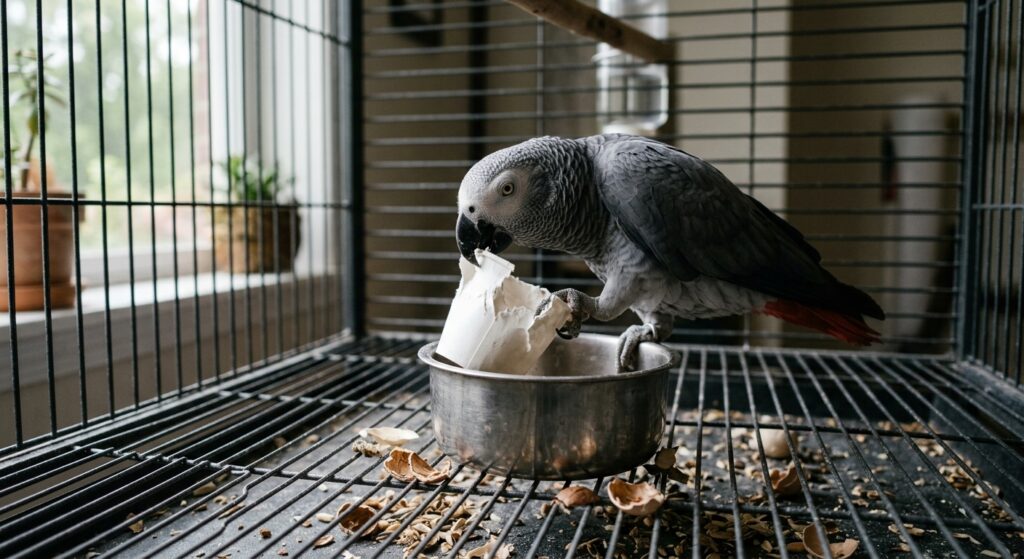
The Wild Bird's Workday
Across roughly 80 shows recorded in our Kansas City studio since 2015, one idea surfaces more than almost any other, and it comes from trainers, wildlife biologists, and rescue operators alike: in the wild, a parrot's day is organized around food, but very little of that time is spent actually eating. The bulk of it goes to everything that happens before the swallow.
A free-living parrot has to:
- Travel to a site where food is likely to be available
- Search through foliage, bark, seed pods, or ground litter
- Select what is ripe, safe, and worth the effort
- Chew, strip, crack, or peel the item open
- Reject what turns out to be unsuitable and start over
- Stay alert to flock movement and predators the entire time
That sequence is cognitively demanding and physically repetitive, and it fills hours. Our guests describe it as the bird's job — the single largest block of occupied time in its day.
What a Full Bowl Actually Removes
Set down a full dish of pellets and the entire sequence above collapses into a few minutes of eating. The nutrition arrives intact. The work does not. This is the point guests return to when callers describe screaming, feather damaging behavior, or a bird that seems restless no matter how many toys hang in the cage: the problem is often not a shortage of toys but a surplus of unstructured time.
| Daily element | Wild foraging bird | Bowl-fed companion bird |
|---|---|---|
| Time spent acquiring food | Hours, spread across morning and late afternoon | Minutes |
| Physical effort | Climbing, flight, chewing, manipulating | Reaching into a dish |
| Problem solving | Constant — what to open, what to skip | None required |
| Choice and control | Bird decides where and what to work on | Decided by the keeper |
| Remaining unoccupied time | Little | Most of the waking day |
The right-hand column is what we are trying to fix with foraging toys. Not the diet — the schedule.
Work Is Not Deprivation
The most common objection we hear from listeners is that making a bird work for food sounds like withholding it. Our guests consistently push back on that framing. The daily ration does not shrink; it changes delivery. The bird still receives the full amount of food its diet calls for, but it arrives inside wrapped paper, skewered produce, a shreddable packet, or a puzzle the bird can solve. Guests who run rescues and sanctuaries also point out the behavioral payoff: a bird with a task is a bird that is not rehearsing a problem behavior for the same stretch of hours.
Foraging enrichment is about relocating the food your bird already eats into something it has to work to reach — never about reducing the amount it gets in a day.
Foraging as Behavior Work, Not Just Entertainment
When guests come on the show to talk about a bird that plucks, screams at sunrise, or lunges at hands, the conversation almost always circles back to the same question: what is this bird doing all day? Foraging is not a side topic in those episodes. It is usually the first thing a behavior-minded guest changes, because it is the cheapest, fastest way to give a parrot a job that it was built to do.
What an occupied beak displaces
A bird working a foraging toy cannot simultaneously be chewing its chest feathers, pacing a perch, or contact-calling the kitchen. That is the whole mechanism. Enrichment does not "cure" anything on its own, but it competes with the behaviors owners dislike by filling the hours those behaviors were filling.
Here is how the three complaints we hear most often tend to line up with time budgets:
| Complaint | What the day often looks like | Where foraging fits |
|---|---|---|
| Feather destruction | Full bowl, long unbroken stretches with nothing to manipulate | Spreads eating across hours, gives the beak a legitimate target |
| Cage-bound lethargy or stereotypy | Same cage layout for months, food in the same two cups | Moves food around the cage, forces climbing and searching |
| Screaming and contact calling | Quiet bird while the household is busy, loud bird the moment it is alone | Gives the bird something to do during the exact windows it would otherwise call |
Build the day, not just the toy
Guests who get results treat foraging as a schedule, not a purchase. A rough version of what they describe:
- Split the daily ration into three or four placements instead of one bowl.
- Put the first placement out before the household gets loud, so the bird starts the morning working.
- Reserve the highest-value item — the nut, the sprouted seed, the palm fruit — for the hardest puzzle.
- Leave one easy, always-solvable option available so a frustrated bird can still succeed.
- Rotate position and difficulty weekly so the cage stops being predictable.
Where training has to carry the load
Foraging handles the bird's time. It does not teach the bird what to do instead of screaming when you walk out of the room, and it does not teach a bird to step up calmly. That is training work, and it belongs in a separate column of the plan.
If screaming is the problem you are actually trying to solve, start with our article on screaming and what reinforces it, then pair it with our piece on positive reinforcement for the mechanics of marking and rewarding the quiet behavior you want more of. Enrichment and training reinforce each other — a bird with a full day is a calmer training partner, and a bird with clear cues is easier to manage around new toys.
Adding foraging toys while still filling the bowl to the brim changes nothing, because the bird will always choose the free food over the puzzle.
Starting a Bird Who Has Never Had to Work for Food
A bird raised on a full bowl has never had to solve anything to eat. Dropping a stuffed foraging wheel into that cage does not read as a puzzle — it reads as the food being gone. Rescue guests on our shows come back to this point more than almost any other: a bird who does not understand foraging can simply stop eating, and a small parrot does not have many days of reserve to spare. The progression below is the one our guests describe, and the pace is set by the bird, not by the calendar.
Stage One: Visible Food, Loosely Covered
Start where there is no mystery. The bird sees the food, smells the food, and only has to move something light to reach it. A sheet of plain paper laid over the top of a familiar bowl. A pellet sitting in an open paper cup. Food on a flat tray with a few toy parts scattered around it.
What guests look for here is not cleverness — it is willingness. Does the bird touch the paper at all, or does it sit back and wait for the barrier to disappear?
Stage Two: Partially Wrapped
Once the bird is reliably pushing paper aside, cover more of the food but leave a window. A pellet twisted into the end of a paper strip with the tip showing. A cup half-folded shut. Food threaded into a loose weave where a corner is still visible.
This is where most birds either click or stall, and stalling is information, not failure. Back up a stage and stay there longer.
| Stage | What the bird can see | Effort required | Ready to advance when |
|---|---|---|---|
| Visible, loosely covered | All of the food | Nudge or push aside | Bird clears the cover without hesitation, several days running |
| Partially wrapped | A corner or edge | Pull, tear, unfold | Bird works the wrap on its own, not just when you demonstrate |
| Fully hidden | Nothing | Search, remember, problem-solve | Bird investigates containers it has never seen before |
Stage Three: Fully Hidden — and How to Protect the Bird
Only when the bird is actively hunting should food disappear from view entirely. Even then, our guests keep guardrails in place:
- Keep a known, open food source available while the new foraging format is introduced.
- Weigh the bird on a gram scale, not by eye — feather cover hides weight loss.
- Watch droppings daily; volume drops before a bird looks unwell.
- Count what goes in and what is left at night, so you know what was actually eaten.
- Move to the next stage only after several consecutive successful days, never after one good session.
If a bird's weight or dropping output falls while you are advancing the foraging difficulty, go back to an open bowl immediately and rebuild from the easiest stage.
The Household Materials Guests Reach for Before a Catalog
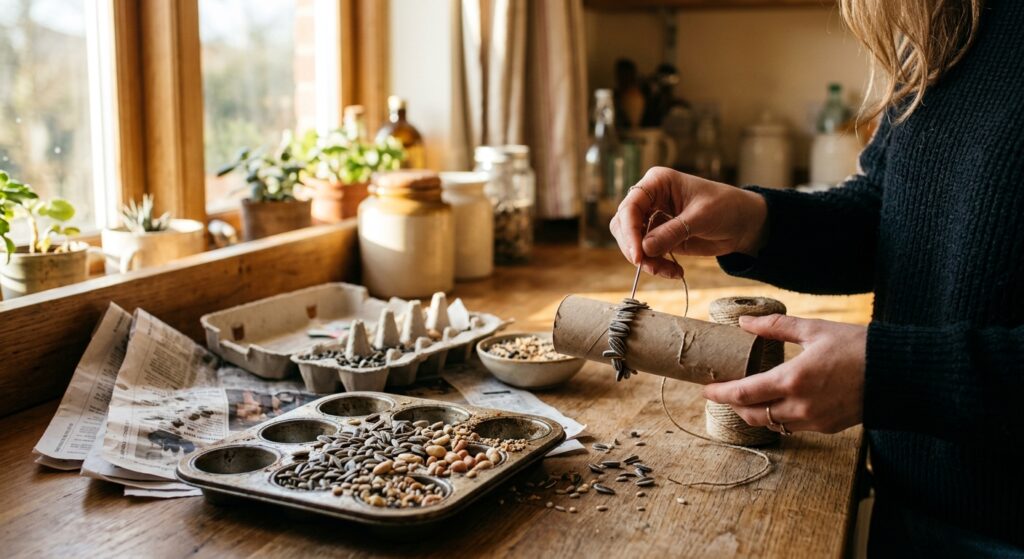
Ask a working bird keeper what their flock destroys fastest and you rarely get a product name back. You get a list of things already in the house. The same handful of materials comes up again and again across our interviews, from breeders and trainers to rescue volunteers, and they share one trait: the bird is supposed to wreck them.
The short list that keeps coming up
- Plain paper — register tape, butcher paper, unprinted newsprint, torn into strips to wrap a single almond or pellet.
- Cardboard — shipping boxes cut into squares, toilet paper tubes with the ends folded shut, egg flats for small species.
- Untreated, bird-safe wood — pine blocks, drilled dowels, branches with bark still on them.
- Woven palm and vine — palm leaf strips, seagrass mats, vine balls and rings that a parrot can unravel thread by thread.
- Paper cups and small paper bags — stuffed with shredded paper and a few seeds, then clipped shut or crumpled closed.
- Skewers of fresh produce — a stainless steel kabob loaded with carrot chunks, apple, corn on the cob, pepper halves, and leafy greens so the bird has to work down the shaft.
Why disposable beats durable
The pitch for an expensive toy is that it lasts. For a foraging bird, that is the problem. A toy that survives the week is a toy the bird stopped interacting with on day two. The chewing, shredding, and unraveling is the behavior you are trying to buy.
| Material | Typical cost | Lifespan with an active chewer | Best suited to | Replaceable at home |
|---|---|---|---|---|
| Paper, newsprint | Free to pennies | Minutes to an hour | Any size, first-time foragers | Yes, endlessly |
| Cardboard tubes, boxes | Free | One to a few sessions | Conures through macaws | Yes |
| Untreated wood blocks | Low | Days to weeks | Heavy chewers, large beaks | Needs purchase |
| Palm, seagrass, vine | Low to moderate | Hours to days | Shredders, cockatoos, greys | Needs purchase |
| Paper cups and bags | Very low | One session | Small to medium species | Yes |
| Produce skewer | Cost of the produce | One meal | All sizes, picky eaters | Yes, daily |
Renewable means you actually refill it
The practical argument our guests make is about the owner, not the bird. If a foraging setup costs real money every time it gets destroyed, most people slow down, put it off, or leave the empty toy hanging. Cheap and renewable removes that hesitation. You load a paper cup every morning without thinking about it, which is exactly the daily rhythm that changes a bird's behavior.
It also lets you rotate. Four different cheap materials in a week beat one expensive toy that stays up for a month and becomes invisible.
Check every material before it goes in the cage — no staples, no glossy printed ink, no treated or pressure-washed lumber, no glue-heavy packaging, and no unsupervised access to a skewer's sharp end.
Matching the Puzzle to the Beak: Species and Individual Differences
Beak Power Decides the Material, Not the Price Tag
The single most common correction we hear from professional keepers on the show is that people buy a toy for the bird they imagine rather than the bird in the cage. A greenwing macaw or a Moluccan cockatoo treats thin pine, cardboard, and lightweight acrylic as a two-minute problem — not because the puzzle was clever, but because the whole device came apart. A green-cheeked conure or a cockatiel presented with that same hardwood-and-stainless puzzle will often sit beside it and wait for someone to open the food bowl instead.
Matching material to beak strength is the first filter. Matching difficulty to the individual bird is the second, and that one takes observation rather than a product description.
| Bird type | Material that holds up | Starting difficulty | Usual failure mode |
|---|---|---|---|
| Large macaws, Moluccan and umbrella cockatoos | Thick hardwood, vegetable-tanned leather, stainless hardware | Moderate — they want work, not a vault | Destroys the toy before foraging, swallows soft plastic fragments |
| Amazons, greys, smaller cockatoos | Mixed wood and cardboard, paper-wrapped parcels | Moderate to high | Solves it once, then ignores it |
| Conures, caiques, Poicephalus | Cardboard, paper cups, light wood, woven palm | Low to moderate | Intimidated by a large, heavy, noisy device |
| Budgies, cockatiels, lovebirds, finches | Paper, millet, shallow trays, soft woven material | Low | Won't approach an unfamiliar object at all |
Personality Overrides the Species Chart
Guests who manage collections rather than one bird are blunt about this: two greys of the same age, raised the same way, will need different puzzles. Things worth watching before you adjust difficulty:
- Does the bird investigate new objects with its beak, or back away from the perch?
- Does it work a puzzle persistently, or quit after one failed attempt?
- Is it food-driven, or does it prefer shredding and destruction as the reward?
- Does it forage more when flockmates are visible and doing the same?
Free-Flight and Show Trainers Use Food Differently
This is where the conversation splits. In our recurring episodes with Yvonne Patterson Burbach, the owner and trainer behind the Wings of Love bird shows, food motivation is managed deliberately as part of a working relationship — the bird's appetite is the currency that makes recall, flight, and show behaviors reliable, and it is tracked closely alongside weight and condition.
A companion-bird household is doing something different. There, foraging is not building a trained behavior chain; it is filling the hours between morning and evening and giving the bird a job. The goal is time spent working, not precision. Copying a show trainer's approach to appetite management without their weight records and daily handling is where pet owners get into trouble.
Weight management belongs to trainers who weigh their birds daily — in a companion home, make the food harder to reach, not scarcer.
Safety Limits, Placement, and Knowing Whether It Is Working
The Hazards That Come Up Most Often
The cautions we hear repeated on the show are rarely exotic. They are the same handful of failures, and they almost always show up after a toy has been in the cage long enough to be chewed down to something its maker never intended.
| Hazard | Where it shows up | What to do |
|---|---|---|
| Fibrous strands | Shredded rope, cotton, sisal, frayed fabric | Trim frayed ends short; retire a rope toy once strands are long enough to loop a toe or leg |
| Toe and beak entrapment | Open chain links, split rings, narrow gaps, keyring-style clasps | Use closed hardware; check that gaps are either too small for a toe or too large to trap one |
| Hardware failure | Zinc or galvanized clips, screws, washers, wire | Stick to stainless steel or nickel-plated hardware; pull-test anything that holds weight |
| Toxic materials | Treated or unknown woods, inks, dyes, glues, glossy printed cardboard | Use plain untreated wood and unprinted paper and cardboard |
| Spoilage | Fresh produce, soaked seed, cooked food tucked into a forager | Pull fresh food within a few hours in a warm room, and inspect crevices where soft food hides |
New toys get supervision, not just approval. Put the toy in, stay in the room, and watch how the bird actually attacks it — birds find the one weak point you did not. A toy that is safe when assembled may not be safe after twenty minutes of a macaw's work on it.
Where the Forager Goes in the Cage
Placement decides whether the toy gets used at all. A few practical rules:
- Put the first foragers near, or just above, the spot where the food bowl used to sit. Birds search where food has always appeared.
- Hang foragers at or slightly below the bird's favorite perch height, within comfortable beak reach from a stable footing.
- Keep them clear of the path a bird takes to flee, and clear of the space directly over food and water bowls.
- Spread several small foragers around the cage rather than clustering them in one corner, so the bird has to travel between them.
- Leave the cage interior navigable. A cage packed wall to wall is a cage the bird will not move through.
Telling Whether It Is Actually Working
Trust the body, not your impression of the bird's mood.
- Weight. A gram scale, same time each morning, before the first meal. A steady or gently varying weight means the bird is getting fed. A downward trend means back up a step.
- Droppings. Normal volume and normal fecal portion mean food is going in. Scant, dark, or reduced droppings are the early warning.
- Eagerness. The bird goes to the toy on its own, works it without prompting, and returns to it after you refill.
- Emptied devices. Food gone, not scattered beneath the cage untouched.
Never leave a bird alone with a new foraging toy until you have watched it work the toy to pieces and confirmed that what it produces is not a strand, a sharp edge, or a loop that can catch a toe.