You've decided you want a parrot from a rescue, and then the process stalls: a four-page application, questions about your income and your other pets, a home visit, and no bird in sight for weeks.
Since 2015 we've hosted, engineered, and produced roughly 80 pre-recorded live shows from our Kansas City studio, and bird rescue organizations have been regular guests alongside professional bird keepers and wildlife biologists. What follows is a walkthrough of what adoption actually looks like, drawn from what those rescue guests describe on air.
Six sections cover why parrots end up in rescue, the application, matching, trial periods, the first weeks home, and the contract itself. We've covered positive reinforcement training and diet elsewhere; this builds on that rather than repeating it.
Why Parrots End Up in Rescue in the First Place
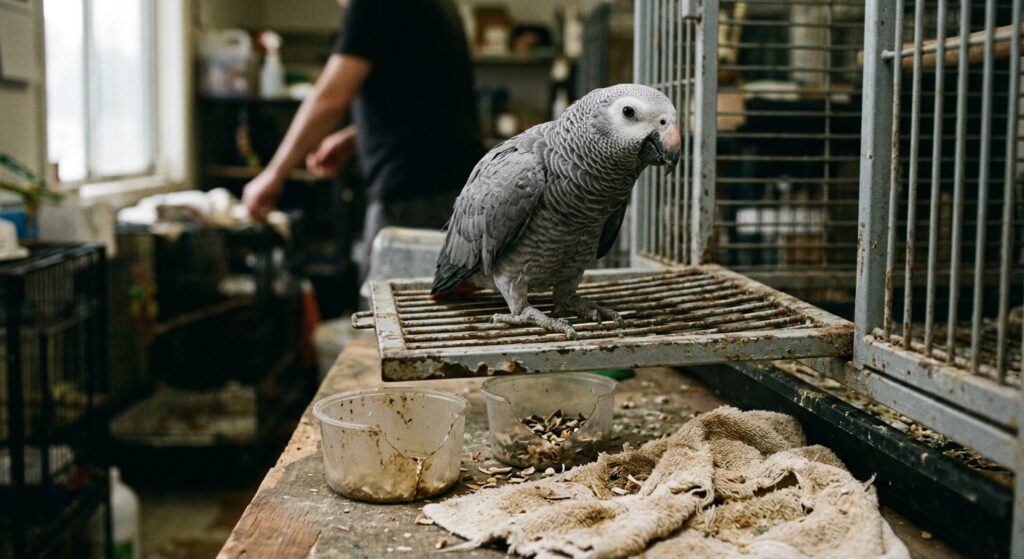
When we have rescue directors and sanctuary operators on the show, one theme comes up again and again: the reason a bird lands in rescue usually has nothing to do with the bird. The intake paperwork tells a story about a household that changed, not a parrot that failed.
The Most Common Surrender Stories
Guests who run intake for rescues describe the same handful of situations over and over:
- Owner illness or disability. A person who could handle a large macaw at 55 may not be able to manage cage cleaning, out-of-cage time, or a beak that outweighs their grip strength at 75.
- Death of the owner. Long-lived species routinely outlive the people who bought them. Heirs often have no interest in, or no ability to keep, the bird.
- Divorce or separation. Two households form where there was one, and neither has the space, schedule, or agreement about who keeps the bird.
- Moving. Rentals with no-bird clauses, downsizing, military transfers, and overseas relocations all end the same way.
- Noise complaints. Apartment neighbors and landlords rarely negotiate with a cockatoo at sunrise.
- Allergies. Feather dust from cockatoos, cockatiels, and African greys can trigger respiratory problems that show up years after the bird arrived, often when a new baby or partner joins the home.
- New babies and changing schedules. The time budget that supported a demanding bird disappears.
Lifespan Is the Quiet Driver Behind Most of It
Parrots are not short-term pets, and that single fact sits underneath most surrender histories. A bird purchased by a young adult can still be in its prime when that person retires. Every life event in between — jobs, marriages, children, moves, health changes — is an opportunity for the match to break down. Rescue guests on our shows consistently point out that a bird passing through three or four homes is not evidence of a problem bird; it is evidence of a long-lived animal moving through short-lived human circumstances.
Changed Circumstances vs. Genuine Behavior Issues
| What people assume | What rescues actually report |
|---|---|
| "It must bite or it wouldn't be here" | Most intakes are logistical: illness, death, housing, allergies |
| "Screaming means the bird is broken" | Normal contact calling that a specific housing situation couldn't absorb |
| "Plucked birds are damaged goods" | Often diet, boredom, or medical causes that respond to changed care |
| "Multiple homes means multiple failures" | A 40- to 60-year lifespan crossing several human life stages |
Behavior problems do exist, and good rescues disclose them plainly. But the picture that emerges from years of interviewing rescue organizations, professional bird keepers, and trainers is that the bird in the adoption cage is usually a normal parrot whose previous household stopped working.
Judge an adoptable parrot by what it does in front of you and what the rescue documents, not by how many homes it has had.
The Application: Why Rescues Ask So Many Questions
The application form can run several pages, and it is easy to read it as suspicion. It isn't. Rescue intake staff have already met the bird you want to adopt, and they know what went wrong in the home it came from. Every question on that form exists because a bird arrived at their door after that exact issue went unaddressed.
What They Ask, and Why
Most applications work through the same territory: who lives in the house, what the day looks like, and what happens to the bird when circumstances change. Expect questions on:
- Daily routine and work hours — how many hours the bird is alone, and whether anyone is home in the morning and evening
- Other pets and children — dogs, cats, and toddler-height cage access
- Cookware and household products — non-stick pans, self-cleaning oven cycles, aerosols, scented candles, air fresheners
- Cage dimensions and placement — the actual measurements, plus which room and whether it's near a kitchen
- Avian veterinary access — the name of a vet who treats birds, not just dogs and cats
- Diet — what you plan to feed, and whether you understand converting a seed-only bird
- Long-term plans — who takes the bird if you move, become ill, or die before it does
Each Question Maps to a Surrender
The connection is direct. Rescues have watched these situations play out repeatedly.
| What they ask | What it prevents |
|---|---|
| Work hours and time alone | Screaming and feather-destructive behavior in an under-stimulated bird |
| Other pets and children | Bite incidents and predator stress, two common reasons a family gives up |
| Non-stick cookware and aerosols | Sudden death from fumes in a kitchen-adjacent cage |
| Cage size and placement | Birds surrendered as "aggressive" after years in a cage too small to move in |
| Named avian vet | Illness caught too late, then surrendered as an expense the owner can't meet |
| Diet plan | Seed-only birds arriving with fatty liver disease and poor feather condition |
| Successor plan | The single largest driver of intake for large parrots |
The Long-Term Question Is the Serious One
The plan-for-the-future question deserves a real answer, not a placeholder. A large macaw or cockatoo can outlive the person adopting it, and rescues want to know that someone has been asked, has agreed, and knows what the bird needs. Some applications ask for that person's name and contact information. Write down a real one.
Across the shows we've produced since 2015, rescue guests return to the same point: the screening is not a test of whether you are a good person. It is a check on whether this specific bird, with its specific history and needs, fits the house you actually live in.
Answer honestly rather than strategically — a rescue that knows you work twelve-hour shifts can steer you toward a bird that tolerates it, while a rescue you've misled will simply see that bird returned.
Matching the Bird to the Household, Not the Household to the Bird
The Bird on Your Wish List Is Usually the Wrong Starting Point
Most people walk into a rescue with a species already in mind. It is often a macaw or a cockatoo, because those are the birds that show up in photographs and videos. Rescue staff have seen the outcome of that decision more times than they care to count, and it is a large part of why their intake lists look the way they do.
So the conversation shifts. Instead of asking which bird you want, an adoption coordinator asks what your home actually sounds like, how much floor space and ceiling height you have, who else lives there, how long the bird will be alone on a workday, and whether anyone in the household is elderly, very young, or unwilling to be around a parrot at all. The bird gets matched to those answers.
What Rescues Are Weighing on Your Behalf
| Factor | What it means in practice | Why rescues push back |
|---|---|---|
| Volume | Flock calls at dawn and dusk are normal, not a behavior problem | Apartments, shared walls, and night-shift roommates rule out the loudest species |
| Size and strength | A large beak can damage cabinetry, doors, and hands | Bite injuries from big macaws and cockatoos are serious, not nips |
| Bite risk and handling | Some individuals are cage-territorial or hormonally driven | A household with small children changes the shortlist immediately |
| One-person bonding | Many parrots choose a single human and defend that person | A bird that bites everyone but you creates a household conflict |
| Bonded pairs | Two birds who have lived together may not be split up | You may be asked to adopt both, or neither |
Why You Often Leave With a Different Bird
Individual history matters as much as species. Two Amazons of the same age can be completely different adoption prospects depending on how they were kept, whether they were hand-raised, and what they learned about people. Rescues know their birds as individuals, which is why they will steer you toward one specific animal rather than a category.
Expect the conversation to include some version of these:
- A quieter, smaller species than the one you asked about
- An older bird, which is frequently steadier and already past the worst of its adjustment
- A bird with a plucking history or a physical limitation that does not affect quality of life
- A bonded pair, adopted together, because separating them would undo years of stability
- A bird that has already shown a preference for someone with your household profile
On our shows, rescue operators and professional keepers return to the same point: the adoption that lasts is the one where the bird's noise level, size, and social needs already fit the home before anyone signs paperwork.
If a rescue tells you the bird you came for is wrong for your household, that is the organization doing its job — and arguing your way past that assessment is how birds end up surrendered a second time.
Visits, Foster-to-Adopt, and the Trial Period
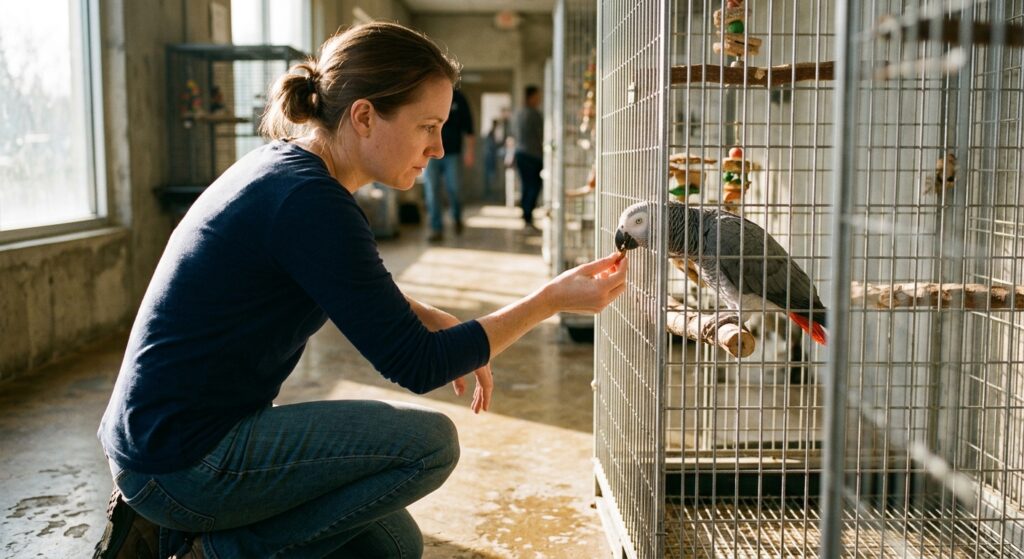
Nobody Hands You a Bird on the First Visit
Expect to come back. Most rescues want to see you at the facility several times before a bird leaves the building, and the visits are not just for the bird's benefit — they are for yours. A cockatoo that is charming for twenty minutes on a play stand is a different animal at 6 a.m. on day nine. Repeat visits let you hear the volume, watch the mess, and see how the bird reacts to you on a bad day as well as a good one.
During these visits, staff are usually watching whether the bird's interest in you holds up across sessions, whether you follow handling instructions, and whether you keep showing up. Consistency at this stage is read as a predictor of consistency later.
The Trial Placement or Foster-to-Adopt Period
Many rescues place the bird in your home under a foster or trial agreement before ownership transfers. The bird is still legally theirs; you are providing the home while everyone finds out whether it works. There is normally a defined check-in window with scheduled contact, and sometimes a home visit.
| Stage | Where it happens | What the rescue is watching for | What you should be judging |
|---|---|---|---|
| Facility visits | Rescue site | Repeat attendance, handling, bird's response to you | Noise level, mess, honest reaction to the bird |
| Trial / foster placement | Your home | Setup, diet compliance, weight, safety, follow-through on contact | Whether your household adapts to the bird's routine |
| Check-in window | Phone, email, home visit | Bird's condition and behavior trend over weeks | Whether the fit is improving or degrading |
Common things a rescue asks about during check-ins:
- Weight, appetite, and droppings — early indicators of stress or illness
- Whether the bird is eating the diet it arrived on, not just seed or table food
- Sleep hours and cage location relative to household traffic
- Feather condition and any new plucking or self-directed behavior
- Screaming, biting, or fear responses, and what preceded them
- Whether other pets and children are being kept out of reach
If It Does Not Work Out
Returning the bird during a trial is a normal outcome, not a disqualification. That is the entire point of the structure. Rescues would rather absorb a return in week three than place the bird permanently into a home that resents it and rehomes it privately in year two. Ask before you sign what the return process looks like, whether fees are refundable, and whether you remain eligible for a future match with a different bird. Rescue guests on our shows return to this point repeatedly: honesty during the trial protects the bird more than persistence does.
Say something the moment a problem appears rather than waiting for the scheduled check-in, because a rescue can usually fix a placement it hears about in week one and rarely one it hears about in month six.
Bringing the Bird Home: The First Weeks
Quarantine Comes Before Introductions
If you already keep birds, the new arrival does not meet them yet. Set the rescue bird up in a separate room with its own air space where possible, and handle your resident birds first each day, the new bird last. Change clothes and wash hands and forearms between the two groups. Most avian veterinarians ask for a quarantine period of several weeks, and your vet should be the one to set the length based on the bird's history and test results — not a number you read online.
Quarantine protects the birds you already have, but it also protects the newcomer. A bird that has moved through a surrender, a rescue holding area, and now your house has had enough change without a flock introduction stacked on top.
Book the Avian Vet Exam Early
Schedule a wellness exam with an avian vet in the first week or two, even if the rescue provided recent paperwork. Bring whatever records came with the bird, a fresh droppings sample if your clinic asks for one, and a note of what the bird has actually been eating and drinking since it arrived. Baseline bloodwork now gives you something to compare against in a year, which matters more with parrots than with most pets because they hide illness well.
Change Nothing for the First Few Weeks
The instinct after adoption is to upgrade everything at once — new cage, pellets, new perches, new toys. Resist it. Ask the rescue what the bird was eating and how the cage was arranged, and reproduce that as closely as you can. Then change one thing at a time, once the bird is eating and drinking normally in your home.
| Item | First few weeks | After the bird settles |
|---|---|---|
| Diet | Exactly what the rescue fed, same brand and schedule | Gradual conversion, one new food at a time |
| Cage | Same size, bar spacing, and perch layout if possible | Rearrange or upgrade slowly |
| Toys | One or two familiar items from the rescue | Add new textures and foraging toys |
| Handling | Sit nearby, talk, offer food through the bars | Step-up and target work |
Expect regression. A bird that stepped up cheerfully at the rescue may refuse for weeks. Talkers often go silent. Some birds eat less, sleep more, or pick a single corner of the cage and stay in it. This is normal settling behavior, not a sign the match was wrong.
What Comes Next
Once the bird is eating well and the quarantine period has cleared, diet conversion and training become the real work. We have covered both extensively on Bird Talk Radio — diet with professional bird keepers and rescue organizations, and positive reinforcement training with guests including Yvonne Patterson Burbach of Wings of Love. Those shows are the natural next step after this stage.
Do not let enthusiasm for a fresh start push you into changing the bird's food, cage, and routine all at once — a parrot that stops eating during a diet switch it did not ask for can be in serious trouble within days.
The Adoption Contract, Follow-Up, and Returning a Bird
What You Sign, and What It Actually Means
The paperwork at a parrot rescue looks different from the paperwork at a pet store, and the difference is the point. A store transaction ends when you walk out. An adoption contract is written to keep following the bird for the rest of its life, which for a macaw or cockatoo may be several decades.
Fees vary widely between organizations and often scale with species, age, and the medical work the rescue has already paid for. Ask what the fee covers before you assume — some rescues have already done a wellness exam, bloodwork, and a wing or nail trim, while others pass those costs to you.
Common clauses to read closely:
- Retained ownership. Some rescues never fully transfer title. You become the bird's permanent caretaker, not its legal owner, which gives the rescue standing to intervene if care deteriorates.
- Right of first refusal. If you can no longer keep the bird, the rescue gets the first opportunity to take it back before you rehome it privately.
- Mandatory return. Stronger than first refusal — the bird must come back to the rescue, not to a friend, a bird club, or a classified ad.
- No breeding, no resale, no transfer. Nearly universal, and usually non-negotiable.
- Care standards. Cage minimums, diet requirements, avian vet visits, and sometimes a ban on free-flighting outdoors or on wing clipping.
| Clause | What the rescue is protecting against | What it asks of you |
|---|---|---|
| Retained ownership | Bird resold or passed along untracked | Accept ongoing rescue oversight |
| Right of first refusal | Bird landing in an unvetted home | Call the rescue first, always |
| Mandatory return | Chain rehoming across strangers | Return the bird, not rehome it |
| No breeding clause | More unwanted parrots entering the cycle | Keep pairs and singles as companions |
| Care standards | Slow decline in husbandry | Keep vet records and honor the diet plan |
Follow-Up Is Not Surveillance
Expect contact after the bird goes home. Depending on the organization, that may be a phone call at two weeks, a photo request, a request for the first avian vet invoice, or an in-person home visit. Some rescues do this once; others check in annually. Treat these as free consulting. The people calling have handled hundreds of birds and can tell you whether the feather chewing you are worried about is stress, molt, or something a vet needs to see.
Returning a Bird Is the System Working
A return is not a verdict on you. Households change — a new baby, a divorce, a move, a diagnosis, a bird that screams at a pitch a particular family genuinely cannot live with. Rescues would far rather take a bird back in good condition, with honest notes about what did and did not work, than find that same bird four owners later in worse shape.
The worst outcome is not returning a parrot to the rescue — it is quietly rehoming it to a stranger and breaking the only chain of accountability that bird has.