You want to know what to put in your bird's bowl tomorrow morning, and you've probably been told that pellets are right and seeds are wrong. That framing is narrower than the conversation our guests actually have.
Since 2015 we've hosted, engineered, and produced around 80 bird talk shows from our Kansas City studio. Whether the guest is a professional breeder, a trainer like Yvonne Patterson Burbach of Wings of Love, a rescue operator, or a wildlife biologist, diet resurfaces more than any other subject.
We are not veterinarians. We are the people who kept the microphone open while experts argued this out. What follows maps where they agree, where they genuinely don't, and what you should do with conflicting advice. The archive streams 24/7/365 if you want the full context.
Why "Pellets vs. Seeds" Is the Wrong Question to Start With
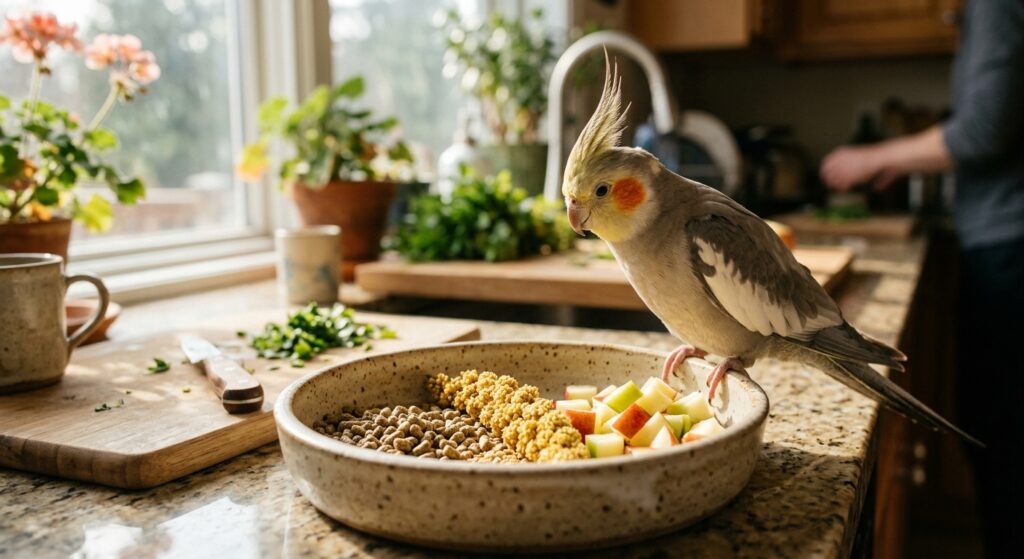
It is the most common question we get, in one form or another: should I feed pellets or seeds? After hosting, engineering, and producing around 80 shows since 2015, we can say that almost no guest answers it the way it is asked. They pause, they reframe, and then they start asking questions of their own.
The question gets rewritten before it gets answered
Bring the pellets-versus-seeds framing to a professional bird keeper, a wildlife biologist, or someone running a rescue, and the conversation almost always widens within the first minute. The reframe usually moves in three directions:
- From a single food to total daily intake. What goes in the bowl matters less than what the bird actually eats over a day, including whatever it takes from a foraging toy, a shared plate, or the floor.
- From "birds" to a species. Guests rarely accept "parrot" as a useful category. A macaw, a budgie, a cockatoo, and a lory are not interchangeable, and neither are their diets.
- From the population to the individual bird. Age, weight, activity level, breeding status, medical history, and what the bird was raised on all change the answer.
That is why the binary frustrates experts. It asks them to rank two grocery categories when the variables they actually work with sit somewhere else entirely.
Why the framing itself is the problem
| What the listener asks | What the guest asks back | Why the reframe matters |
|---|---|---|
| "Pellets or seeds?" | "What does the whole day of food look like?" | A base diet is only part of total intake |
| "Which brand is best?" | "What species, and what age?" | Requirements differ by bird, not by label |
| "How much should I feed?" | "What is this individual bird actually eating?" | Offered food and consumed food are not the same |
| "Is seed bad?" | "Bad compared to what, and in what proportion?" | The answer depends on the rest of the diet |
Set out this way, the pattern is easy to see. The listener is asking for a rule. The guest is trying to describe a system.
What experts want to talk about instead
Guests on our shows — including Yvonne Patterson Burbach of Wings of Love, who joins us regularly — tend to steer toward the things they can actually observe and adjust: what the bird eats versus what it is offered, how food is presented, how a change is introduced, and how the bird responds over weeks rather than days. Training, enrichment, and feeding come up together, because in practice they are not separable topics.
That is the honest answer to why the most popular question is the one specialists are least eager to answer as posed. It has no single correct response, and answering it cleanly would mean leaving out everything that makes the answer useful.
If a source gives you a confident pellets-versus-seeds verdict without asking about your species, your bird's history, and its full daily intake, treat that confidence as a reason for caution rather than reassurance.
Where Our Guests Actually Agree: The All-Seed Diet
Across roughly 80 shows, we have put breeders, rescue operators, wildlife biologists, and trainers like Yvonne Patterson Burbach of Wings of Love in front of the same microphone. They disagree about plenty — pellet brands, how much fruit is too much, whether sprouting is worth the labor. They do not disagree about this: a bird eating nothing but dry seed, with no supplementation and no fresh food, is a bird headed for trouble. That is the baseline problem every other recommendation on our shows is built around solving.
Why Seed Alone Fails
The objection our guests raise is not that seeds are bad food. It is that a seed mix left in a bowl is not a diet — it is a buffet the bird gets to edit. Given the choice, most parrots eat the high-fat items and leave the rest. Sunflower and safflower go first. The smaller, less appealing seeds sit at the bottom of the bowl until the owner tops it off, which hides how little variety the bird is actually consuming.
The result our guests describe is a bird eating three or four ingredients out of a twelve-ingredient mix, day after day, for years. Even a well-formulated seed blend cannot deliver a complete profile when the animal only eats a fraction of it.
What Rescue Operators Report Seeing
Rescue guests are the most direct on this point, because surrendered birds arrive with a history the owner often cannot describe. The patterns they tell us they see repeatedly:
- Overweight birds with poor exercise tolerance, particularly Amazons and budgies
- Dull, brittle, or poorly barred feathers, sometimes with abnormal molt patterns
- Dry, flaky skin and overgrown beaks and nails
- Birds that panic or refuse to eat when anything unfamiliar enters the bowl
- Birds that arrive apparently healthy and then decline quickly under any stress
That last point comes up often. Guests describe seed-only birds as having no reserve — they hold together until something taxes them, then fall apart fast.
The Two Problems, Separated
It helps to keep these distinct, because they need different fixes.
| The problem | What guests attribute it to | What it takes to correct |
|---|---|---|
| Nutritional gaps | Selective eating from an unsupplemented mix | Adding formulated food and fresh items to the rotation |
| Food neophobia | Years of an unchanging bowl | Slow, patient conversion work — weeks or months, not days |
A bird can have both at once, and the second usually blocks the fix for the first. Rescue guests tell us the hardest conversions are not the sickest birds; they are the birds that have never seen a vegetable and treat one as a predator in the cage.
If you take one thing from our guests, take this: the danger is not seed itself but a bowl that never changes, because a bird that has only ever eaten one thing will resist the very food that would help it.
The Case for Pellets, as Professional Keepers Make It
Every Bite Carries the Same Nutrition
The argument we hear most often from guests who build their programs around a formulated pellet comes down to predictability. A pellet is manufactured so that each piece contains the same profile of protein, fat, vitamins, and minerals as the piece next to it. Whatever the bird eats, it eats the whole formula.
Compare that to a mixed diet assembled by hand. Even a careful keeper is estimating — how much calcium is in this week's kale, how much vitamin A actually survived in a piece of sweet potato that sat in the bowl for six hours, how much fat is in a particular batch of sunflower. Guests who work in rescue and sanctuary settings tell us they simply do not have the labor to run that calculation bird by bird, so they start from a base they can trust and adjust from there.
Removing the Bird's Ability to Sort
The second argument is behavioral, and it is the one that comes up in nearly every diet conversation we record. Given a bowl of mixed items, most parrots do not eat proportionally. They eat their favorites first, and their favorites are usually the highest-fat items in the mix.
A uniform pellet takes that choice away. There is nothing to sort, so there is no way to build a diet out of sunflower seeds and peanuts while leaving the rest to be thrown out at the end of the day.
| What the keeper offers | What the bird tends to eat | What the keeper can verify |
|---|---|---|
| Seed mix with sunflower and nuts | The high-fat pieces, leaving the rest | Only what is left in the bowl |
| Assorted fresh chop | The sweet and starchy items first | Rough estimate at best |
| Single formulated pellet | The same thing every bite | Intake by volume consumed |
The Practical Reality of a Multi-Bird Collection
Nutrition arguments aside, our guests who keep more than a handful of birds raise a point that is purely operational. Feeding twenty or forty birds is a different job than feeding one, and the diet has to survive contact with a real daily routine.
The reasons they cite for a pellet base include:
- One bowl, one product — no per-bird measuring, mixing, or portion adjustment.
- Shelf stability — pellets can sit in a bowl through a hot day without spoiling the way soft food does.
- Delegable feeding — volunteers, staff, or a sitter can feed the collection correctly without training in avian nutrition.
- Traceable problems — when a bird's condition changes, the base diet is a constant, which makes the variable easier to find.
A pellet base is a starting point that guarantees baseline nutrition, not a complete diet — our guests who advocate for it are almost always feeding fresh food alongside it, which is where the next section picks up.
The Pushback: Guests Who Argue Pellets Are Not the Whole Answer
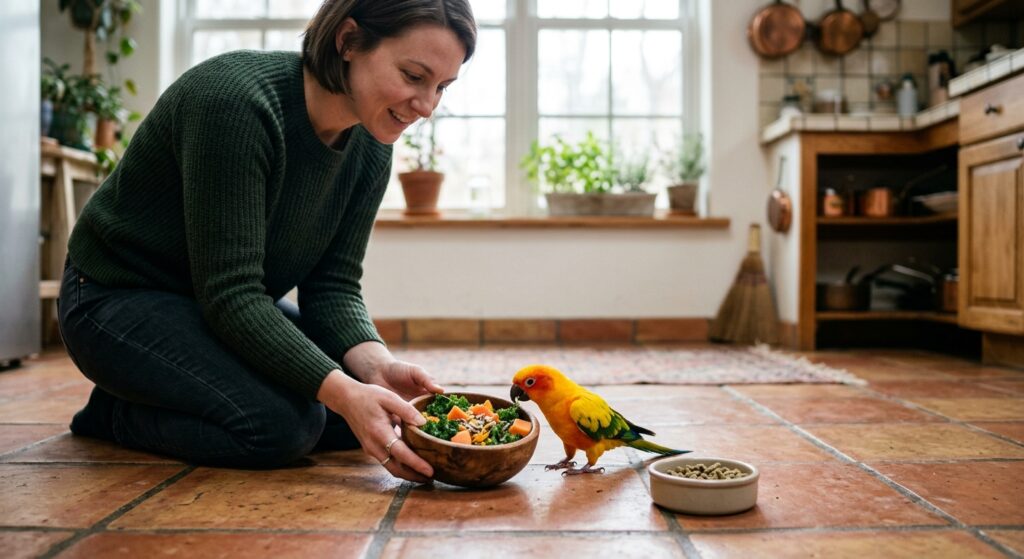
Not every guest who comes on the show treats a bag of formulated diet as the finish line. Over roughly 80 recorded conversations, the most consistent pushback has not been "pellets are bad" — it has been "pellets alone are not a diet plan." The distinction matters, and it comes up in four recurring forms.
One Manufactured Food Carrying the Whole Load
The first objection is structural. If a bird eats a single product for every meal of its life, that product's formulation decisions — which ingredients, which fortification levels, which binders and colorants — become the bird's entire nutritional reality. Guests who work with large collections have pointed out that they have no way to audit that, and that a formulation can change between production runs without the keeper noticing.
Brand-to-brand variation is the same worry at a different scale. Two bags labeled for the same species can differ in protein level, fat content, ingredient quality, and whether artificial color and preservatives are used at all. Owners often assume "pelleted" is a standard. It is a category, not a specification.
| Point of variation | Why guests raise it | What they suggest doing |
|---|---|---|
| Ingredient base | Grain-and-soy versus nut- or fruit-forward formulas suit different species | Match the formula to the bird, not to the shelf |
| Fortification level | Over-supplementation is a real risk when a fortified food is the only food | Read the label; ask the maker questions |
| Artificial color and preservatives | Some keepers avoid them on principle | Compare labels across brands before committing |
| Batch consistency | Recipes and suppliers can change | Watch droppings, weight, and appetite after a new bag |
The Behavior Argument: Food Should Take Work
The second line of pushback has nothing to do with nutrients. A bowl of uniform kibble is solved in minutes. Wild parrots spend a large share of their waking day locating, extracting, cracking, peeling, and rejecting food. Guests working in rescue and sanctuary settings have tied the loss of that daily problem-solving to the behaviors owners call in about most:
- Feather-destructive behavior in birds with nothing to occupy them
- Screaming that starts when the food bowl empties and the day has no other structure
- Neophobia — birds that refuse anything unfamiliar because nothing has ever been unfamiliar
- Cage aggression around a resource that arrives all at once instead of being worked for
A formulated base can still be delivered through foraging toys, wrapped packets, or scattered presentations. The objection is to the bowl, not necessarily to the pellet.
Wild Diets Are Seasonal, Not Fixed
Building on our earlier discussion of Tony Silva's field-informed approach, several guests have made the broader point that no wild population eats one thing year-round. Availability shifts by season, and so does intake — different fruits, seeds at different stages of ripeness, browse, and periods of relative scarcity. A diet that never changes is, in that framing, unlike anything the species evolved to handle.
The strongest version of this argument is not "skip the pellets" — it is that a fixed bowl of anything, fed the same way every day for twenty years, ignores how birds are built to eat.
Fresh Food, Chop, and What Guests Say Actually Gets Eaten
Vegetables First, Fruit as a Garnish
If there is one piece of fresh-food advice that comes up in nearly every show we record, it is that vegetables should make up the bulk of the fresh portion and fruit should be treated as a small extra. Guests give slightly different reasons — sugar content, water content, the tendency of birds to pick sweet items out and leave the rest — but the practical instruction is consistent. Dark leafy greens, squashes, peppers, sweet potato, carrot, broccoli, and beans come up repeatedly. Fruit is described as a topper, a training reward, or a way to get a suspicious bird interested in something new.
Where guests genuinely disagree is on how much fresh food a bird should get and what proportion of the overall diet it should represent. Those are preferences shaped by species, individual birds, and each keeper's own flock. The vegetables-over-fruit ordering is not a preference; it is close to unanimous on our shows.
Chop, Preparation, and Getting It Eaten
"Chop" — a mixed batch of chopped vegetables and grains, made ahead and portioned — comes up constantly because it solves a real problem: fresh food only works if it actually gets served. Guests who batch-prepare describe freezing portions and thawing daily. Others prefer chopping fresh each morning and argue nutrients hold up better. Both camps agree that a bird refusing fresh food usually needs repeated, patient exposure rather than a different vegetable.
Common serving tactics our guests describe:
- Cutting or shredding to a size the bird can hold in a foot
- Offering the same item several different ways — raw, cooked, whole, grated — before deciding a bird dislikes it
- Serving fresh food early in the day, when birds tend to eat most
- Modeling the food yourself, or letting a bird watch another bird eat it
- Removing uneaten fresh food before it sits and spoils
Spoilage and the Foods Nobody Argues About
Fresh food carries a spoilage risk that dry diets do not. Guests routinely warn about warm rooms, humid cages, and food left in a bowl all day. The rule repeated most often is simple: put it in, take it out.
The toxic list is the least controversial thing discussed on any of our diet shows.
| Item | Why guests flag it | What they advise |
|---|---|---|
| Avocado | Toxic to birds | Never offer, in any form |
| Chocolate | Toxic | Keep off counters and out of reach |
| Caffeine | Toxic | No coffee, tea, or soda sharing |
| Salt / salty snacks | Birds are small; salt loads add up fast | Avoid salted human foods entirely |
| Alcohol | Toxic | Never |
Fresh food that sits in the cage for hours can do more harm than the fresh food you never offered, so serve it, watch it, and pull it out before it spoils.
Converting a Seed-Only Bird: The Training Problem Nobody Skips
Why the Diet Question Keeps Becoming a Behavior Question
Somewhere in almost every diet episode we record, the conversation stops being about nutrition and starts being about behavior. A caller asks what to feed a bird that has eaten sunflower seed for eleven years, and the answer from the trainers and rescue operators we host is never a shopping list. It is a method. The bird does not recognize pellets or chopped vegetables as food, and a parrot that does not recognize something as food will let it sit in the bowl until it spoils.
That reframing matters. Conversion is a training project with a nutritional goal, not a feeding change with a training footnote. Trainers who work with birds daily — including Yvonne Patterson Burbach of Wings of Love, a regular guest on our shows — talk about conversion the same way they talk about teaching any new behavior: small approximations, patience, and reinforcement for the step the bird actually offered rather than the one you wanted.
What Our Guests Consistently Recommend
Across shows, the practical guidance our guests give lines up closely:
- Go gradual. Abrupt removal of the familiar food is the failure mode our rescue guests hear about most often, usually after the fact.
- Offer the new food when the bird is most motivated to eat, and keep the presentation consistent day to day.
- Model the behavior. Eating the food yourself, or feeding a flock member who already accepts it, does work a bowl cannot do.
- Involve an avian veterinarian before you start, so you have a baseline and someone to call if the bird stalls.
- Give it weeks, not days. Guests who run rescues describe conversions that took months for older birds.
Monitoring: The Part People Skip
A bird can appear to be converting while quietly eating almost nothing. Our guests are emphatic that you measure rather than assume.
| What to monitor | Why it matters | When it warrants a call |
|---|---|---|
| Weight, on a gram scale, at the same time daily | Loss shows up here before it shows anywhere else | Sustained decline, or a drop your avian vet has flagged as significant for that bird |
| Droppings | Volume and content indicate whether the bird is genuinely eating | Reduced volume, or a change that persists past a normal dietary adjustment |
| Bowl contents | Food scattered is not food eaten | Consistently untouched new food after repeated sessions |
| Activity and posture | Energy drops with intake | Any fluffed, quiet, or perch-bound change |
The Method Underneath All of It
The reinforcement mechanics that make conversion work are the same ones we covered with Ginger's Parrot Rescue in our positive reinforcement episodes. If you want the underlying method — what to reinforce, how to break a goal into approximations, and why punishment has no role — start there and bring it to the food bowl.
Never remove the old diet before the bird is reliably eating the new one, because a parrot will starve beside a full bowl of food it does not recognize.