Your bird screams when you leave the room, when you're on the phone, when the sun goes down — and nothing you've tried has quieted it for long.
Across roughly 80 shows we've hosted, engineered, and produced from our Kansas City studio since 2015, no question has come up more often than this one. And our guests — professional bird keepers, trainers like Yvonne Patterson Burbach of Wings of Love, wildlife biologists, rescue operators — keep landing on the same framing: a screaming parrot is communicating, not misbehaving.
What follows gathers that on-air guidance into one place. It treats screaming as a matter of routine, environment, and reinforcement rather than discipline. None of it replaces a veterinary exam when your bird's noise changes suddenly.
What a Scream Actually Is in a Wild Flock
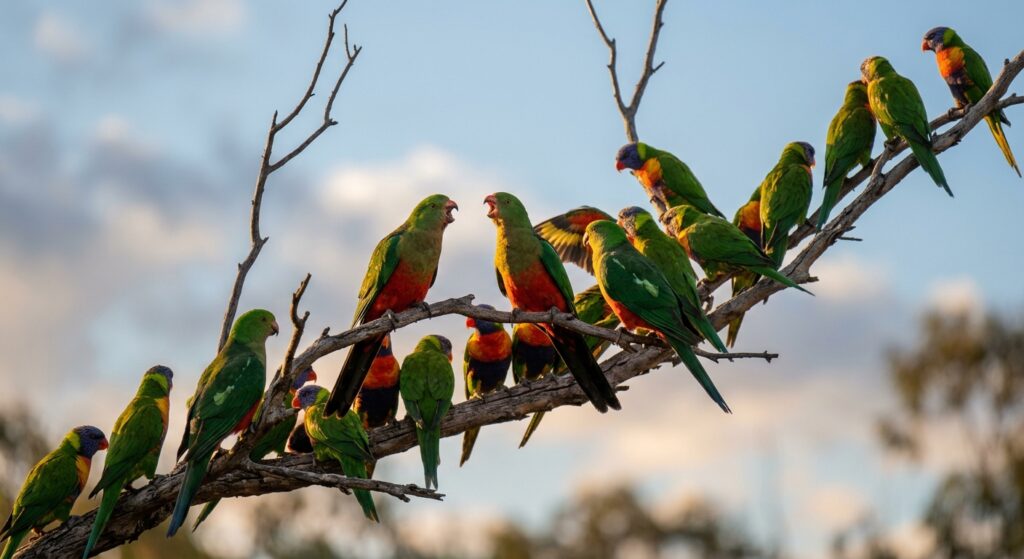
A parrot's voice is not an accident of domestication. It is field equipment, built for a bird that lives in a canopy where its flock mates are often out of sight but rarely out of earshot. The wildlife biologists and professional keepers who have come on our show since 2015 return to this point over and over: before you can change screaming, you have to understand what the sound is for.
The Contact Call Is a Question, Not a Complaint
In a wild flock, a loud call thrown out across the trees generally means something close to "where are you?" A flock mate answers, and both birds get the information they need — everyone is accounted for, nobody has been picked off, the group is still cohesive. That call-and-answer loop runs all day long. It is how a flock stays a flock while individual birds forage, preen, and move through dense foliage.
Volume is the whole point. A sound that has to travel through leaves, wind, and distance has to be loud, sharp, and repetitive enough to cut through. Our guests consistently describe this as normal, healthy equipment functioning exactly as designed. The same call that works across a hundred meters of canopy simply lands differently across twelve feet of living room.
Not All Loud Sounds Mean the Same Thing
Keepers and biologists on the show tend to separate loud vocalizing into distinct categories with distinct causes. Lumping them all together as "screaming" is what leads owners to try the wrong fix.
| Vocalization | Function in the flock | What it tends to look like at home |
|---|---|---|
| Contact call | Locating flock mates who are out of sight | Bird calls when you leave the room; stops when you return or answer |
| Alarm call | Warning the flock about a perceived threat | Sudden, sharp bursts tied to a hawk overhead, a new object, a visitor |
| Flock chorus | Group vocalizing at dawn and dusk | Predictable loud periods at sunrise and sunset regardless of what you do |
| Learned demand call | Not a wild behavior — shaped by response | Escalating, targeted, reliably produces attention, food, or release |
What This Means for Your Expectations
The practical takeaway our guests offer is a reframing of the goal:
- A parrot that never vocalizes loudly is not a well-adjusted parrot — it may be a sick or shut-down one.
- Dawn and dusk noise is species-typical and is generally managed by scheduling, not eliminated by training.
- Contact calling is answerable. If your bird is asking where you are, a whistle back is a legitimate response.
- Only the learned demand call is genuinely a behavior problem, and it is one that the household usually built without meaning to.
The mistake that sinks most screaming plans is trying to train away a contact call, which is a normal question your bird is entitled to ask, instead of identifying which of these four sounds you are actually dealing with.
Sorting Normal Noise From the Screaming You Want to Change
The Sounds That Come With Owning a Parrot
Before anyone builds a behavior plan, it helps to separate the vocalizing that comes standard with a parrot from the vocalizing that signals a problem. Two categories almost never need fixing:
- Dawn and dusk sessions. Most parrots ramp up loudly for roughly 15 to 30 minutes after the lights come on and again as the light fades. It is predictable, it stops on its own, and it happens whether or not anyone responds.
- Contact calling. Short, repeated calls when you leave the room. Your bird is checking that the flock is intact. Answer with a whistle or a word from the next room and the calling usually stops.
- Excitement noise. Shower running, vacuum on, favorite person walking through the door, another bird calling outside the window. Loud, brief, tied to an obvious trigger.
- Foraging and play chatter. Ambient background sound while the bird is busy. This is a bird that is doing well.
What Escalating Screaming Looks Like
The screaming worth addressing has a different shape. It does not resolve on its own, it gets louder rather than quieter when ignored inconsistently, and it often has no visible trigger by the time you notice it.
| Feature | Normal vocalizing | Screaming worth addressing |
|---|---|---|
| Timing | Dawn, dusk, tied to events | Scattered through the day, no clear pattern |
| Duration | Minutes, self-limiting | Long stretches, restarts quickly |
| Volume trend | Steady or fading | Escalates when unanswered |
| Response to a return call | Settles | Intensifies or continues |
| Body language | Relaxed, foraging, preening between calls | Pacing, cage-bar climbing, feather damage, refusing food |
| What usually fixes it | Nothing needed | Change to diet, enrichment, sleep, or attention timing |
Guests on our shows come back to the same short list of unmet needs behind persistent screaming: not enough sleep, a diet that leaves the bird under-stimulated or under-nourished, too little foraging work, and an attention schedule the bird cannot predict. Training addresses the last one. The first three are husbandry.
When to Call an Avian Vet Instead
A training plan is the wrong first move when the vocalization itself changes character. Book an avian veterinary exam, not a behavior consult, if you notice:
- A voice that turns hoarse, weak, wheezy, or drops out entirely.
- Screaming that starts abruptly in a bird that was previously quiet, with no change at home to explain it.
- Vocalizing paired with tail bobbing, open-mouth breathing, clicking sounds, or discharge.
- A sudden shift in an older bird, or one that appears alongside weight loss, changed droppings, or reduced appetite.
Parrots conceal illness well, and a change in voice is sometimes the first crack in that cover.
If the screaming appeared suddenly in a bird that never screamed before, treat it as a medical question until an avian vet tells you otherwise.
The Reinforcement Loop Owners Build Without Meaning To
Every parrot in a wild flock learns the same lesson: call out, and the flock answers. A bird in a living room cage is running that same program, and the people in the house answer it far more reliably than any wild flock ever would. That is the whole mechanism. Nothing about it requires the bird to be spiteful, spoiled, or badly bred.
What the Bird Is Actually Learning
In our episode on positive reinforcement with Ginger's Parrot Rescue, the core idea was simple: behavior that gets a bird something it wants happens more often. Owners tend to apply that to step-up training and target sticks and then forget it applies to everything else in the house, including the noise they hate.
From the parrot's side of the bars, a scream is a question and your reaction is the answer. Consider what the bird experiences when it lets loose while you are in the next room:
- You walk in. The flock returned. Screaming works.
- You shout "Quiet!" A loud contact call answered with a loud contact call. Screaming works, and the flock is loud too.
- You cover the cage. You appeared, spoke, moved, and touched the cage. Screaming works, with a light show at the end.
- You hand over a nut to stop it. Screaming works and pays.
- You leave the room in frustration. Sometimes the only response that doesn't reinforce anything — but only if you left before the noise started, not because of it.
The bird is not doing arithmetic. It is simply repeating what produced results.
Why Inconsistency Makes It Worse
Most owners do not respond every time. They ignore the first four screams, then break on the fifth because they are on a work call or the neighbors are home. That intermittent pattern is the most durable reinforcement schedule there is. A bird that gets an answer one time in ten will keep calling for a very long time before giving up, because it has learned that persistence eventually pays.
| What you do | What the bird learns | What happens to the volume |
|---|---|---|
| Answer every scream | Screaming reliably summons the flock | Stays constant, often escalates in pitch |
| Answer sometimes | Keep going, it works eventually | Gets longer and more persistent |
| Answer only quiet contact calls | Soft calls summon the flock | Softer calls increase, screams fade |
| Ignore everything, including quiet | Nothing I do brings anyone | Screaming often escalates first |
The Reaction You Cannot Hide
Parrots read body language far better than most owners expect. Stomping in with a tense posture, a raised voice, and hard eye contact is a large, dramatic, interesting event. Several of our guests have made the same point from different angles: an angry human is still an engaged human, and engagement is the payoff.
Before you try to change your bird's behavior, spend three days honestly tracking your own — you cannot stop reinforcing a scream you have not yet noticed yourself answering.
Routine, Light, and Sleep: The Environmental Causes Our Trainers Raise First
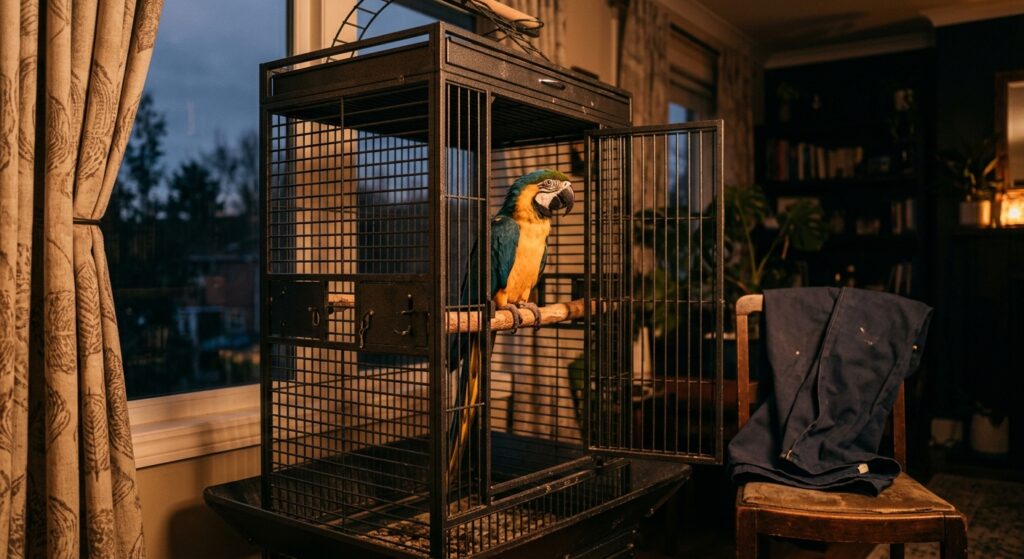
When a caller comes to a show with a screaming problem, the first questions from our guests are almost never about training. They are about the house. Professional keepers, rescue operators, and trainers like Yvonne Patterson Burbach of Wings of Love tend to start with the bird's day — when it wakes, where it sits, what it can see, and whether any of that changes from one morning to the next. A flock bird organizes its behavior around predictability. Take the predictability away and the noise usually follows.
Sleep and Light Come First
Sleep is the variable guests raise more than any other, because a short or interrupted night shows up as irritability and volume the next day. A parrot sleeping in the main living room is not sleeping — it is dozing between television, conversation, and lamp light, and waking at every change. The related issue is the light cycle itself. Long artificial evenings stretch a bird's perceived day well past what it would get outdoors, and several of our guests connect that stretched photoperiod to both screaming and hormonal behavior in mature birds.
Practical points that come up repeatedly on air:
- A separate, dark, quiet sleeping space beats a cage cover in a busy room.
- Consistent lights-out matters as much as total hours.
- Sudden darkness with no warning can trigger night frights in some species; a low night light helps certain birds and disturbs others.
- Weekend schedules that differ sharply from weekdays reset the problem every seven days.
Cage Location Changes the Volume
Where the cage sits determines how much a bird has to yell to stay in contact with its people.
| Placement | What the bird experiences | Common vocal result |
|---|---|---|
| Isolated back room | Out of sight of the flock all day | Loud, repeated contact calling |
| Center of a high-traffic room | Constant motion, no retreat | Startle calls, overstimulation |
| Corner of a shared room, one solid side | Company plus a defensible back wall | Lower baseline noise |
| Directly at a large window | Hawks, cats, delivery vans | Alarm screaming with no off switch |
Meals and Daily Rhythm
Feeding is a flock event, and birds anticipate it. When meals arrive at wildly different times, a hungry parrot has no reason to wait quietly — calling is the only tool it has. Guests routinely suggest anchoring the day with fixed points: uncover, breakfast, out-of-cage time, foraging food mid-day, dinner, and bed. The specific schedule matters less than the fact that it repeats. Sudden household changes — a new work shift, a move, a family member leaving — commonly show up as a screaming episode a few days later, and owners often miss the connection because the noise did not start the same day the routine did.
Fix sleep, light, and schedule before you change a single thing about how you respond to the screaming, because a tired, overstimulated bird will not respond to training you have not given it the rest to absorb.
Boredom, Foraging, and What Wings of Love Show Birds Do All Day
A Show Bird's Day Is Mostly Work, and That Is the Point
Yvonne Patterson Burbach, owner and trainer behind the Wings of Love bird shows, has been one of our most frequent guests since we began recording in 2015, and the thread that runs through her appearances is how much structure a performing bird's day carries. A show bird isn't idle. It has training sessions, travel and crate time, handling, rehearsal of behaviors it already knows, and food delivered as part of that work rather than dumped in a bowl at sunrise. The bird spends its waking hours solving small problems with a person paying attention to it.
Compare that to the standard pet-bird day: a full dish of seed or pellets at 7 a.m., a cage, and eight hours of nothing until someone comes home. A parrot with the intelligence to learn a stage routine and nothing to apply it to will apply it to noise, because noise reliably produces a person.
Turning Show Structure Into Home Occupation
You don't need a stage. You need the same principle: make the bird earn, search, and shred for most of what it gets.
- Split the daily ration into four to six portions and hide them across the cage instead of serving one bowl.
- Wrap pellets in butcher paper, stuff them in paper cups, or bury them in shredded paper so the bird has to work through packaging.
- Run two or three short training sessions a day — five minutes each is enough — on simple behaviors like step-up, target, or station.
- Rotate toys weekly rather than leaving the same four in place for months.
- Give destructible material daily: soft wood, palm leaf, cardboard, untreated paper.
- Schedule one predictable out-of-cage session so contact isn't something the bird has to scream to obtain.
Match the Difficulty to the Bird
Birds that have never foraged will ignore a hard puzzle and go hungry rather than solve it. Start visible and get harder.
| Stage | Setup | Right for |
|---|---|---|
| Level 1 | Food in an open dish with paper laid over the top | Birds new to foraging |
| Level 2 | Food in several small cups around the cage, uncovered | Birds already searching |
| Level 3 | Food wrapped in paper or inside cardboard tubes | Confident shredders |
| Level 4 | Commercial puzzle toys, skewers, hidden caches | Birds foraging reliably at Level 3 |
Move up only when the bird empties the current level within a few hours. If food is left untouched at the end of the day, drop back a stage and try again in a week.
Never convert a bird to foraging toys overnight and walk out the door — verify it is actually eating at each new difficulty level before you make the next one harder.
Teaching a Quieter Contact Call: A Practical Plan From the Rescue Side
The plan our rescue and training guests describe on air is not complicated, but it depends on doing the same thing every day for weeks. Most of it comes down to changing what you say back, not what the bird says first.
Choose a Replacement Call and Answer It Consistently
The starting point is picking one sound you are willing to make for the rest of the bird's life. A two-note whistle, a short word, a phrase — the specific sound matters less than your willingness to repeat it thousands of times. Rescue operators who take in screaming birds have described running this the same way with every intake:
- Pick the call and teach it in calm moments, when the bird is settled and you are in the room.
- Whistle or say it, and reward any attempt the bird makes to copy it — head tilt, partial sound, full match.
- Walk out of sight, wait a beat, and give the call from the next room. Answer immediately when the bird returns it.
- Increase the distance and the delay gradually, so the bird learns you will answer even when you are not visible.
- Use the call before the bird has a reason to scream — on your way out of the room, not after the noise starts.
The goal is a bird that checks in quietly because checking in quietly works.
Handle the Scream Without Going Silent
Total silence often makes things worse, because from the bird's side an unanswered contact call means the flock is gone. What our guests recommend is answering the quiet, not the volume.
| What you do when the scream starts | What the bird learns |
|---|---|
| Run in, shout, cover the cage | Screaming brings the flock back fast |
| Full silence, no response at all | Nobody answered — call louder |
| Stay put, say nothing, then give your call the moment there's a pause | Quiet sounds get answered; screams don't |
| Give your call before leaving the room | I already know where you are |
The pause is the part people miss. Wait for two or three seconds of quiet, then whistle. If you wait for perfect silence you may wait forever; take the first gap you get and shorten your reaction time as the bird improves.
Expect Weeks, and Expect It to Get Louder First
Every rescue guest who has walked through this on the show has said the same thing about timing: the behavior gets worse before it improves. A bird that has been reinforced for months or years will escalate when the old response stops working, and that spike is evidence the plan is doing something, not evidence it failed. Judge progress across several weeks, not day to day.
The single fastest way to undo weeks of work is to answer one especially loud scream because you finally cracked — that one response teaches the bird exactly how long to hold out next time.