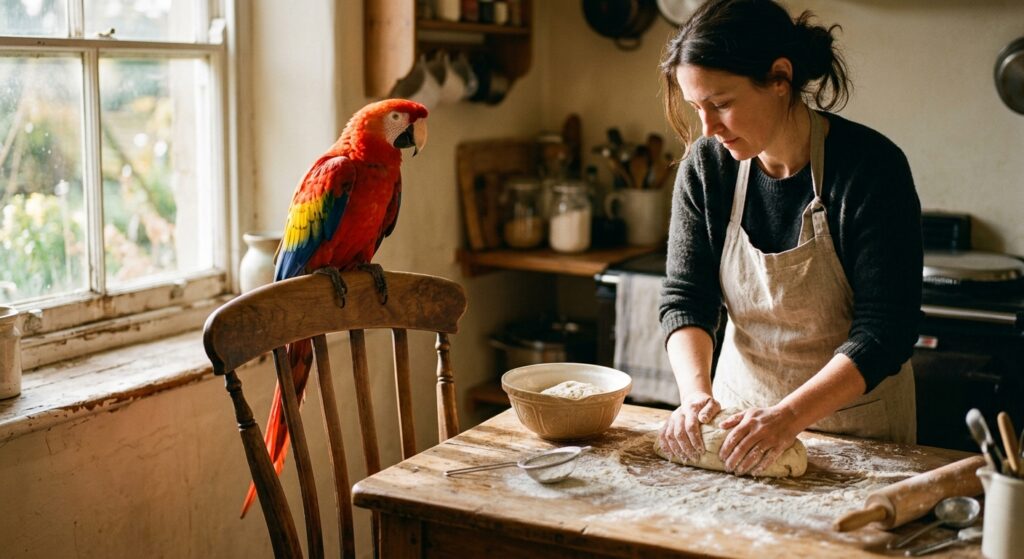
You hear it in a bird club meeting or a rescue's intake call and nobody stops to explain it: someone's "FIDS" need a sitter, or their FIDS just moved to a bigger cage. It's shorthand for feathered kids — and the people using it mean it fairly literally.
Since 2015, across roughly 80 shows produced from our Kansas City studio, we've heard that word used naturally by breeders, wildlife biologists, rescue operators, and trainers like Yvonne Patterson Burbach of Wings of Love. A companion parrot lives inside the household for decades, not on a shelf as decor.
This article covers where the term came from, what it obligates a keeper to do, and the real behavioral differences between a domestically raised parrot and a wild-caught bird.
Where "FIDS" Came From and Why the Word Stuck
A Contraction Born in Typing, Not in Speech
"FIDS" is simply "feathered kids" squeezed down to a few letters. It started as keyboard shorthand — the kind of abbreviation that grows naturally in message boards, email lists, and later social media groups where parrot people trade advice at all hours. When you are typing a post about four birds, three of whom are screaming while you type, "my fids" is faster than "my feathered kids." The word spread the way most community slang spreads: someone used it, everyone understood it instantly, and nobody needed it explained.
What is notable is that it survived the jump out of text. In the roughly 80 shows we have hosted and produced from our Kansas City studio since 2015, guests say it out loud — keepers, rescue volunteers, and trainers alike. A term that started as typing shorthand became part of how aviculturists actually talk about the birds in their homes.
Why "Pet" Never Quite Fit
Most people who keep parrots eventually run into the limits of the word "pet." It is not wrong, exactly. It just does not describe the arrangement. A parrot is not a low-maintenance addition to a household — it is a long-term resident with opinions, preferences, and a voice.
| What the relationship involves | What "pet" suggests | What "fid" suggests |
|---|---|---|
| Length of commitment | A few years to a decade | A shared life, often planned around in a will |
| Daily interaction | Feeding and occasional play | Meals, out-of-cage time, training, conversation |
| Behavioral needs | Basic care | Enrichment, foraging, social contact, routine |
| Household role | An animal you own | A member of the household with a schedule |
The Practical Reasons Keepers Reach for It
Beyond sentiment, the word does real work in conversation. Enthusiasts prefer it because:
- It signals the timeframe. Larger parrots can outlive the arrangements made for them, which is why rescue and sanctuary placement is a recurring topic on our shows. "Fid" carries that weight in a way "pet" does not.
- It flags a shared set of assumptions. If someone refers to their fids, you already know they think in terms of diet quality, training, and enrichment — the same subjects our guest speakers, including professional bird keepers and wildlife biologists, return to again and again.
- It acknowledges the bird's independence. Parrots are not domesticated the way dogs are. "Kid" captures the dependence and the willfulness at once.
- It travels well between audiences. A first-time cockatiel owner and a sanctuary director both understand it.
None of this means the word is required, and plenty of experienced keepers never use it. But it caught on because it is accurate.
If the word "pet" feels too small for the bird in your living room, that instinct is worth taking seriously — it usually means you are already thinking about a commitment measured in decades rather than years.
What Calling a Parrot Your Kid Actually Commits You To
Calling a bird your "kid" is a fair description of the relationship, but it also describes a workload. The people we have hosted on air since 2015 — breeders, trainers, rescue operators, wildlife biologists — tend to circle back to the same practical realities, no matter what species they work with.
The Commitment Outlasts Most Life Plans
Parrots are not short-term animals. Larger species can live for decades, and it is common for a cockatoo, macaw, or amazon to outlive the person who brought it home, or at least to outlive that person's ability to care for it. That is why serious keepers treat placement as a planning question, not a crisis question:
- Name a specific person — not a vague "someone in the family" — who has agreed in advance to take the bird.
- Write the arrangement into your will or trust, with funds attached if you can manage it.
- Keep a written care record the next caretaker can actually use: diet, vet history, band or microchip number, behavioral quirks.
- Talk to a sanctuary or rescue before you need one. Intake space is finite and rarely available on short notice.
The Daily and Weekly Obligations
The word "FIDS" implies a household member, and household members do not get fed and ignored. Here is what the commitment looks like in practice, and what tends to go wrong when it slips.
| Obligation | What it looks like day to day | What slipping usually produces |
|---|---|---|
| Out-of-cage time | Supervised hours outside the cage, every day, with something to chew and destroy | Frustration behaviors, screaming, feather destruction |
| Species-appropriate diet | Fresh foods and a formulated base, not a seed bowl on repeat | Nutritional disease that shows up years later |
| Avian veterinary care | An avian vet identified before there is an emergency, plus baseline wellness exams | Late diagnosis, because prey animals hide illness until it is advanced |
| Training and handling | Short, consistent sessions built on cooperation, not force | A bird that becomes progressively harder to handle, medicate, or rehome |
Diet and training come up on our shows more than any other topics, and for good reason — they are the two areas where a well-meaning owner can be doing something wrong for years without obvious symptoms. A general-practice veterinarian is not a substitute for someone who works with birds routinely.
The Emotional Labor Part
The piece that surprises people is not the cleaning or the produce chopping. It is that an intelligent, socially bonded animal never fully outgrows dependence the way a dog largely does or a child eventually should. Your parrot will still need your attention, your presence, and your patience on the days you have none left. It will notice a change in the household before you announce it. That is the actual meaning of the word.
If you cannot name today who takes your bird when you no longer can, you have not finished making the commitment the word "FIDS" implies.
Wild-Caught Versus Domestically Raised: What Changes in the Bird
A parrot that hatched in a nest hollow and was trapped as an adult is not a pet that needs socializing. It is a wild animal that happens to be in your living room. Its flight response, flock vigilance, and predator-avoidance instincts are fully intact and were reinforced every day of its life before capture. A parrot hatched in a breeder's or keeper's home has spent its entire existence with human faces, human hands, and human noise in the background. That difference in starting point shapes almost everything that follows.
The Wild-Caught Starting Point
For a wild-caught bird, a human reaching into a cage reads as a predator reaching into a nest. Nothing about that interpretation is a behavior problem — it is an accurate read of the world the bird came from. Common consequences keepers and rescue organizations describe include:
- Freezing, thrashing, or crashing at the far side of the enclosure when approached
- Contact calling that never resolves, because the flock it is calling for does not exist
- Refusal of unfamiliar foods, since foraging preferences were set in the wild
- Feather damage and stress behaviors that appear months after arrival, not immediately
- Slow, uneven trust-building that can be undone by a single frightening event
None of this means a wild-caught parrot cannot live well. It means the timeline is measured in years and the goal is a calm, unpressured life rather than a hands-on companion.
The Domestically Raised Starting Point
A parrot raised around people forms its early associations with human presence rather than against it. Hands, towels, carriers, vacuum cleaners, and dogs are simply part of the environment it grew up in. The bird still has full prey-species instincts — every parrot does — but those instincts are not triggered by ordinary household activity.
| Dimension | Wild-caught | Domestically raised |
|---|---|---|
| Baseline response to humans | Predator avoidance | Neutral to social |
| Flock reference point | Lost wild flock | Human household |
| Diet flexibility | Narrow, wild-set | Broader, formed in captivity |
| Novel objects | Often alarming | Usually investigated |
| Handling potential | Limited, may never be safe | Generally achievable |
| Recovery from a scare | Slow, may regress | Faster, usually recovers |
Why the Difference Persists
Fear that is chronic rather than situational is the real dividing line. A domestically raised parrot startles, recovers, and returns to baseline. A wild-caught parrot may never fully return to baseline in a household setting, because the environment itself is the stressor. Guests on our shows — professional bird keepers, wildlife biologists, and rescue organizations discussing training and behavior — consistently frame this as a management question rather than a training question: you adjust the enclosure, the sightlines, the routine, and your own approach speed, rather than expecting the bird to change.
If you take in a wild-caught parrot, plan your setup around a bird that may never want to be touched, and treat any progress toward handling as a bonus rather than the objective.
Why Domestic Rearing Is Not the Same as Good Behavior
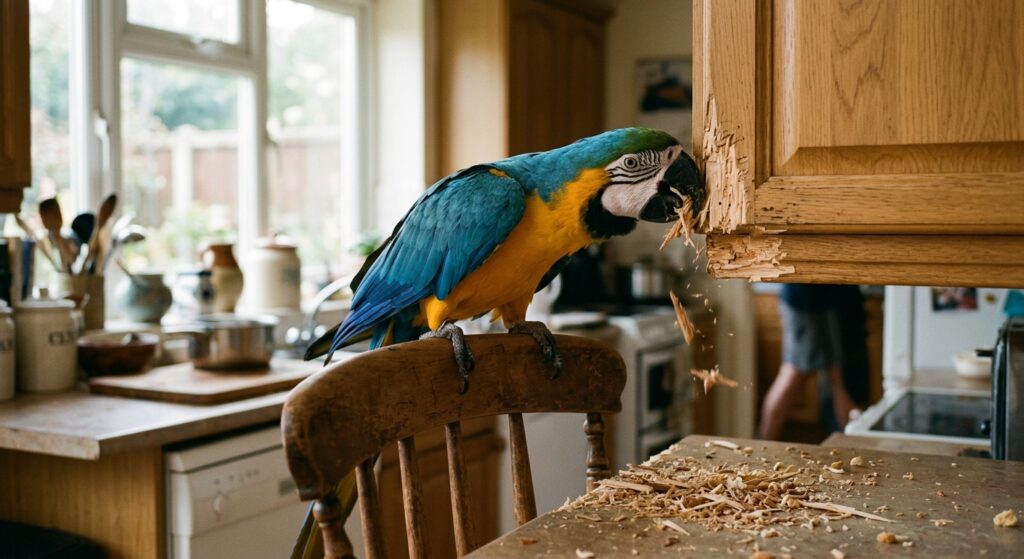
A hand-fed baby is not a blank slate that arrives pre-programmed for cooperation. Domestic rearing changes where a parrot's fear responses point — it does not install manners, patience, or the ability to entertain itself. Some of the loudest, most bitten-fingered households we've heard from over the years are homes with birds that never saw a tree they didn't own.
The Rearing Failures That Show Up Years Later
Most of the behavior problems people describe to us trace back to something that happened before the bird was a year old, or to something the home does the same wrong way every day.
- Early weaning. A chick pushed off formula before it decides it's ready often stays food-anxious, begs into adulthood, and gets frantic around the food bowl or the person who fills it.
- Isolation from other birds. A parrot raised only around humans never learns bird body language — the beak-up warning, the pinned eye, the step-away. It has no vocabulary for "back off" except lunging.
- No foraging opportunity. In a bowl-fed cage, the hours a wild parrot spends working for food become empty hours. Empty hours get filled with screaming or with the bird's own feathers.
- Inconsistent handling. When a step-up is enforced Monday and negotiated Tuesday, the bird learns that resistance sometimes works. Intermittent reinforcement is exactly how you build a stubborn behavior.
Same Behavior, Different Cause
Screaming, biting and plucking are symptoms, not diagnoses. Treating them without asking what's driving them usually makes things worse.
| Behavior | Common rearing/husbandry driver | What it is not |
|---|---|---|
| Contact screaming at set times | Learned that noise brings a human back into the room | The bird being "naturally loud" |
| Biting on the hand or shoulder | Never learned to signal discomfort; warnings were ignored | Aggression or dominance |
| Feather destruction | No foraging outlet, boredom, or a medical issue not yet ruled out | A permanent personality trait |
| Panic at new objects or people | Raised in one small unchanging environment | Wild instinct resurfacing |
Why "It Was Bred in Captivity" Explains So Little
Guests on our shows — professional keepers, wildlife biologists, and the rescue organizations that end up with the results — keep circling back to the same point: a parrot is only a handful of generations removed from wild birds, and none of those generations bred out the need to chew, forage, flock, and make noise at dawn and dusk. Captive breeding changed the bird's paperwork, not its nervous system.
That's also why rescues fill up with hand-raised birds. They weren't badly bred. They were raised and kept in ways that gave a smart, loud, long-lived animal nothing legitimate to do.
If your bird's behavior has changed, get a veterinary workup before you assume it's a training problem — plucking and sudden biting can both start with pain.
Reading a Parrot's Body Language Before It Becomes a Bite
A bite is almost never the first thing a parrot says. It is usually the fourth or fifth, delivered after the earlier messages were missed. Birds telegraph discomfort with their eyes, feathers, beak, body, and voice, and those signals arrive in a fairly predictable order. Learning to read them is what separates a keeper who gets bitten regularly from one who rarely does.
The Signals That Come Before the Bite
| Signal | What relaxed looks like | What escalation looks like |
|---|---|---|
| Eyes | Steady, normal pupil | Rapid pinning — pupils flashing wide to narrow, often paired with a hard stare |
| Nape and head feathers | Smooth, laid flat | Raised nape, crest up in cockatoos, feathers stiff rather than fluffed |
| Beak | Loose, quiet, occasional grinding | Open, held forward, lunging, or clicking |
| Posture | Weight balanced, feathers relaxed | Leaning away, crouched to launch, one foot lifted, body slimmed and tall |
| Voice | Chatter, whistles, contact calls | Growling, sharp repeated squawks, or a sudden hard silence |
Pinned eyes deserve special mention because they are ambiguous on their own. A bird pins its eyes when it is excited about a favorite person, a new toy, or a peanut — and also when it is furious. The eyes tell you the bird's arousal is high. The feathers and posture tell you which direction that arousal is headed.
Read Signals in Combination, Not Isolation
Before you reach for a bird, run through the whole picture:
- Where are the head and nape feathers — flat, or standing?
- Is the body leaning toward your hand or away from it?
- Is the beak closed and quiet, or open and forward?
- Has the vocal tone shifted from chatter to growl, or gone abruptly quiet?
- Is the bird on a cage top, a shoulder, or near a mate or favorite toy — places where many parrots defend harder?
If two or more of those read as tense, the answer is to wait. Nothing is lost by asking again in five minutes.
Why This Is the Skill That Changes Everything
Once you can see the "no" before it becomes a bite, you stop forcing interactions — and the bird notices. Every time you back off at the raised nape instead of pushing through it, you teach the bird that its quieter signals work. Birds that learn this stop escalating, because they no longer need to.
That is exactly the foundation the positive-reinforcement approach we discussed on our Ginger's Parrot Rescue show rests on. Reinforcement builds the behavior you want; reading body language protects the trust that makes reinforcement possible in the first place. Trainers and rescue people who work with difficult birds spend far more time watching than handling.
Ignoring a raised nape or pinned eyes and reaching anyway teaches your parrot that only a bite gets your attention, which is the exact habit that lands birds in rescues.
What Our Guests Have Taught Us About Raising FIDS Well
The Themes That Keep Coming Back
Across roughly 80 pre-recorded live shows hosted, engineered, and produced from our Kansas City studio since 2015, the same handful of subjects surface no matter who is sitting in the guest chair. Professional bird keepers, wildlife biologists, and rescue organizations rarely agree on every detail, but they circle the same ground:
- Diet. Seed-only feeding comes up again and again as the starting point for problems that show up years later. Guests consistently push toward variety and species-appropriate feeding rather than convenience.
- Training. Almost every trainer we have interviewed frames training as daily communication, not a weekend project or a fix applied after behavior breaks down.
- Enrichment. Foraging, chewing, and having something to do all day are treated as baseline care, not extras.
- Rescue realities. Rescue and sanctuary guests describe the same intake stories repeatedly — birds surrendered over noise, mess, biting, and lifespan. The pattern says more about human expectations than about the birds.
- Free flight. A specialized discipline, not a milestone every companion parrot should reach.
| Theme | What guests emphasize | Where owners commonly go wrong |
|---|---|---|
| Diet | Variety and species-appropriate feeding | Defaulting to a seed mix indefinitely |
| Training | Consistency and small daily sessions | Only training when there is a problem |
| Enrichment | Occupying the bird's whole day | Toys added and never rotated |
| Rescue | Matching bird to household honestly | Choosing on appearance or talking ability |
| Free flight | Structured, specialist-level work | Treating it as a casual next step |
What Free Flight Taught Us About Everything Else
Yvonne Patterson Burbach, owner and trainer behind the Wings of Love bird shows, has been a regular guest, and giving her a platform to explain her work changed how we hear other training conversations. Free-flight demonstration birds do not perform because they were born tame. They perform because the relationship, the recall, and the reinforcement history were built deliberately and maintained constantly.
That standard scales down. If a flighted show bird returns reliably because someone invested in that behavior every single day, the parrot in your living room deserves the same seriousness applied to stepping up, going back in the cage, and accepting a towel or a nail trim.
Go Deeper in the Archive
Our stream runs 24/7/365, and the podcast archive is where the detail lives. The Tony Silva episode is a good entry point for anyone interested in aviculture at the breeding and conservation level rather than the single-bird household level — it puts companion parrot ownership in a much larger context.
Listen in order, or pick the guest whose specialty matches your current question. Diet episodes, rescue episodes, and training episodes all reward a second listen once you have a bird in front of you.
The single most consistent message across our guest list is that parrot problems are almost never sudden — they are the accumulated result of diet, enrichment, and training decisions made long before the behavior appears.